










Lord's Mark licence clears January 2027 screening rollout
Key highlights
- Lord's Mark received Class B manufacturing licence MFG/MD/2026/000736 for its breast screening kit.
- The Lords Med Breast Cancer Screening Kit uses 2,836 thermal sensors and operates without radiation.
- Lord's Mark plans to start screening services through Lord's Path Labs in January 2027.
- Lord's Mark proposes a screening price below Rs 700 per test.
powered by IRIS
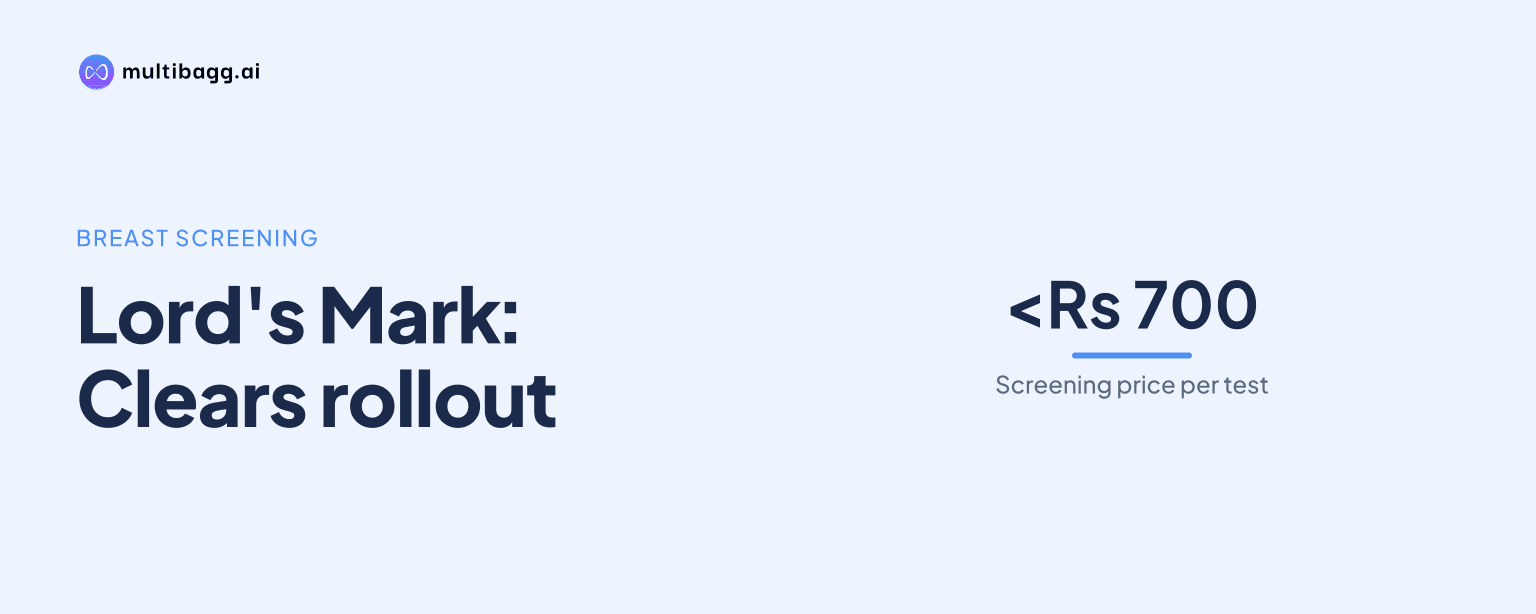
Lord's Mark Industries Limited has received manufacturing licence MFG/MD/2026/000736 for its Class B, radiation-free Lords Med Breast Cancer Screening Kit, enabling manufacture for sale or distribution and supporting its planned January 2027 screening-services start through Lord's Path Labs at a proposed price below Rs 700 per test.
Know Lords Mark Industries inside out
Results, valuation, peers and who's buying, in one view.
What does Lord's Mark's manufacturing licence permit?
Lord's Mark's licence permits the manufacture of the Class B Lords Med Breast Cancer Screening Kit for sale or distribution under Form MD-5 of the Medical Devices Rules, 2017. Licence MFG/MD/2026/000736 gives the company the regulatory authorisation cited in its 23 November 2026 announcement for a commercial screening offering.
Lord's Mark describes the licence as a foundation for its planned commercial rollout of the radiation-free device. The filing says the authorisation covers manufacture for sale or distribution, but it does not disclose production capacity, expected device volumes, revenue targets, approvals outside India or a timetable for availability across all proposed channels.
The company identifies the device as Class B, the classification stated in the manufacturing licence, and says Form MD-5 is the basis of the authorisation. This approval does not mean that every proposed partnership with hospitals, diagnostic laboratories or government healthcare schemes has been executed, as the announcement does not name any signed commercial partner.
Lord's Mark calls the kit its second major medical-device offering after its artificial intelligence, or AI, enabled dialysis machine. The disclosure places the breast screening kit within the company's medical-technology portfolio, although it does not quantify sales or financial contribution from either the dialysis machine or the newly licensed screening device.
How does Lord's Mark's radiation-free screening kit work?
Lord's Mark says the Lords Med Breast Cancer Screening Kit is a wearable, non-invasive system containing 2,836 thermal sensors that measure breast-surface temperature patterns. The system identifies variations that may indicate underlying biophysical abnormalities and operates without radiation, according to the company.
The company positions the 2,836-sensor device as a first-line breast cancer screening solution, not as a final diagnostic tool. Lord's Mark says the result is intended to guide further confirmatory diagnostic investigations and subsequent treatment decisions, meaning the filing does not present a screening result as a definitive cancer diagnosis.
Lord's Mark also states that the technology can screen at a very initial level, including for dense breast size. That is the company's statement on intended screening use; the 23 November 2026 filing does not provide clinical-study populations, sensitivity, specificity, comparative results against mammography or patient-outcome data.
The wearable and radiation-free mechanism are the product characteristics disclosed by Lord's Mark. Its commercial proposition also includes a proposed price below Rs 700 per test, but the announcement does not disclose manufacturing cost, laboratory margin, reimbursement arrangements or the final price that third-party healthcare institutions may charge.
When will Lord's Mark start screening services and at what price?
Lord's Mark plans to begin screening services through its Lord's Path Labs from January 2027, at a proposed price below Rs 700 per test. The company also intends to work with private hospitals, diagnostic laboratories and other healthcare institutions to extend access beyond its own laboratory network.
January 2027 is a stated plan rather than a reported service launch. Lord's Mark says it aims to develop a wider screening-services network across India, particularly in communities where infrastructure, affordability and awareness affect access to preventive healthcare, but it does not disclose the number of Lord's Path Labs, cities, partner sites or tests expected in the initial phase.
Lord's Mark also intends to explore integration with government healthcare schemes to reach women across socioeconomic groups. Management said affordability and partnerships with government programmes, hospitals and diagnostic networks are central to its access strategy, but the filing identifies no specific scheme, agreement or implementation schedule beyond the planned January 2027 start.
The proposed sub-Rs 700 price is the only direct pricing figure in the announcement. It establishes the company’s intended affordability position, while leaving open whether pricing will be uniform at Lord's Path Labs and partner institutions and whether follow-up diagnostic investigations will carry separate charges.
Got a follow-up? Ask IRIS
What market need is Lord's Mark addressing?
Lord's Mark is targeting broader access to breast cancer screening in India, where the International Agency for Research on Cancer, or IARC, estimated 237,231 new breast cancer cases in 2024. The company cites that figure in explaining its focus on timely medical evaluation and wider screening access.
The filing says the company wants to serve communities where screening infrastructure, affordability and awareness shape access to preventive healthcare for women. Lord's Mark's proposed below-Rs 700 test price and planned network of laboratories, hospitals and diagnostic institutions are the mechanisms it identifies to address those access barriers.
Lord's Mark also cites Grand View Research's estimate that India's breast cancer diagnostics market generated USD 179.7 million in revenue in 2025 and could reach USD 419.1 million by 2033. The cited outlook implies an increase of USD 239.4 million between the two periods and a projected compound annual growth rate, or CAGR, of 11.4% from 2026 to 2033.
These market figures are third-party estimates cited in Lord's Mark's announcement rather than company forecasts. The filing does not state Lord's Mark's expected market share, device sales, tests per month or the revenue contribution that the screening kit could make relative to its AI-enabled dialysis-machine offering.
How does the licence change Lord's Mark's medical-device plans?
Lord's Mark says the manufacturing licence establishes a regulatory basis for translating its radiation-free screening technology into a commercial service. The Class B approval allows manufacture for sale or distribution of the Lords Med Breast Cancer Screening Kit and supports the company's stated January 2027 laboratory rollout plan.
The licence follows Lord's Mark's AI-enabled dialysis machine as its second major medical-device offering, according to the filing. The company is therefore adding a breast cancer screening product to a portfolio that already includes renal-care technology, though it does not disclose the number of dialysis machines sold or the financial scale of that existing offering.
Management said the company's vision is to support earlier screening, timely medical intervention and better healthcare outcomes through indigenous innovation, affordable pricing and partnerships. Those are management objectives tied to the proposed below-Rs 700 price and planned institutional network, not reported evidence of screening volumes or healthcare outcomes.
The filing does not disclose whether Lord's Mark has completed commercial contracts with hospitals or diagnostic laboratories before the planned January 2027 start. It also does not set a target for laboratories, women screened, geographic coverage or revenue, leaving the pace and scale of commercial adoption unresolved.
Conclusion
Lord's Mark now has a manufacturing licence under Form MD-5 to make its Class B radiation-free breast cancer screening kit for sale or distribution. The 2,836-sensor wearable system is positioned as a first-line screening tool that can direct users towards confirmatory investigations, while the proposed below-Rs 700 price underpins the company's stated accessibility strategy.
The next disclosed milestone is the planned January 2027 start of screening services through Lord's Path Labs. The company’s plan to partner with private hospitals, diagnostic laboratories, other healthcare institutions and potentially government healthcare schemes makes partnership announcements, launch locations, implemented pricing and early service volumes the next matters to watch.