










LT Foods builds a US convenience platform with Maya Kaimal
Key highlights
- LT Foods announced the Maya Kaimal acquisition presentation on November 19, 2026.
- Maya Kaimal is present across more than 10,000 retail touchpoints in the US.
- LT Foods is targeting ready-to-eat, ready-to-cook and ready-to-heat categories through the acquisition.
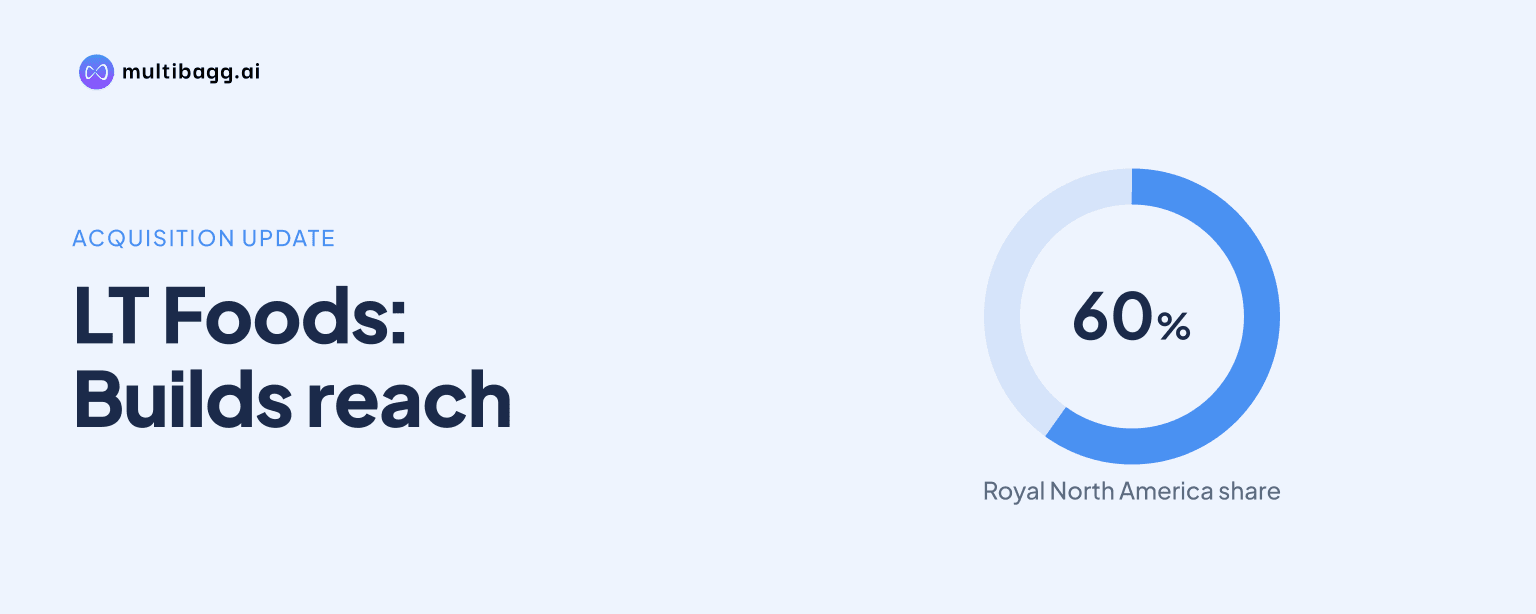
- LT Foods says Royal has about 60% share in North America.
powered by IRIS
On November 19, 2026, LT Foods Limited said its Maya Kaimal acquisition would broaden its US portfolio into ready-to-eat, ready-to-cook and ready-to-heat foods, adding a brand present at more than 10,000 retail touchpoints. LT Foods frames the move as a way to add premium packaged foods, product-development capability and distribution reach.
Know L T Foods inside out
Results, valuation, peers and who's buying, in one view.
How does Maya Kaimal fit LT Foods’ growth strategy?
Maya Kaimal fits LT Foods’ strategy by adding a premium packaged-food brand to its value-added and adjacent food categories. The company’s four stated strategic pillars are expanding its consumer franchise across global markets, building stronger premium brands, building the next growth engine, and creating a future-ready value chain through technology, traceability and sustainable sourcing.
The acquisition is positioned particularly against LT Foods’ third pillar, which calls for increased participation in value-added and adjacent food categories. Maya Kaimal adds ready-to-eat (RTE), ready-to-cook (RTC) and ready-to-heat (RTH) products, whereas LT Foods’ consumer-franchise goal covers deeper household penetration in India and wider distribution in international markets.
The deal also supports the second pillar because LT Foods describes Maya Kaimal as an established premium consumer brand. Its products are positioned around chef-founded recipes and authentic flavour, while its clean-label, vegan and gluten-free ranges give LT Foods a defined proposition in the US convenience-food segment.
The intended platform is therefore broader than a single rice-led purchase occasion. LT Foods describes the combined meal proposition as rice, sauces and curries from one company, linking its existing staples offering to Maya Kaimal shelf-stable sauces and RTE meals. This is a stated strategic rationale, not a disclosed revenue or profit forecast.
What products and consumer proposition does Maya Kaimal add?
Maya Kaimal adds shelf-stable sauces and RTE meals to LT Foods’ portfolio, extending the group into RTE, RTC and RTH categories. The presentation lists Tikka Masala, Madras Curry, Butter Masala, Kashmiri Curry and Chili Crisp among the sauce range, alongside Everyday Chicken Curry, Everyday Chana and Everyday Dal RTE offerings.
The product set is built around convenient Indian meals rather than rice alone. Other RTE products named by LT Foods include Vegetable Tikka Masala and Madras Potatoes, while the broader brand proposition covers clean-label and plant-based food choices. LT Foods also cites organic product options as part of the offering.
Maya Kaimal was founded in 2003 by cookbook author Maya Kaimal, according to LT Foods. The company calls it a leading brand among mainstream US consumers and says its chef-founded recipes underpin premium positioning, an attribute it identifies as complementary to a complete Indian meal comprising rice, sauce and curries.
The market context cited by LT Foods is a US Indian packaged-food market projected to grow at a compound annual growth rate of more than 6% through 2031. That projection is not a sales target for LT Foods or Maya Kaimal, but it is the external category-growth backdrop disclosed for the expansion into these food segments.
Got a follow-up? Ask IRIS
How does LT Foods expect to create distribution and cost synergies?
LT Foods expects distribution to be the main source of revenue synergies, using its North American portfolio and distributors to widen Maya Kaimal’s reach. The company says Royal is the number-one basmati brand with about 60% share in North America and identifies Golden Star as the number-one jasmine brand, providing existing routes across mainstream and ethnic channels.
The plan is to cross-sell Maya Kaimal through those distributor relationships while widening distribution and pursuing cross-category opportunities. Maya Kaimal already has more than 10,000 retail touchpoints, so the disclosed opportunity is to combine that established presence with LT Foods’ rice brands and expand the convenience-food range into new global markets.
On costs, LT Foods identifies sourcing synergies across rice, spices and packaging, alongside the benefit of procurement at scale. The company also expects co-developed products to accelerate innovation, making procurement and product development the two operational mechanisms it cites beyond distribution-led revenue opportunities.
Infrastructure is the third synergy area identified in the presentation. LT Foods plans to optimise logistics through freight and third-party logistics, or 3PL, consolidation, and to seek efficiencies in back-office operations, broker arrangements and trade spend. The presentation does not quantify expected savings, synergy timing, integration costs or a margin effect.
What should investors watch in LT Foods’ execution plan?
Investors should watch whether LT Foods translates the Maya Kaimal platform into wider US distribution, cross-category sales and new product development, because these are the mechanisms management identifies for the acquisition. The plan spans RTE, RTC and RTH foods and relies on combining the acquired brand’s premium proposition with LT Foods’ Royal and Golden Star distribution capabilities.
A second execution point is whether LT Foods can operationalise its proposed procurement, logistics and back-office efficiencies. LT Foods specifically names inputs such as rice, spices and packaging, plus freight, 3PL providers, brokers and trade spend, but it provides no numerical synergy target or schedule against which these initiatives can be measured.
The disclosed market opportunity runs through 2031, with the US Indian packaged-food market projected to grow at more than 6% annually. LT Foods’ presentation does not provide Maya Kaimal revenue, profitability, acquisition consideration, funding details, an expected closing date or a financial contribution target, leaving those items unresolved in this document.
LT Foods also cautions that forward-looking statements may differ materially from actual outcomes because of factors including competition, growth-management challenges, international operations, economic conditions and fiscal costs. The stated US platform is therefore management’s strategy for the acquisition rather than evidence of completed distribution expansion or realised cost savings as of November 19, 2026.
Conclusion
LT Foods is using Maya Kaimal to move beyond a rice-centred offering toward a US meal platform combining rice, shelf-stable sauces and convenient curries. The strategic fit rests on three disclosed elements: RTE, RTC and RTH category participation, a premium clean-label and plant-based proposition, and Maya Kaimal’s presence at more than 10,000 retail touchpoints.
Next, investors should watch progress on distribution expansion, cross-selling, co-developed products and procurement or logistics consolidation. The relevant market backdrop is projected US Indian packaged-food growth of more than 6% through 2031, while the presentation leaves financial targets, deal consideration and the timing of measurable synergies undisclosed.