










LT Foods Limited targets distribution-led Maya Kaimal synergies
Key highlights
- Maya Kaimal reported US$1.79 crore of revenue for the 12 months ended September 30, 2026, versus US$1.55 crore in 2025.
- LT Foods Americas Inc. agreed to acquire 100% of MK Food Holdings, Inc. at a US$58 lakh enterprise value.
- Royal has about 60% of North America’s basmati market, according to LT Foods’ presentation.
- Maya Kaimal products are sold through more than 10,000 retail touchpoints in the United States.
powered by IRIS
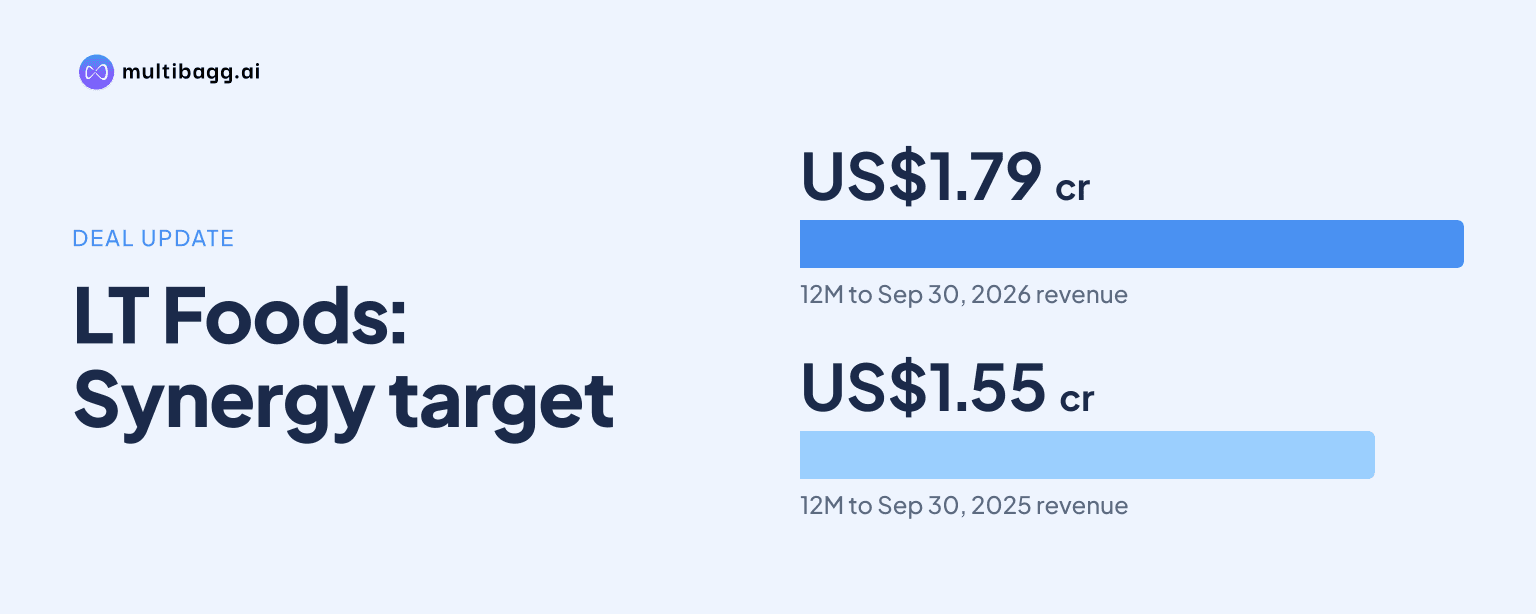
LT Foods Limited plans to make distribution its main revenue-synergy lever in the Maya Kaimal acquisition, using Royal’s roughly 60% North American basmati share and Golden Star’s leading jasmine position while seeking savings in procurement, freight, third-party logistics and back-office functions. Maya Kaimal recorded US$1.79 crore of revenue in the 12 months ended September 30, 2026.
Know L T Foods inside out
Results, valuation, peers and who's buying, in one view.
How will LT Foods create revenue synergies from Maya Kaimal?
LT Foods intends to create revenue synergies by widening Maya Kaimal distribution and cross-selling its products through the company’s North American distributors. The proposed offering combines rice with shelf-stable sauces and ready-to-eat curries for the same Indian meal occasion. Management identifies distribution as the primary revenue-synergy route, but provides no quantified sales target.
LT Foods plans to use Royal, which the presentation describes as North America’s number-one basmati brand with about 60% share, and Golden Star, described as the number-one jasmine brand. Maya Kaimal products are to be sold through LT Foods distributors in mainstream and ethnic channels. The plan also includes expansion into new global markets, although the presentation does not identify countries, dates or expected revenue.
Maya Kaimal already has more than 10,000 retail touchpoints in the United States. Its shelf-stable sauces include tikka masala, Madras curry, butter masala and Kashmiri curry, while its ready-to-eat range includes everyday chicken curry, everyday chana, everyday dal, vegetable tikka masala and Madras potatoes. Those products add categories beyond rice to LT Foods’ distributor and retailer relationships.
The acquisition also supports LT Foods’ participation in ready-to-eat, ready-to-cook and ready-to-heat food categories. The presentation forecasts growth of more than 6% compound annual growth rate, or CAGR, for the Indian packaged-food market in the United States through 2031. It does not provide a market-size estimate, a Maya Kaimal market-share figure or sales by category.
What cost synergies does LT Foods expect from the deal?
LT Foods expects procurement-related savings from sourcing rice, spices and packaging at greater scale. Management says the combined businesses can unlock sourcing synergies in those inputs and that Maya Kaimal can benefit from LT Foods’ procurement scale. The presentation does not disclose a savings value, a timing target or a procurement-cost baseline.
LT Foods also identifies co-developed products as an innovation mechanism. Maya Kaimal adds chef-founded recipes, culinary capabilities and a portfolio spanning shelf-stable sauces and ready-to-eat meals, while LT Foods identifies ready-to-eat, ready-to-cook and ready-to-heat foods as a growth pillar. The presentation does not specify products under development or planned launch dates.
For infrastructure, LT Foods plans to optimise freight and third-party logistics, or 3PL, through consolidation. It also identifies back-office activities, brokers and trade spend as potential efficiency areas. These are planned cost-synergy routes rather than confirmed reductions because the presentation gives no facility, contract, headcount or implementation details.
Got a follow-up? Ask IRIS
How fast was Maya Kaimal growing before the acquisition?
Maya Kaimal reported US$1.79 crore of revenue for the 12 months ended September 30, 2026, compared with US$1.55 crore in 2025. Revenue was therefore US$24 lakh higher in the later period. The presentation does not disclose profit, cash flow, gross margin or earnings before interest, tax, depreciation and amortisation.
The comparison shows that LT Foods is buying an operating consumer-food business with reported revenue growth, rather than only product rights. Maya Kaimal was founded in 2003 by cookbook author Maya Kaimal and is presented as a leading brand among mainstream US consumers. The presentation also highlights clean-label, vegan, gluten-free and organic product options, without giving sales by product, channel or consumer segment.
What are the transaction terms and timetable for LT Foods?
LT Foods Americas Inc., a subsidiary of LT Foods, signed a Stock Purchase Agreement with MK Food Holdings, Inc. and its shareholders on November 17, 2026. LT Foods Americas Inc. is to acquire 100% of MK Food Holdings, Inc.’s equity share capital at an enterprise value of US$58 lakh on a cash-free, debt-free basis. MK Food Holdings, Inc. and its affiliates offer the Maya Kaimal portfolio primarily in the United States.
The transaction also includes an earnout agreement with identified parties, under which additional consideration may be paid based on post-closing sales performance. The presentation does not disclose the maximum earnout amount, sales thresholds, duration or recipient identities. This leaves part of the final purchase consideration dependent on terms not disclosed in the presentation.
Management expects the transaction to complete within three months, subject to customary closing conditions. The presentation does not list those conditions, regulatory approvals or integration milestones. Until completion, the distribution, procurement and logistics actions remain planned initiatives rather than implemented changes.
Conclusion
LT Foods is pursuing Maya Kaimal to combine its North American rice distribution with a premium portfolio of sauces, curries and rice products. Distribution through Royal, Golden Star and LT Foods distributors is management’s stated revenue lever, while procurement scale, freight and 3PL consolidation, and back-office efficiencies are the identified cost levers.
The next event to watch is completion within the stated three-month period following the November 17, 2026 agreement, subject to customary closing conditions. Subsequent disclosures could clarify the sales-linked earnout, the pace of global market expansion and whether LT Foods quantifies revenue gains or cost savings from integration.