










Lumel Alucast targets FY27 EBITDA break-even after reset
Key highlights
- Alucast H1 FY27 revenue declined 36.6% to Rs 85.5 crore after management removed loss-making volume.
- Alucast reported a Rs 3.2 crore adjusted EBITDA loss in H1 FY27 and targets EBITDA of roughly plus or minus 1% to 2% for FY27.
- Potential programmes under discussion could add €2 million to €3 million of annual turnover, subject to contract signatures.
- Management expects signed die-casting programmes to require three to six months for tooling, launch and production ramp-up.
powered by IRIS
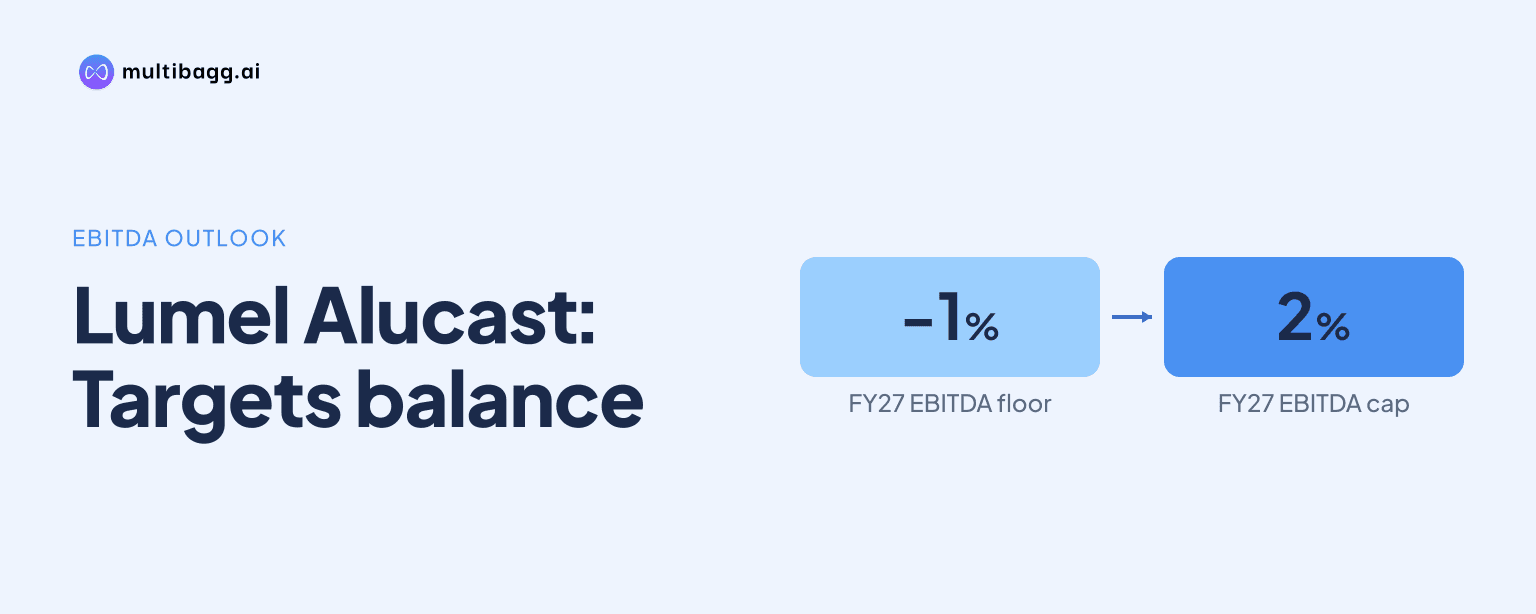
Lumel Alucast is targeting EBITDA break-even in FY27 after deliberately reducing H1 FY27 revenue 36.6% to Rs 85.5 crore and reporting an adjusted EBITDA loss of Rs 3.2 crore. Alucast is seeking replacement programmes that could add €2 million to €3 million of annual turnover, although production would take three to six months after contracts are signed.
Know Rishabh Instruments inside out
Results, valuation, peers and who's buying, in one view.
Why did Alucast revenue fall in H1 FY27?
Alucast revenue fell because management chose profitable work over volume that did not provide sustainable returns. H1 FY27 revenue was Rs 85.5 crore, down 36.6% year on year, and management said the decline was deliberate rather than a retreat from its recovery plan. The lower Alucast base also contributed to consolidated revenue growth of 6.3% in H1 FY27.
The reduction followed the phase-out of legacy contracts with price-adjustment issues, management said in response to an analyst. These contracts were still being supplied in the first half of the prior financial year, but volumes were much lower in its third and fourth quarters and remained low in the first two quarters of FY27. Management did not project revenue growth for the high-pressure die-casting, or HPDC, business in FY27.
The contrast with Electrical Electronics Instrumentation, or EEI, shows why Alucast is being treated as a turnaround. EEI delivered H1 FY27 revenue of Rs 325.5 crore, up 29.3% year on year, and adjusted EBITDA of Rs 75 crore, up 29.9%. EEI accounted for 79.2% of consolidated H1 revenue, while Alucast was rebuilding its order base after discontinuing lower-return work.
Can Alucast reach EBITDA break-even in FY27?
Management expects Alucast to finish FY27 around plus or minus 1% to 2% at the EBITDA level. The business recorded negative adjusted EBITDA of Rs 3.2 crore in H1 FY27, while management separately described it as operating-level break-even during the half year. Its plan relies on pricing discipline, cost control, improved plant utilisation and a broader non-automotive mix.
Management expects Alucast to remain a drag on group profit after tax even if EBITDA approaches break-even. It guided to a FY27 loss after tax of Rs 10 crore to Rs 15 crore, primarily due to depreciation and withholding-tax provisions rather than operating losses. The group had net cash and cash equivalents of Rs 169.8 crore on September 30, 2026, according to management.
The distinction matters because EBITDA excludes depreciation and tax-related charges that management identified as the main causes of the expected loss after tax. Management did not disclose an FY27 revenue target for Alucast. Its immediate objective is to stabilise operations at break-even before considering longer-term decisions about the unit.
What programmes could restore Alucast revenue?
Alucast has several requests for quotation and customer programmes in commercial negotiation, qualification or approval stages, and management said a few were nearing signature. The potential programmes discussed on the call could add €2 million to €3 million of annual turnover. Management did not treat those opportunities as secured because contracts had not yet been signed.
Management said the potential awards could remove its concern about losses from the next financial year, but their conversion would not produce immediate revenue. Die-casting programmes require a mould to be built, a project launch and a production ramp-up. Management estimated that this process would take three to six months after a contract is signed.
Management also said Alucast would need another complete year to reach a robust business position. That indicates that FY27 break-even, if achieved, would be an operational milestone rather than evidence of a fully restored earnings base. The timeline depends on both commercial conversion and the execution of tooling and production launches.
Got a follow-up? Ask IRIS
How is Alucast rebuilding its customer mix?
Alucast is trying to increase non-automotive work, obtain more business from existing customers and take over programmes left by closed die-casting suppliers. Management identified non-automotive mix as a central part of the FY27 recovery plan, alongside pricing and utilisation. The company did not disclose the revenue share of automotive and non-automotive work.
Management said the Alucast business represented about 20% of the group, compared with about 40% two years earlier. It also said several European die-casting companies had folded or had assets for sale. Management sees potential opportunities where customers move tooling from closed suppliers, provided the work does not shift to China.
Competition for new programmes comes increasingly from China, Southeast Asia and India rather than only from Poland or other European producers, management said. Alucast’s proposition to customers is based on quality, shorter lead times and faster quality response. Management also cited European discussion of local-content policies, but did not identify a policy change or a customer order tied to one.
What could delay the Alucast turnaround?
The main unresolved issue is the conversion of programmes still in negotiation, qualification and approval stages. Even signed programmes need three to six months for mould construction, launch and ramp-up, and management said the broader rebuilding process would take another full year. No contracted production pipeline or expected margins for the €2 million to €3 million opportunity were disclosed.
Geopolitical tensions, particularly around West Asia, have increased volatility in energy, freight and insurance costs and affected the availability and pricing of some inputs, management said. These pressures weighed on group gross margins during the quarter and half year. Management said it was responding through supplier diversification, disciplined procurement, closer inventory planning and coordination with customers and logistics partners.
Alucast is also pursuing the turnaround while management maintains that it may assess longer-term ownership only after profitability is restored. Management said the unit had generated profitability nearly comparable with the electrical business about three years ago, without providing historical financial figures. For now, the disclosed strategy is to rebuild a profitable operation rather than decide whether to retain or dispose of it.
Conclusion
Alucast’s H1 FY27 performance reflects a deliberate removal of loss-making revenue: sales fell 36.6% to Rs 85.5 crore and adjusted EBITDA was negative Rs 3.2 crore. Management is pursuing a limited FY27 objective of EBITDA around plus or minus 1% to 2%, while accepting that depreciation and withholding-tax provisions could result in a Rs 10 crore to Rs 15 crore loss after tax.
The next points to watch are whether programmes worth €2 million to €3 million of annual turnover are signed and then move through the stated three-to-six-month production ramp-up. Management has also said Alucast needs another complete year to establish a robust business position, leaving pricing, utilisation and conversion of non-automotive opportunities as the key measures of progress.