










Rishabh retains 20%-25% EEI growth target amid FY27 supply risks
Key highlights
- Rishabh retained FY27 EEI top-line growth guidance of 20% to 25% after about 29% growth in H1 FY27.
- Rishabh targets FY27 EEI adjusted EBITDA of Rs 140 crore to Rs 150 crore and PAT of about Rs 95 crore to Rs 100 crore.
- Management expects FY27 EEI adjusted EBITDA margin of about 20% to 22%.
- Rishabh reported net cash and cash equivalents of Rs 169.8 crore at September 30, 2026.
powered by IRIS
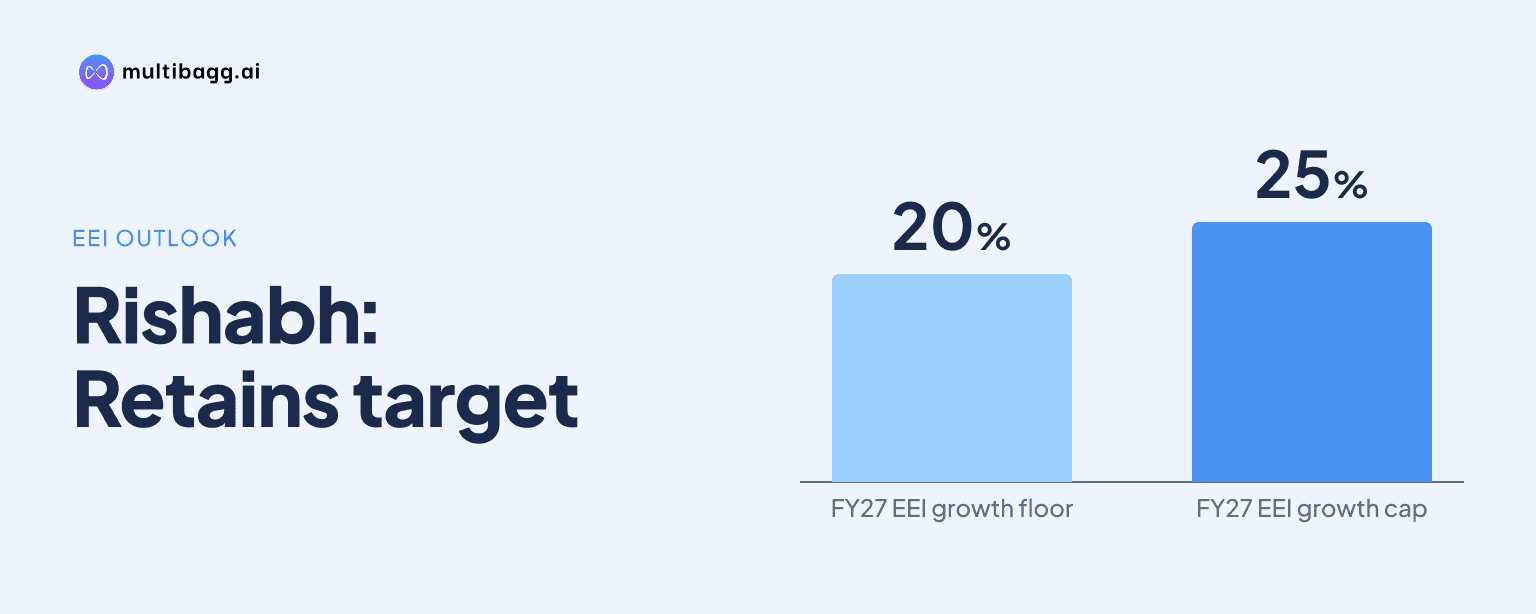
Rishabh retained its FY27 EEI top-line growth target of 20% to 25% despite about 29% growth in H1 FY27, as management cited electronic-component availability, longer lead times and rising commodity costs. Management said EEI demand and order books remain healthy across its markets and disclosed no specific production or demand-related reason to lower the outlook.
Know Rishabh Instruments inside out
Results, valuation, peers and who's buying, in one view.
Why has Rishabh kept its EEI growth guidance unchanged?
Rishabh has kept its FY27 EEI growth guidance at 20% to 25% rather than raise it after the segment grew by about 29% in H1 FY27. Management said it has sought in recent quarters to deliver more than it promises, but wants to retain the existing range while geopolitical and supply-chain uncertainty persists.
Management said EEI order books were healthy in India, Poland through Lumel SA, the United States, the United Kingdom and China. It said there was no particular dip visible and no specific issue causing concern about a lower forecast. The unchanged guidance therefore reflects caution about external variables rather than a disclosed decline in orders or an inability to produce.
Rishabh also said it remains on track for its full-year EEI targets of Rs 140 crore to Rs 150 crore of adjusted earnings before interest, tax, depreciation and amortisation, or EBITDA, and about Rs 95 crore to Rs 100 crore of profit after tax, or PAT. Management had announced those targets at the beginning of FY27 and said its focus was growth alongside profitability and cash generation.
What could disrupt Rishabh's EEI growth in H2 FY27?
Electronic-component availability and longer delivery times are the main risks Rishabh identified for H2 FY27. Management said geopolitics had reduced the availability of electronic components and extended lead times, creating a supply-side problem that its teams are working to overcome.
Seasonality could also affect the timing of revenue. Management said December and January are shorter activity months in Europe because roughly half of each month has limited business activity, which can reduce sales at Lumel SA and Rishabh exports to those markets. It also flagged China’s holiday break as a possible source of supply disruption, while describing these effects as normal seasonal factors rather than weaker demand.
Commodity costs are another constraint on execution and margins. Rishabh named polycarbonate for product housings, copper for current transformers, printed circuit board material and silver as inputs whose prices have risen. Management said it seeks to pass on cost increases to customers, but price revisions do not occur immediately, particularly under medium-term and long-term customer arrangements.
Is EEI demand still supporting Rishabh's FY27 outlook?
Yes, Rishabh said EEI demand and order books remain supportive across its operating markets, with no specific reason currently visible for growth to fall. Management’s assessment covered India, Lumel SA in Poland, and the U.S., U.K. and China markets discussed during the FY27 call.
Management linked longer-term demand to industrial electrification, electric mobility, cooling requirements, renewable generation and data-centre expansion. It said artificial-intelligence-enabled data centres could be relevant to Rishabh’s measurement and instrumentation portfolio because those facilities require reliable power, continuous monitoring and power-quality management. Management described these as potential customer-program opportunities, not signed contracts.
The demand drivers differ by geography. Rishabh cited renewable energy, transmission and distribution, smart infrastructure and domestic manufacturing investment in India. It identified data-centre spending as a driver of electrical-instrument requirements in the U.S., while it linked Southeast Asia and Africa to electrification and grid expansion. In Europe, management said it would pursue selected higher-value instrumentation, automation and energy-efficiency opportunities.
Got a follow-up? Ask IRIS
What is Rishabh expecting for EEI margins?
Rishabh expects EEI adjusted EBITDA margin to end FY27 at about 20% to 22%, after an analyst on the call referred to a September-quarter margin of about 21.5%, versus roughly 25% to 26% in prior periods. Management said its longer-standing operating expectation while growing the business had been an EBITDA margin of 18% to 20%.
Management attributed the change largely to product mix. Solar products and electronic manufacturing services, or EMS, have been gaining sales but generate lower contribution-level margins than Rishabh’s traditional electronics products. Management said some traditional products can have contribution margins of 50% to 60%, compared with 10% to 15% for solar inverters, while EMS margins are also lower.
The mix effect has been partly offset by Lumel SA, where management said gross margins improved substantially from the prior year due to sales of more complex products in higher-value markets. Rishabh also said the expansion of solar and EMS can use part of its existing infrastructure, which management expects to support return on capital employed even though it gave no return-on-capital figure.
How will costs and investment shape Rishabh's outlook?
Rishabh said it generally transfers input-cost increases once or twice a year, with interim adjustments for selected product groups when costs rise sharply. Until then, management said it manages the impact through manufacturing efficiency, output per employee and internal operating measures. It cited copper, aluminium, steel, cold-rolled grain-oriented electrical steel and polycarbonate as materials whose price changes cannot always be passed through one for one.
In the U.S., management said it absorbed part of trade-duty-related pressure to retain customers, while customers bore the remaining part. It said the U.S. business grew 100%, without providing a comparison period or revenue base. Management said it intends to support the market carefully and does not plan to let temporary measures materially harm the bottom line.
Capital spending on two buildings is almost complete, according to management. Rishabh expects incremental annual investment of Rs 10 crore to Rs 20 crore as it adds equipment such as surface-mount technology lines. Management also said it is evaluating inorganic growth opportunities, but any transaction would need strategic significance rather than merely adding sales.
What does Lumel Alucast mean for Rishabh's FY27 results?
Lumel Alucast is expected to remain a drag on Rishabh’s FY27 PAT while operating around EBITDA breakeven. Management’s target for the high-pressure die-casting, or HPDC, business is EBITDA within negative or positive 1% to 2%, while its expected year-end PAT loss is Rs 10 crore to Rs 15 crore.
Management said the expected PAT loss at Lumel Alucast would primarily reflect depreciation and withholding-tax provisions rather than operating losses. At the consolidated level, Rishabh reported Q2 FY27 PAT of Rs 18.1 crore, down 18% year on year, citing Rs 1.3 crore of additional depreciation from a new Nashik building, lower other income and a Rs 2.5 crore withholding-tax provision at Lumel Alucast.
Several Lumel Alucast proposals were at commercial negotiation, qualification and approval stages. Management said potential contracts worth annual turnover of EUR2 million to EUR3 million could address losses from next year, but said no result should be assumed before signing. It added that production would begin only three to six months after a contract is signed because tools must be built and programs launched and ramped up.
Conclusion
Rishabh’s decision to retain 20% to 25% EEI growth guidance balances about 29% H1 FY27 expansion against external supply and cost risks. Management sees demand and order books holding across its principal markets, but component shortages, longer lead times, rising material costs and a larger solar and EMS sales mix could affect the pace and profitability of growth in the second half.
The next disclosures to watch are delivery against the FY27 EEI adjusted EBITDA target of Rs 140 crore to Rs 150 crore and PAT target of about Rs 95 crore to Rs 100 crore. Management plans to announce FY28 guidance nearer the end of FY27, while Lumel Alucast’s possible EUR2 million to EUR3 million of annual-turnover contracts remain unresolved and would require a further three to six months to enter production after signing.