










Rishabh builds 12,000-unit monthly solar-inverter capacity
Key highlights
- Rishabh commissioned a solar-inverter line capable of 400 units a day, or about 12,000 units a month.
- The 1-5-kilowatt iUNO range achieved operational profitability in H1 FY27, according to management.
- Rishabh has expanded into three-phase iNEO inverters up to 12 kilowatts and is developing products up to 50 kilowatts.
- EEI revenue rose 29.3% year on year to Rs 325.5 crore in H1 FY27 and represented 79.2% of consolidated revenue.
powered by IRIS
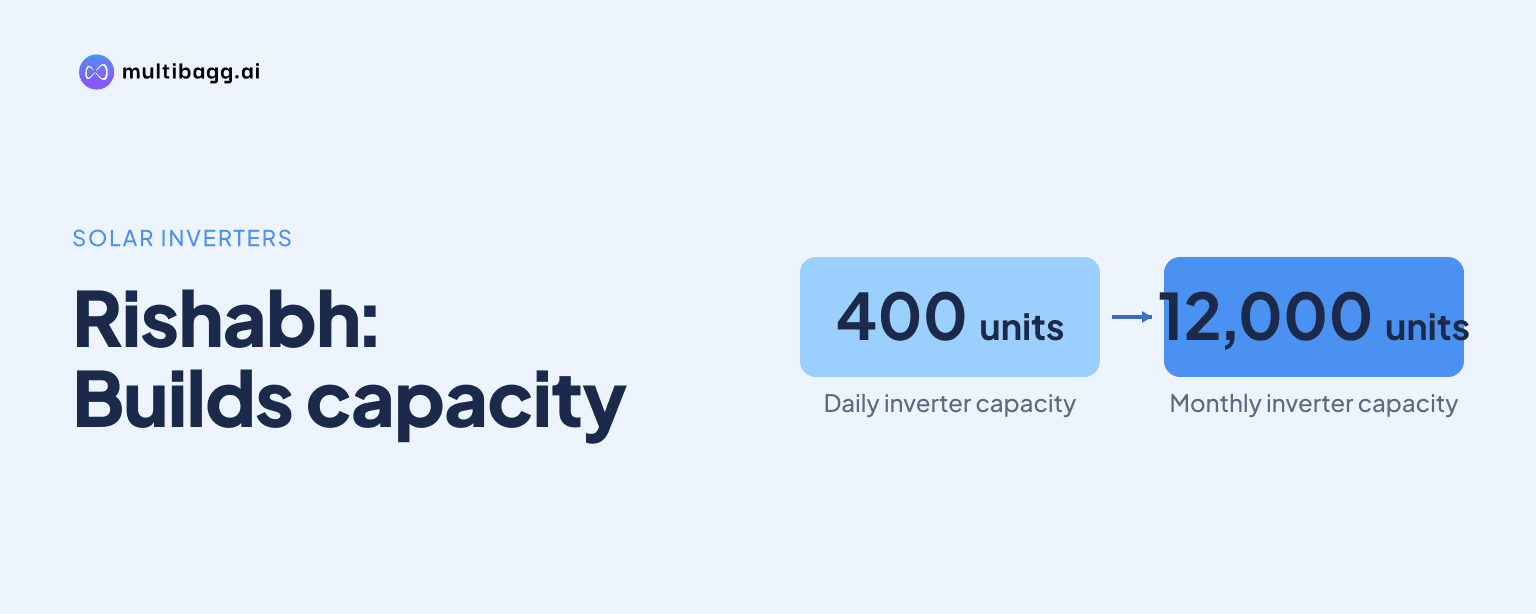
Rishabh Instruments Limited commissioned solar-inverter manufacturing capacity of 400 units a day, or about 12,000 units a month, in H1 FY27 after its 1-5 kilowatt iUNO range achieved operational profitability. Rishabh is broadening its offering to three-phase, hybrid and up-to-50-kilowatt products while building distributor, original equipment manufacturer and engineering, procurement and construction sales channels.
Know Rishabh Instruments inside out
Results, valuation, peers and who's buying, in one view.
What solar-inverter capacity has Rishabh commissioned?
Rishabh has commissioned a solar-inverter line with capacity for 400 units per day, equivalent to about 12,000 units per month. Management said the line provides a manufacturing base to support growth as demand develops, rather than disclosing that output is already running at that rate. The facility was discussed during the Q2 and H1 FY27 earnings call on November 16, 2026.
The new line is part of a broader manufacturing programme that includes the Nashik capacity expansion. Rishabh said new Nashik facilities have been partly commissioned and capacity has been substantially enhanced; its near-term priorities are disciplined ramp-up, higher utilisation, throughput, quality and delivery. Investments in automation, testing and process improvements are intended to support larger domestic and export programmes, including the inverter business.
Which solar-inverter products is Rishabh taking to market?
Rishabh’s currently cited residential offering is the single-phase iUNO range from 1 kilowatt to 5 kilowatts, which management said has received encouraging market acceptance. The range enabled the solar-inverter business to achieve operational profitability, although the call did not disclose its revenue, unit sales, margin or the date at which that threshold was reached.
The product range has widened with the three-phase iNEO line, including models up to 12 kilowatts. Management said development is under way for products up to 50 kilowatts and hybrid inverter solutions. That roadmap would extend Rishabh’s stated applications from smaller single-phase systems towards residential and commercial installations, including systems integrating solar generation and batteries.
The solar programme fits Rishabh’s stated investment areas of solar inverters, power-quality measurement and control, energy management and related technologies. Management described renewable generation, distributed generation and battery storage as drivers of demand for grid stability, intelligent monitoring, efficiency and integrated power management. It said the strategy is selective expansion into adjacent areas where engineering capability, customer relationships and market knowledge can be used.
How will Rishabh sell solar inverters?
Rishabh plans to convert product interest through distributors, original equipment manufacturers, or OEMs, and engineering, procurement and construction, or EPC, engagement. Management specifically said its focus is to strengthen the distributor and OEM network, deepen EPC engagement and build a service ecosystem. The transcript does not quantify OEM orders, EPC contracts or inverter sales through any channel.
A television advertising campaign has generated what management called a strong pipeline of inquiries for the 1-5-kilowatt iUNO range. The stated priority is channel execution and customer follow-up to convert those inquiries. Management also identified product reliability, responsive aftersales support and channel confidence as conditions for scaling the business, meaning the commercial effort extends beyond factory capacity and product launches.
Rishabh’s wider India sales approach includes distributors, OEMs and direct engagement with large industrial and infrastructure customers across measurement, power quality, testing, energy monitoring and automation. In H1 FY27, the standalone India business reported revenue of Rs 165.6 crore, up 29.6% year on year, and adjusted earnings before interest, tax, depreciation and amortisation, or EBITDA, margin of 23.3%. Those figures cover the overall India business, not solar inverters separately.
Got a follow-up? Ask IRIS
How does the inverter expansion compare with Rishabh’s other businesses?
Rishabh’s Electrical & Electronic Instruments, or EEI, segment remains the group’s principal growth and earnings platform, rather than solar inverters alone. EEI generated H1 FY27 revenue of Rs 325.5 crore, up 29.3% year on year, and adjusted EBITDA of Rs 75 crore, up 29.9%. The segment accounted for 79.2% of consolidated revenue in the half year, placing the inverter initiative within a larger electrical measurement and electronics business.
The comparison shows why group revenue growth was slower than EEI growth. Consolidated revenue increased 6.3% to Rs 411.1 crore in H1 FY27, while Lumel Alucast revenue declined 36.6% to Rs 85.5 crore under a plan to prioritise profitable business over volume. Management said the aluminium business was at operating-level breakeven, although adjusted EBITDA remained negative at Rs 3.2 crore, whereas the inverter venture was described as operationally profitable.
Internationally, Lumel SA in Poland recorded H1 FY27 revenue of Rs 133.8 crore, up 24.8%, and adjusted EBITDA margin of 21.9%. Rishabh also said its US business doubled revenue in the half year, while its UK and China businesses grew 38% and 25%, respectively. These businesses provide product, customer and market channels, but management did not state that solar inverters are currently sold through those overseas operations.
What is Rishabh’s next solar-inverter growth plan?
Rishabh’s next stated plan is to turn its inquiry pipeline, 400-unit daily production capacity and expanded product development into sustainable growth. Management plans to pursue the iUNO and iNEO ranges through distributors, OEMs and EPCs while developing up-to-50-kilowatt and hybrid products. It did not provide an inverter revenue target, market-share target, production-utilisation target or timetable for the new models.
The company has launched about 15 new products across its portfolio over the last two years and has more than 10 products planned for FY27 and FY28. Management said product development is aimed at defined customer needs and higher-value applications. For solar, the disclosed roadmap combines a 1-5-kilowatt range in the market, a three-phase range up to 12 kilowatts, and work in progress on larger and hybrid systems.
Management also said it will continue investing in product innovation, technology, manufacturing capability and talent while maintaining investment discipline and a focus on profitable growth. Its November 2026 remarks linked solar, storage and renewable integration to stronger grid management and power-quality requirements. The practical test for the inverter business will be whether the new production line and sales routes can be converted into repeatable demand with service support.
Conclusion
Rishabh is building a broader solar-inverter platform alongside its electrical measurement and energy-management businesses. Operational profitability in the 1-5-kilowatt iUNO range, 12,000-unit monthly manufacturing capacity and three-phase products up to 12 kilowatts establish the disclosed starting point. The approach also combines prospective distributor, OEM and EPC sales routes.
Next, investors can watch for progress in converting television-led inquiries into channel sales, ramping up and utilising the 400-unit-per-day line, and launching up-to-50-kilowatt and hybrid inverters. Management has disclosed more than 10 group product launches planned across FY27 and FY28, but has not set a separate solar revenue, volume or utilisation target.