








Maan Aluminium says Rs 50-60 crore capex is already tied up
MAX Plan at ₹4,999/yr

Find your next multibaggerBe a Pro Investor
Research stocks and track your picks on the go. Download the app.
Key highlights
- Maan Aluminium said Rs 50 crore to Rs 60 crore of capex is already tied up, including about Rs 40 crore for a Dewas extrusion machine.
- Maan Aluminium described the wider Rs 80 crore programme as indicative and subject to demand, readiness, funding availability and commercial success.
- Management said Dewas and Pithampur could start generating cash in about two years, without providing revenue or margin guidance.
- Maan Aluminium said first-half revenue rose about 27%, while product mix, aluminium costs and fixed-cost absorption pressured margins.
powered by IRIS
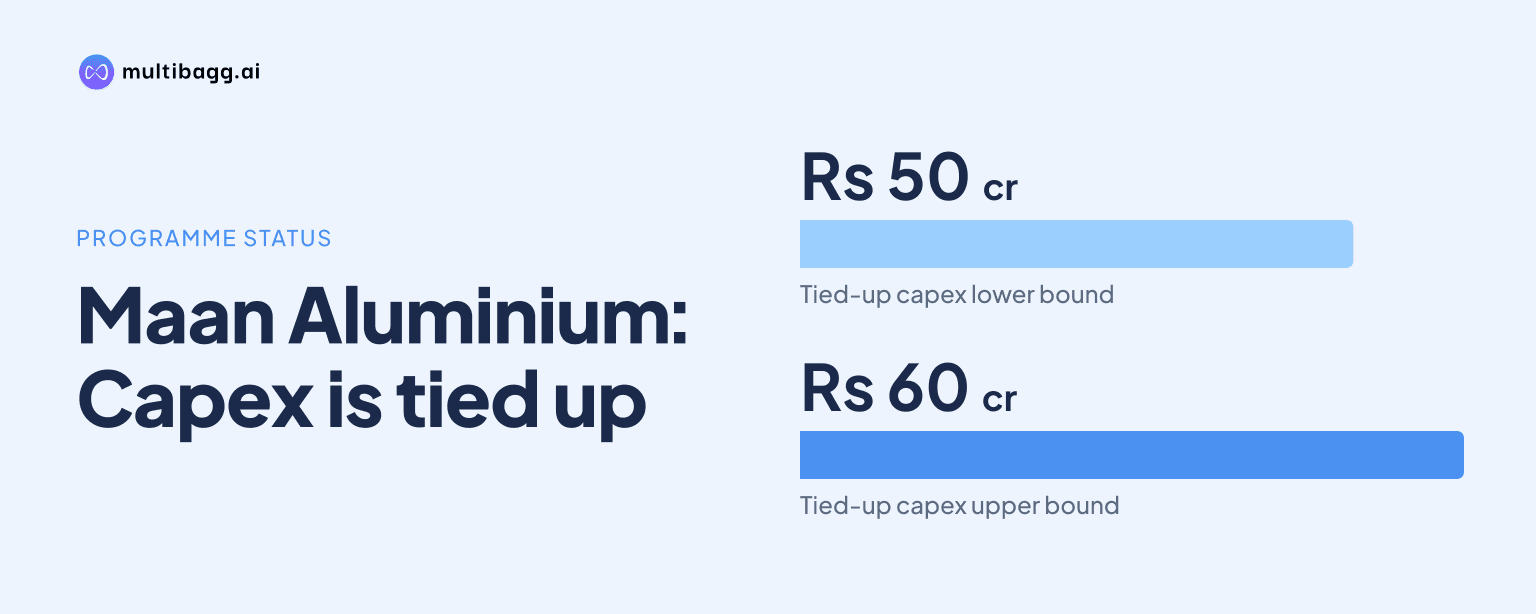
Maan Aluminium Limited said Rs 50 crore to Rs 60 crore of its indicated Rs 80 crore capital-expenditure programme was already tied up, including about Rs 40 crore for a Dewas extrusion machine, while management gave no funding, peak-debt, revenue, margin or project-return guidance.
Know Maan Aluminium inside out
Results, valuation, peers and who's buying, in one view.
What portion of Maan Aluminium's planned capex is already tied up?
Maan Aluminium said Rs 50 crore to Rs 60 crore of the Rs 80 crore capex discussed for the next two years was already tied up. Umesh Chandra Pant said about Rs 40 crore was tied up for the Dewas extrusion machine and another Rs 10 crore of similar fabrication machines was on order.
Maan Aluminium did not break down the difference between the Rs 50 crore specifically identified in machine commitments and its stated Rs 50 crore to Rs 60 crore total. The range nonetheless indicates that at least a substantial part of the Rs 80 crore programme had advanced beyond an indicative planning stage.
Management also qualified the status of the wider programme. Pant said capex figures presented by Maan Aluminium were indicative projections, rather than unconditional commitments, and that each project would be evaluated against market demand, readiness, funding availability and expected commercial success.
Why is Maan Aluminium continuing capex amid margin pressure?
Maan Aluminium said the capex programme is intended to develop higher-value-added aluminium conversion, despite operating-margin pressure during the first half. Management said revenue rose about 27% in the first half, but that the growth did not translate proportionately into operating profitability.
Pant cited international aluminium prices, procurement costs and the timing of passing price changes to customers as causes of margin variability. He also said domestic and export customers have different pricing arrangements, while product and sales mix matters because simple extrusions and higher-value-added products generate differing levels of contribution.
An analyst said purchases of stock-in-trade were about Rs 311 crore in the first half, representing 60% to 70% of revenue from trading, where the stated margin was 1% to 2%. Maan Aluminium did not confirm a future trading-revenue share or offer a revised segment-margin target, but said trading would remain an opportunity and legacy business.
The company said its strategy is to raise value-added activity while retaining trading. It identified automotive, construction and solar as end markets for value-added products, but did not disclose expected revenue, margins or order volumes from any of those three applications.
What is delaying returns from Maan Aluminium's manufacturing investment?
Maan Aluminium said customer onboarding, product development and the Dewas start-up are delaying the commercial contribution from manufacturing investment. Management said product trials, sample development, process validation, quality approvals and production stabilisation can incur costs before meaningful commercial volumes begin.
The Dewas facility had not started commercial operations and remained in a development and readiness phase during the call. Maan Aluminium said it was incurring establishment, manpower and preparatory costs at Dewas without related revenue, and that trial production, quality control and process stabilisation costs could continue after commissioning.
Management said capacity utilisation is important because manufacturing has a significant fixed-cost component. It expects a gradual ramp-up to improve fixed-cost absorption, but said the pace would depend on commissioning, customer approvals, order inflows and commercial ramp-up rather than a fixed calendar target.
An analyst contrasted extrusion capacity rising from 10,000 to 24,000 since 2024 with volume rising from 4,000 to 8,000, and also referred to Rs 80 crore to Rs 85 crore of spending over 30 months. Maan Aluminium did not validate those figures, but said assumptions made before the investment had been affected by changes in the global environment.
Got a follow-up? Ask IRIS
What has Maan Aluminium disclosed about funding, debt and returns?
Maan Aluminium has not disclosed how it will fund the Rs 80 crore programme, what peak debt it expects at the end of FY '28, or a project-level return hurdle. Asked specifically about funding and peak debt, Pant repeated that implementation would take account of funding availability and expected commercial success.
Management said improving returns on capital is an important objective and requires higher operating margins, better asset utilisation and disciplined capital expenditure. It said deployed investment and operating capital should generate adequate commercial returns as investments mature, without providing a return on capital employed target or a working-capital-day target.
The distinction between disclosed orders and the broader programme is material. About Rs 40 crore for the Dewas extrusion machine and Rs 10 crore for fabrication machines were identified as tied up or on order, while the remaining indicated expenditure remains subject to Maan Aluminium's conditions on demand, readiness, finance and commercial outcomes.
Maan Aluminium also did not state whether the further spending would be met through internal cash generation, borrowing or another source. That omission followed the analyst's concern that current cash flow may not support additional investment and that working capital had been affected by the larger trading business.
When does Maan Aluminium expect Dewas and Pithampur to generate cash?
Maan Aluminium said Dewas and Pithampur could start generating cash in about two years, but it did not provide a commissioning date, facility-level revenue estimate or margin forecast. Pant also said results may become visible in another 1.5 to two years, depending on operational and customer-related progress.
Management declined to specify when Pithampur's extrusion capacity would be fully utilised. Pant said machinery was in process and arrangements were under way, and that Maan Aluminium would comment on a particular timing only after those matters had stabilised.
Maan Aluminium described the last one to two years as an investment phase that was 70% to 80% complete. Management said investors could see results in the coming one to 1.5 years, while separately indicating about two years for cash generation from Dewas and Pithampur.
The different timeframes reflect separate milestones rather than numerical guidance. The one to 1.5-year statement concerned the possible emergence of investment results, whereas the about-two-year statement concerned the start of cash generation from the two facilities; neither was supported by a revenue or earnings projection.
Conclusion
Maan Aluminium has committed or ordered equipment representing Rs 50 crore to Rs 60 crore of the Rs 80 crore capex programme discussed on the call, even as first-half revenue growth of about 27% did not translate proportionately into operating profitability. The company is pursuing higher-value-added aluminium conversion, but Dewas start-up costs, customer approvals and capacity ramp-up are still affecting the timing of returns.
Investors should watch Dewas commissioning, machine-order progress, customer approvals and order inflows over the next 1.5 to two years. Management expects Dewas and Pithampur to begin generating cash in about two years, while funding sources, peak debt, facility-level revenue, margins and return targets remain undisclosed.

