








Maan Aluminium Revenue Rises 27% as EBITDA Margin Nearly Halves
MAX Plan at ₹4,999/yr

Find your next multibaggerBe a Pro Investor
Research stocks and track your picks on the go. Download the app.
Key highlights
- Maan Aluminium’s H1 FY27 revenue from operations rose 27% to about Rs 511 crore from about Rs 402 crore.
- Maan Aluminium’s H1 FY27 EBITDA fell to about Rs 11.5 crore from Rs 18.2 crore, and margin declined to 2.2% from 4.5%.
- Q2 FY27 revenue rose to about Rs 279 crore from Rs 232 crore in Q1 FY27, while EBITDA fell to about Rs 4.4 crore from Rs 7.1 crore.
- Maan Aluminium said about Rs 50 crore to Rs 60 crore of expansion spending was tied up within an indicative three-year Rs 166 crore plan.
powered by IRIS
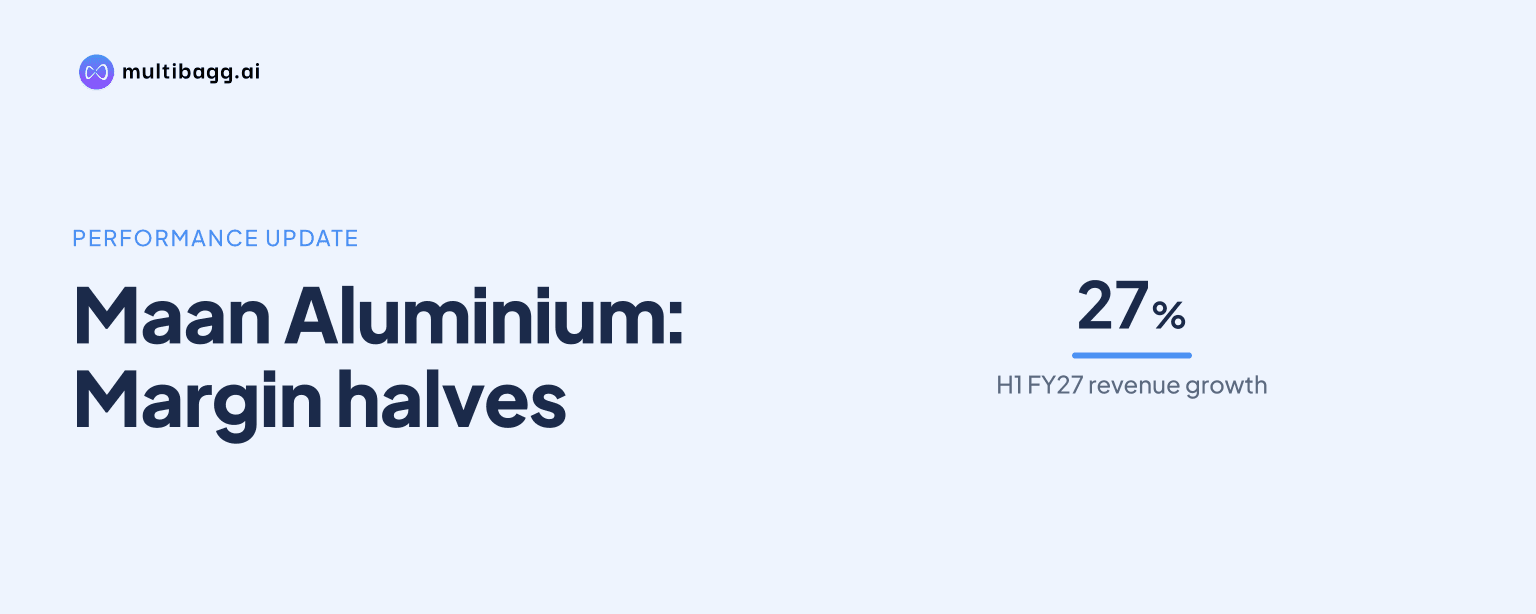
Maan Aluminium Limited increased H1 FY27 revenue from operations by 27% to about Rs 511 crore, but EBITDA margin nearly halved to 2.2% from 4.5% as aluminium-cost pass-through, sales mix, manufacturing utilisation, customer trials and Dewas start-up costs limited operating contribution. EBITDA fell to about Rs 11.5 crore from Rs 18.2 crore.
Know Maan Aluminium inside out
Results, valuation, peers and who's buying, in one view.
What happened to Maan Aluminium’s H1 FY27 earnings?
Maan Aluminium’s revenue growth did not translate into higher earnings in H1 FY27: revenue increased by about Rs 109 crore from Rs 402 crore in H1 FY26, while EBITDA declined by about Rs 6.7 crore and profit after tax fell by about Rs 4.5 crore. Management described the period as mixed, with increased business scale but profitability under pressure.
The sequential comparison also showed continued margin pressure in Q2 FY27. Revenue increased to about Rs 279 crore from about Rs 232 crore in Q1 FY27, but EBITDA declined to about Rs 4.4 crore from Rs 7.1 crore. Profit after tax fell to about Rs 90 lakh from Rs 3.1 crore, indicating that higher quarterly sales did not improve operating contribution.
Why did Maan Aluminium’s EBITDA margin fall in H1 FY27?
Maan Aluminium said changes in aluminium prices affected the relationship between procurement costs and customer realisations. Higher aluminium prices can increase reported revenue, but they also raise material costs; the timing and extent of passing these costs to customers differs across domestic and export pricing arrangements, affecting the contribution retained on sales.
Sales mix was another stated reason. Management said simple extrusions, higher-value products and customer applications carry different levels of value addition and contribution, meaning that turnover growth does not automatically produce a comparable rise in operating margin. An analyst said purchases of stock in trade were about Rs 311 crore in H1 FY27 and suggested trading represented 60% to 70% of revenue, with a 1% to 2% margin based on earlier calls; management did not confirm either figure or provide a segment revenue split.
Manufacturing efficiency also affected margins because the business has significant fixed costs. Maan Aluminium has annual foundry capacity of 12,000 tonnes and extrusion capacity of 24,000 tonnes, with machining and anodising capability. Management said throughput, productivity and material utilisation must improve for better fixed-cost absorption, while responding that manufacturing was not operating at a loss.
How did customer trials and Dewas affect Maan Aluminium’s costs?
Maan Aluminium said onboarding new customers and developing higher-value applications create costs before commercial volumes are secured. The process includes sample development, product trials, process validation, quality approvals and product stabilisation. Management said initial runs can involve lower production yields, material wastage and quality-related rejections, reducing manufacturing efficiency before the process is settled.
The Dewas facility had not begun commercial operations as of the November 18, 2026 earnings call, but it was already incurring establishment, manpower and preparatory costs. These costs had no corresponding revenue contribution during the readiness phase. Management said that, after commissioning, spending on process stabilisation, quality control and trial production could continue before capacity use reaches an optimal level.
Management therefore identified two related mechanisms behind the H1 FY27 margin outcome: revenue mix and commodity-cost pass-through, alongside the cost of establishing additional manufacturing capability. It expects gradual ramp-up, improved capacity utilisation and better fixed-cost absorption, but said the pace depends on commissioning, customer approvals, order inflows and commercial ramp-up rather than setting a margin target.
Got a follow-up? Ask IRIS
When does Maan Aluminium expect manufacturing cash generation?
Maan Aluminium said Pithampur and Dewas could start generating cash in about two years, although management did not give annual revenue, EBITDA margin, utilisation or debt guidance. It also said investment results could become visible in about one to two years, describing the recent period as an investment phase that was around 70% to 80% complete.
The timetable remains linked to equipment delivery and operational readiness. Management said Dewas has a tubing machine, but importing its extrusion press was affected by higher costs associated with geopolitical conditions. The company said the press was in production and referred to a three-to-four-month period, while adding that it was strengthening domestic markets alongside its export business rather than replacing exports.
Maan Aluminium has outlined indicative cumulative capital expenditure of about Rs 166 crore over the next three years for Pithampur, new facilities, dies and general capital expenditure. Management said the figure is not an unconditional commitment and will be assessed against demand, project readiness, funding availability and expected commercial success. About Rs 50 crore to Rs 60 crore was already tied up, including roughly Rs 40 crore for the Dewas extrusion machine and about Rs 10 crore for fabrication machines.
What should readers watch in Maan Aluminium’s next results?
Maan Aluminium’s principal operating test is whether greater manufacturing utilisation, product stabilisation and a larger share of higher-value products reverse the Q2 FY27 pattern of rising revenue and falling EBITDA. Management identified procurement efficiency, material utilisation, capacity use and tighter costs as priorities, while naming automotive, construction and solar as target industries for value-added products.
Working capital is the second issue because operating cash flow in H1 FY27 was affected by absorption in receivables and other current assets. Management said it is focusing on collection efficiency, closer receivables monitoring, working-capital planning and disciplined fund deployment. It did not disclose a working-capital-days target, an intended trading-share range or a date for full utilisation at Pithampur.
Conclusion
Maan Aluminium’s H1 FY27 results show that a Rs 511 crore revenue base did not offset lower contribution from commodity-price timing, mix and manufacturing costs. EBITDA fell to about Rs 11.5 crore and the EBITDA margin declined to 2.2%, while Q2 FY27 reinforced the pattern of higher sales but lower operating earnings.
The next developments to watch are Dewas commissioning, customer approvals, order inflows and the ramp-up of Pithampur and Dewas. Management expects those facilities to begin generating cash in about two years, while the about Rs 50 crore to Rs 60 crore of tied-up equipment spending is assessed within the broader indicative Rs 166 crore three-year capital-expenditure plan.

