










Macpower awaits Gujarat policy for 60-acre land allotment
Key highlights
- Macpower’s 13-acre expansion is under execution and is expected to add capacity by the end of Q2 FY28, supporting roughly three years of growth.
- Macpower is eligible for a 60-acre Gujarat land allotment but is waiting for a replacement policy before accepting the parcel rather than paying market rates.
- Macpower said its combined 13-acre and 60-acre sites could eventually provide visibility for 10,000 machines.
- Macpower refunds an average of 10 to 20 machines each month because it cannot meet requested delivery dates.
powered by IRIS
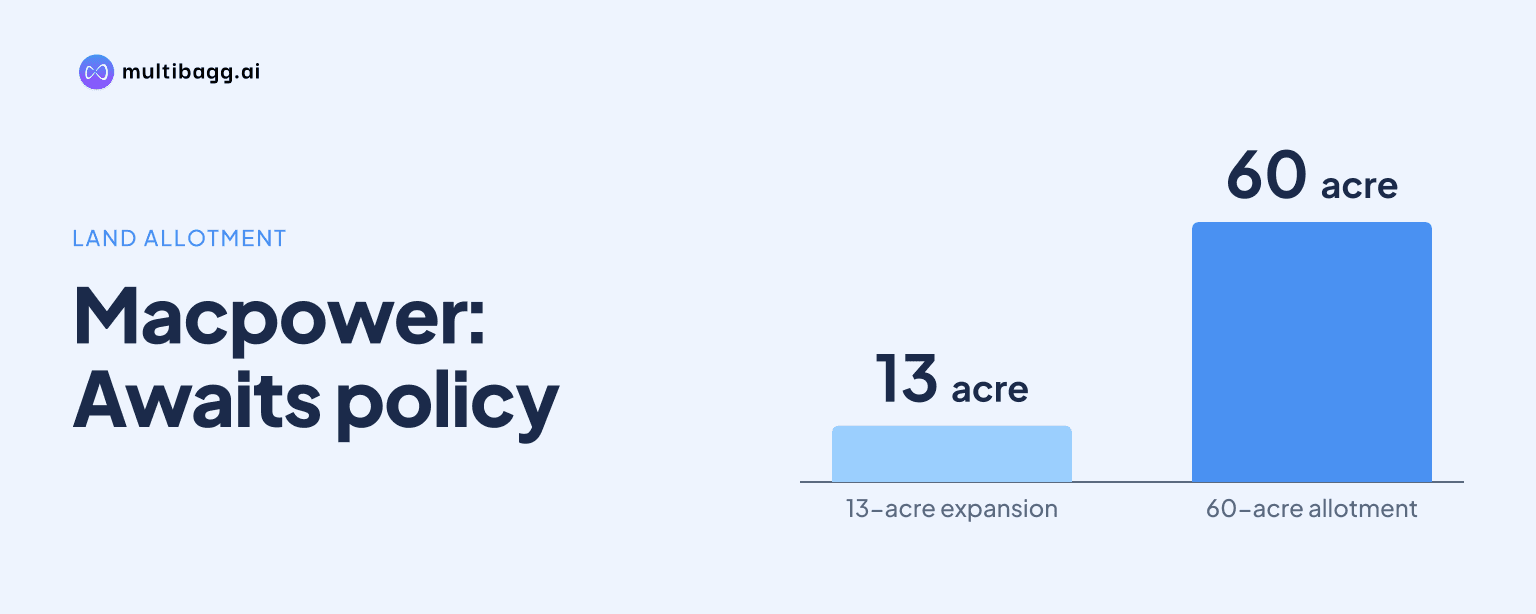
Macpower is waiting for Gujarat’s new policy before taking its eligible 60-acre land allotment rather than paying market rates. Management said its 13-acre expansion is already under execution and can support about three years of growth, while the combined sites could eventually provide visibility for 10,000 machines.
Know Macpower CNC Machines inside out
Results, valuation, peers and who's buying, in one view.
Why is Macpower waiting for the 60-acre land allotment?
Macpower is waiting because the earlier 2016 policy expired and management said a replacement policy had not yet been issued. Management said the policy expired in the previous February, was extended until August, and was still awaited at the time of the call. It identified the absence of the policy, rather than a lack of eligibility, as the obstacle to receiving the 60-acre parcel.
The proposed land area increased from the 30 acres cited previously to 60 acres after the government showed Macpower a larger site. Management said it had paid token money and completed documentation, including clearances from more than 32 departments. It said Macpower is eligible for 60 acres rather than the initially discussed 30 acres.
Macpower does not intend to pay the market rate for the parcel while the policy is unresolved. Management said it did not require the land within one or two months and could accept a further delay of five or six months. The decision links the allotment timing to policy-related benefits rather than an immediate need for physical capacity.
What will Macpower do before the 60-acre site is available?
Macpower’s implemented alternative is its 13-acre project, where construction work and capital expenditure are already under way. Management said this site can support roughly three years of growth and described it as plan B while the 60-acre allotment remains plan A. The 13-acre project is therefore intended to meet near-term production needs without the larger parcel.
Management expects the new capacity at the 13-acre site by the end of the second quarter of FY28. The first phase focuses on debottlenecking machining and component manufacturing, including backward integration. Macpower said about 90% of its capacity calculations were complete and that it expected to place further equipment orders within one month.
For the expansion, management said most equipment has a three-month delivery period plus about one month for logistics, and was not required before May or June. It had already placed about 20% of orders for items with lead times of five to six months, including spindle, sheet-metal and telescopic-cover capacity. Macpower also said its construction contract requires completion within six months and includes a penalty clause.
How does the 60-acre parcel support Macpower’s defence plans?
Macpower said it would not start capital expenditure at the 60-acre site immediately after obtaining the allotment. Management plans to complete the 13-acre project first, then add capacity, a foundry and component manufacturing gradually at the larger site. It said the 13-acre and 60-acre sites together could provide visibility for 10,000 machines.
The larger site is part of Macpower’s longer-term defence capacity plan, but management said current tender participation is selective. Macpower reported orders from Hindustan Aeronautics Limited, rifle factories and some ordnance factories that it expects to execute in the current financial year. It also said average defence bids released exceed Rs 1,000 crore, while Macpower currently participates in only 25% to 30% of them and does so at the two highest prices.
Management said Macpower would participate more aggressively in defence tenders once it has dedicated capacity. That means the future expansion is not presented as being supported by a disclosed order book for half of the plant or another fixed share of capacity. The stated sequence is to build capacity, broaden tender participation and seek a larger number of orders.
Macpower is also treating five-axis machines as a secondary focus while it executes its existing product range. Management estimated the Indian market for these machines at no more than 150 units, with 90% imported, and cited legalities and potential supply restrictions for defence use. It said Macpower sells about one 4-plus-1 machine a month and recently received an order worth Rs 2 crore for one machine.
Got a follow-up? Ask IRIS
What incentives and component plans has Macpower disclosed?
Macpower said it expects the Vikshit Gujarat policy to provide a 25% subsidy on construction, machinery and equipment for its new capital expenditure, along with a 7% interest subsidy. Management made this statement while discussing the near-term capacity expansion and said the exact size of the addition would be disclosed during the third-quarter earnings call after calculations were finalised.
Backward integration is a central part of the 13-acre expansion because management said existing in-house component capacity is insufficient for planned production. Macpower cited spindle capacity of about 1,400 to 1,500 units while still purchasing about 1,500 components. It assesses components for in-house production based on supply availability, required accuracy, delivery and logistics time, and cost.
Management said scale and additional in-house component capacity could improve margins, while salaries, research and development spending, and operating costs would also rise. In response to an analyst citing a 16% to 17% margin for Macpower and 25% to 26% for a peer, management said Macpower could sustain a margin above 20% after reaching 10,000-machine capacity. This was management’s aspiration, not reported performance or a time-bound forecast.
How does the land delay affect Macpower’s near-term production?
Macpower said the pending 60-acre allotment does not alter its immediate production plan because its 13-acre project is in execution. Management said it expects year-on-year growth of 25% to 30% in each of the coming three years. It also said it was planning for 250 machines a month in the fourth quarter, or 750 machines over the quarter.
Capacity constraints remain relevant to customer fulfilment. Management said Macpower refunds an average of 10 to 20 machines each month because it cannot provide the required delivery dates. It said orders generally carry advances, except distributor and government orders, making the planned capacity addition relevant to both revenue growth and orders that cannot currently be served.
Working-capital days also declined as deliveries increased. Management said working-capital days fell to about 110 in September from about 138 in the prior-year September period because more machines were delivered and there was no finished or unfinished inventory. It also said Macpower had stopped accepting dispatches backed by short-term financing assurance letters, while some corporate customers pay their final 10% or 20% after delivery and commissioning.
Conclusion
Macpower’s land strategy prioritises current execution over a market-rate purchase of the larger parcel. The 13-acre project is intended to remove machining and component bottlenecks, while the 60-acre site would support a later foundry, further backward integration and broader participation in defence tenders. The reported monthly refund of 10 to 20 machines shows why added capacity remains operationally important.
The next developments to watch are Gujarat’s replacement policy, the allotment terms for the eligible 60 acres, and Macpower’s third-quarter disclosure on the planned capacity addition. Management has set the end of Q2 FY28 as the target for the 13-acre capacity to come on stream and said it will finish that project before beginning capital expenditure at the larger site.