










NSDL Payments Bank customer base reaches 54.3 lakh in Q2 FY27
Key highlights
- NPBL's retail customer base reached 54.3 lakh in Q2 FY27, up from 33.5 lakh in Q2 FY26.
- NPBL reported Rs 378.1 crore of deposit balances in Q2 FY27, or 1.4-times year-on-year growth.
- NPBL's RuPay NCMC smart cards reached 1.3 crore MSRTC registrations and more than Rs 100 crore of cumulative loads in October 2026.
- National Securities Depository Limited said subsidiaries contributed more than 10% of consolidated profit, versus about 5% one year to 18 months earlier.
powered by IRIS
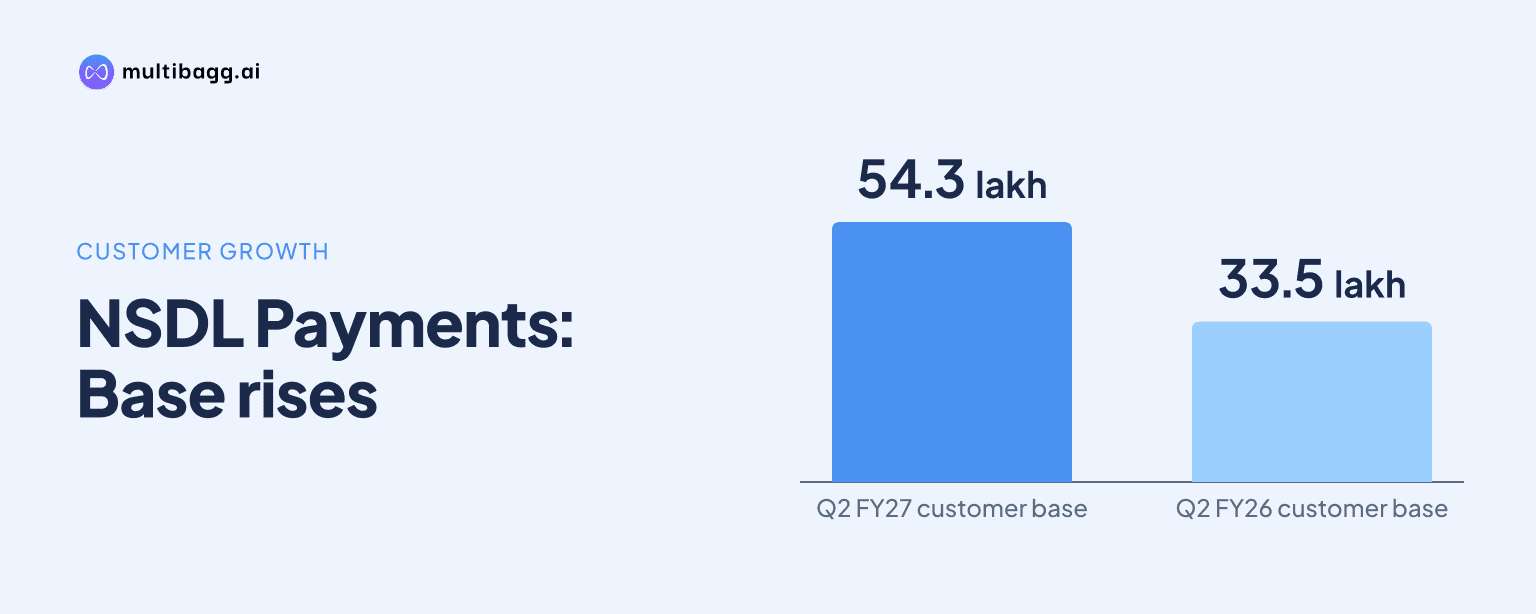
NSDL Payments Bank grew its retail customer base 1.6 times year on year to 54.3 lakh in Q2 FY27 from 33.5 lakh, while deposit balances reached Rs 378.1 crore. Management attributed the operating expansion to customer acquisition, deposits, RuPay transit cards and growing Unified Payments Interface, or UPI, acquiring activity.
Know National Securities Depository inside out
Results, valuation, peers and who's buying, in one view.
How fast did NPBL's customers and deposits grow?
NPBL's retail customer base rose by 20.8 lakh year on year to 54.3 lakh in Q2 FY27, from 33.5 lakh in Q2 FY26. Management described this as 1.6-times growth and identified customer acquisition as one of the payments bank's two principal focus areas alongside deposits.
Deposit balances reached Rs 378.1 crore in Q2 FY27, which management said was 1.4 times the level a year earlier. The company did not disclose the Q2 FY26 deposit balance in rupees, average deposits per customer, or the number of active deposit accounts, limiting the comparison to the reported growth multiple.
The customer base increased faster than the disclosed deposit-balance multiple over the same period. That comparison indicates that NPBL added customers at a greater reported rate than deposits, although the call did not provide a comparable deposit figure that would allow calculation of the change in deposits per customer.
What is driving NPBL's UPI acquiring growth?
NPBL said UPI acquiring is supporting its growth through partnerships with payment-gateway providers and other payments ecosystem participants, which route UPI transaction settlements through the payments bank. Management said the business was started about 18 months before the Q2 FY27 earnings call and has since seen an uptick.
Management identified UPI acquiring and deposit acquisition as the two focus areas behind the bank's growth and profit contribution. However, it did not disclose UPI transaction volumes, merchant numbers, transaction value, acquiring revenue or the share of earnings attributable to UPI acquiring in Q2 FY27.
The acquiring business is distinct from the 54.3 lakh retail customer base and Rs 378.1 crore of deposits. NPBL did not specify whether transit-card holders, UPI users and deposit customers overlap, so the disclosed operating figures cannot be combined into a count of unique active customers.
Management also said merchant discount rate, or MDR, on UPI had been introduced and was then on pause. It did not quantify any possible benefit from a renewed MDR framework, saying that any change applying to the wider payments ecosystem would also apply to the bank.
How is NPBL expanding through Maharashtra transit cards?
NPBL's RuPay National Common Mobility Card, or NCMC, smart-card programme reached 1.3 crore Maharashtra State Road Transport Corporation, or MSRTC, registrations and more than Rs 100 crore in cumulative card loads in October 2026. Management called this an important milestone for the payments bank's growth.
The card programme supports concessional bus travel in Maharashtra under a government mandate effective September 4, 2026. That mandate provides a stated mechanism for card adoption, but the call did not disclose how much of the more than Rs 100 crore cumulative load was generated after the September 2026 start date.
The reported 1.3 crore registrations show the scale of the transit-card network, while the more than Rs 100 crore cumulative loads show payment use. NPBL did not provide active-card numbers, transaction frequency, interchange income, card-load fees or card-related profitability for Q2 FY27.
The transit-card programme therefore adds a payment use case alongside customer deposits and UPI acquiring. Management did not state how many of the 54.3 lakh retail customers used NCMC cards, so the registrations should not be treated as a direct measure of the payments bank's retail customer base.
Got a follow-up? Ask IRIS
What does NPBL's growth mean for consolidated profit?
NPBL's segment result increased from Rs 1.8 crore to more than Rs 5 crore, management said in response to an analyst question during the Q2 FY27 call. Management linked the increase to customer acquisition, deposit growth and UPI acquiring, but did not identify the periods for the comparison or define the segment-result measure further.
Management said all subsidiaries together contributed more than 10% of consolidated profit at the time of the call, compared with about 5% roughly one year to 18 months earlier. This is not a measure of NPBL alone because National Securities Depository Limited also described its database-management and insurance-repository subsidiaries as profitable.
National Securities Depository Limited reported consolidated Q2 FY27 total income of Rs 582.6 crore, up 34.8% from Rs 432.2 crore in Q2 FY26. Consolidated profit after tax rose 10.9% to Rs 122.5 crore from Rs 110.4 crore, while the company said standalone profit accounted for about 88% of consolidated profit.
For H1 FY27, consolidated total income rose 46.7% to Rs 1,143.1 crore and profit after tax rose 10.4% to Rs 220.8 crore. Those results provide the group context for the higher subsidiary contribution, but the company did not disclose NPBL's revenue, profit after tax, capital position or cost-to-income ratio.
What is NPBL's outlook after Q2 FY27?
NPBL gave no numerical target for future customer additions, deposits, UPI transaction volumes or profitability after Q2 FY27. Management instead disclosed the existing operating base of 54.3 lakh customers and Rs 378.1 crore of deposits, and described UPI acquiring and deposits as its focus areas.
The unresolved UPI MDR framework remains a disclosed external factor for acquiring economics. Management said it had not quantified the impact of MDR being declared again, so the call provides no revenue forecast tied to a potential policy change.
At the wider group level, National Securities Depository Limited said it continued to invest in technology resilience, cybersecurity, operational automation, artificial intelligence and critical talent. Management said the pace of critical-talent investment had started moderating, while current-year technology spending was expected to be broadly similar to the previous year.
The company did not set out a separate technology budget, product roadmap or target date for NPBL. Its next operating update will therefore be needed to establish whether the October 2026 milestone of more than Rs 100 crore in cumulative NCMC loads translates into sustained card activity and whether UPI acquiring provides disclosed financial metrics.
Conclusion
NPBL's Q2 FY27 update shows customer growth from 33.5 lakh to 54.3 lakh, supported by Rs 378.1 crore of deposits, a 1.3 crore-registration NCMC programme and management's reported UPI-acquiring uptick. The increase in subsidiaries' combined profit contribution to more than 10% from about 5% also points to a larger group role, though that figure is not attributable solely to NPBL.
The next items to watch are NPBL's customer and deposit growth after Q2 FY27, any disclosure of UPI acquiring volumes or merchant economics, and activity following the September 4, 2026 Maharashtra concession mandate. Management also left the MDR outcome unquantified, making any policy decision on UPI pricing a further unresolved factor.