










NSDL Demat 2.0 pilot settles over Rs 1,000 crore bonds
Key highlights
- NSDL Demat 2.0 has processed 3 primary tokenised bond issues worth a little over Rs 1,000 crore.
- Tokenised bonds on NSDL Demat 2.0 use instantaneous CBDC settlement rather than applicable T+1 to T+3 bond settlement cycles.
- NSDL Demat 2.0 is currently limited to institutional investors, with no retail access or secondary-market trading.
- NSDL reported Q2 FY27 consolidated total income of Rs 582.6 crore, up 34.8% year on year.
powered by IRIS
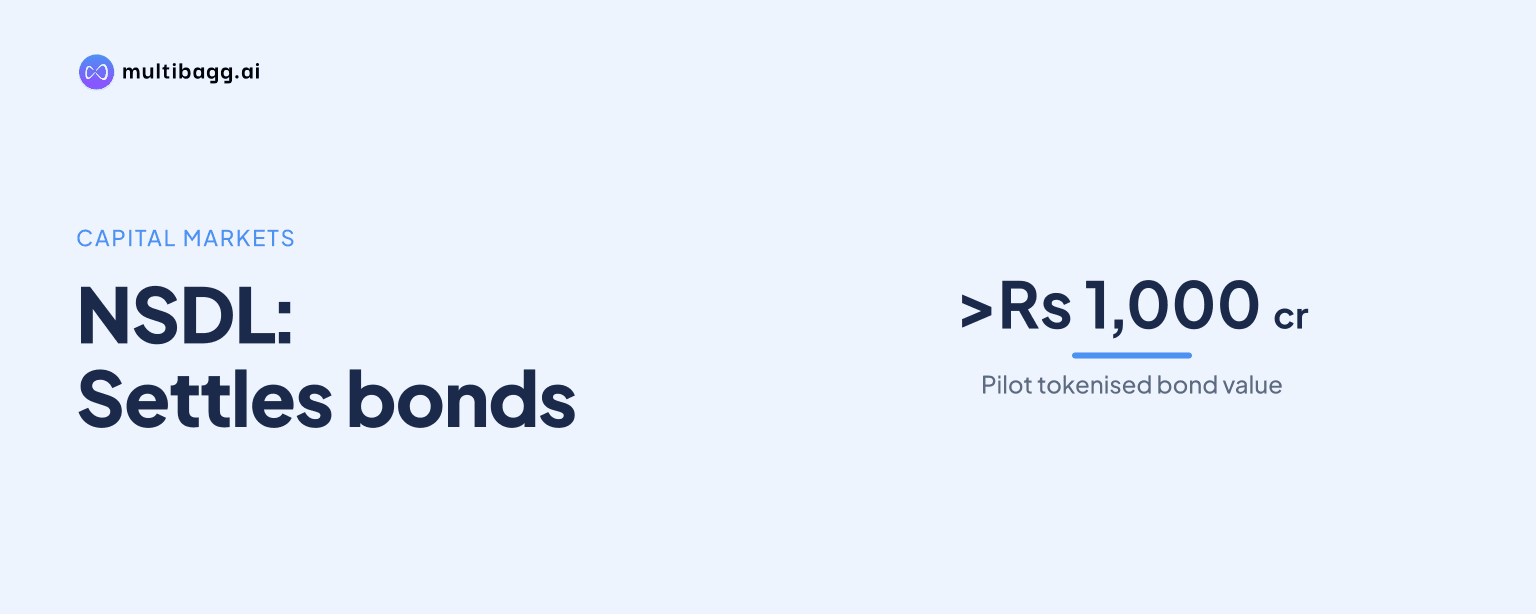
National Securities Depository Limited (NSDL) said its Demat 2.0 pilot had processed three primary tokenised bond issues worth a little over Rs 1,000 crore as of its Q2 FY27 earnings call, using central bank digital currency (CBDC) for instantaneous settlement. The Securities and Exchange Board of India (SEBI) sandbox programme remains limited to institutional bond issuance.
Know National Securities Depository inside out
Results, valuation, peers and who's buying, in one view.
What has NSDL Demat 2.0 processed so far?
NSDL has processed three primary tokenised bond issuances worth a little over Rs 1,000 crore on Demat 2.0. Management disclosed the figure during its Q2 FY27 earnings call and described the programme as a pilot in the SEBI sandbox. The platform is currently restricted to bonds rather than the broader securities market.
The three transactions show use of the platform for issuance rather than post-issue trading. NSDL said the first phase was launched mainly for issuance, while secondary-market capability remains work in progress. The Rs 1,000 crore-plus figure therefore represents the value of primary bond creation on the platform, not secondary-market turnover.
The pilot is a joint initiative of NSDL and CDSL under the SEBI-led tokenisation programme. Management said the two depositories had moved together and did not claim an early-mover advantage. It also said tokenisation is a relatively new development globally, leaving limited international experience on which to base the market's evolution.
How does NSDL Demat 2.0 settle tokenised bonds?
NSDL Demat 2.0 settles tokenised bonds instantaneously when payment is made, instead of bond settlement cycles that can run from T+1 to T+3. Management compared the mechanism with an immediate payment transfer: the investor remits payment and receives the bond at once. T is the transaction date, so T+1, T+2 and T+3 represent settlement one, two and three days later.
The platform uses distributed ledger technology (DLT) instead of the conventional depository model, according to management. Its payment leg uses CBDC rather than a conventional rupee payment. Investors cannot use traditional rupee money directly for a Demat 2.0 tokenised-bond transaction and must use the specified CBDC payment route.
An investor must open a wallet with designated Reserve Bank of India bankers that offer the CBDC service. For the Demat 2.0 account, NSDL said no additional know-your-customer (KYC) process is required because an existing demat account can be extended on request. The CBDC wallet remains a separate requirement for settlement.
Who can use NSDL Demat 2.0 today?
NSDL Demat 2.0 is currently open only to institutional investors, not retail investors. Management made that limitation clear while discussing the three issuances and said the initial bond-tokenisation phase was aimed at the institutional market. Retail investors therefore cannot currently buy or sell tokenised bonds through the platform.
Secondary-market trading is also not available at this stage. NSDL said its development is planned and remains in progress, while SEBI will evaluate the next steps as experience is gathered. Management did not disclose a launch date for a trading facility after the initial Rs 1,000 crore-plus primary issuance activity.
The present scope is narrower than the longer-term opportunity management outlined. Management said tokenised bonds could open a new investment avenue and that tokenised financial instruments beyond bonds could emerge later. It explicitly made that possibility subject to regulatory development and market evolution, leaving the future product range and investor eligibility unresolved.
Got a follow-up? Ask IRIS
Does NSDL have a first-mover advantage in tokenised bonds?
NSDL does not describe Demat 2.0 as a first-mover advantage because NSDL and CDSL are operating the SEBI-led initiative together. Management's view was that the platform could open a new market opportunity over time, but that the market must first develop through investor experience and regulatory feedback. The three primary issuances are an initial operating record, not evidence of a separate commercial lead.
The pilot comes while NSDL is investing more broadly in technology. In H1 FY27, NSDL capitalised Rs 23.9 crore of technology expenditure, compared with Rs 106.1 crore for full-year FY26. Management said it was investing in technology resilience, cybersecurity, operational automation, artificial intelligence and critical talent, while the pace of critical-talent investment had started moderating.
NSDL's standalone revenue from operations rose 11.6% year on year to Rs 227.8 crore in Q2 FY27, while standalone net profit rose 5.2% to Rs 126.7 crore. At the consolidated level, Q2 FY27 total income increased 34.8% to Rs 582.6 crore and profit after tax increased 10.9% to Rs 122.5 crore. Those financial results are separate from the Rs 1,000 crore-plus value of the pilot's bond issuances.
What should readers watch in NSDL Demat 2.0 next?
The next disclosed milestone for NSDL Demat 2.0 is the development of secondary-market trading, because the current record of three issues worth a little over Rs 1,000 crore is confined to primary issuance. Management said this capability was work in progress and did not provide a launch date. SEBI's assessment of the resulting market structure will determine subsequent steps.
Retail access is a second unresolved matter. NSDL said the platform remains institutional-only and linked future decisions to investor experience and regulatory evolution. The required CBDC wallet with designated Reserve Bank of India bankers means any wider rollout would involve payment-access arrangements in addition to an extension of an existing demat account.
Conclusion
NSDL has established an initial operating record for tokenised bond issuance, completing three institutional primary issues worth a little over Rs 1,000 crore with instantaneous CBDC-based settlement. The pilot changes the settlement process from applicable T+1 to T+3 bond cycles, but it does not yet provide either a retail tokenised-bond market or a secondary trading venue.
The next developments to watch are SEBI's decisions on secondary-market capability and retail participation, neither of which had a disclosed date at the Q2 FY27 call. Further primary issuances would show whether activity extends beyond the initial three issues, while NSDL's technology plans indicate that management expects spending to be broadly similar to the prior year before it finalises its next financial-year action plan.