










NSDL expects technology-spending growth to flatten next year
Key highlights
- NSDL expects technology-spending growth to flatten next financial year after capital expenditure rose from about Rs 30 crore to more than Rs 100 crore.
- NSDL reported Q2 FY27 standalone revenue from operations of Rs 227.8 crore, up 11.6% year on year.
- NSDL’s Q2 FY27 standalone EBITDA was Rs 171.6 crore, up 6.8%, while PAT was Rs 126.7 crore, up 5.2%.
- NSDL added 15.6 lakh net demat accounts in Q2 FY27, taking its total to 4.72 crore.
powered by IRIS
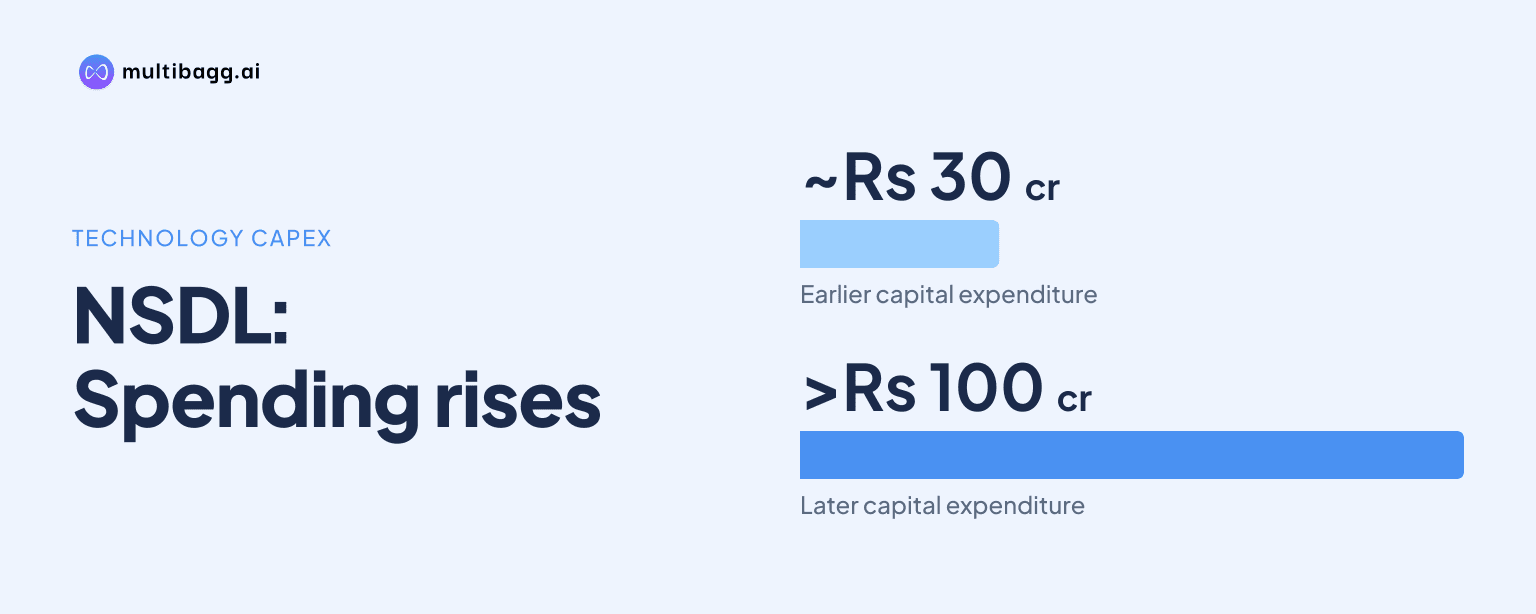
National Securities Depository Limited expects the rate of technology-spending increases to flatten from next financial year after capital expenditure rose from about Rs 30 crore to more than Rs 100 crore, management said on November 2, 2026. NSDL said most of its elevated spending over roughly two years addressed essential catch-up needs, while future allocations could be more selective.
Know National Securities Depository inside out
Results, valuation, peers and who's buying, in one view.
Why does NSDL expect technology spending to flatten next year?
NSDL expects spending growth to flatten next year because its technology-investment base has risen substantially from about Rs 30 crore of capital expenditure to more than Rs 100 crore. Managing Director and Chief Executive Officer Vijay Chandok said expenditure had flattened at this higher base, which should reduce the percentage increase in spending from next year.
Management said FY27 technology spending should be broadly similar to the prior year, although a marginal difference remains possible. Chandok said NSDL has an approximate plan for the next financial year, but a specific, fine-tuned action plan would be completed in the coming months; the company did not give a FY28 expenditure budget.
NSDL also said the pace of investment in critical talent has started moderating. Chandok described the current position as a transition from a period of extensive spending to more discriminating spending, but said the pace at which expenses normalise and operating leverage emerges would still depend on market conditions.
What has NSDL funded in its technology cycle?
NSDL has funded technology resilience, cybersecurity, operational automation, artificial intelligence, critical talent and product development during the elevated spending cycle. Management characterised much of the investment over the preceding roughly 18 to 24 months as necessary catch-up work, rather than expenditure that could readily be deferred.
The programme includes more than 68 application programming interfaces, or APIs, for depository participants, alongside API connectivity for online bond platform providers. NSDL also launched a Demat 2.0 pilot using distributed ledger technology, or DLT, for tokenised bonds and Reserve Bank of India central bank digital currency, or CBDC, settlement.
NSDL capitalised Rs 23.9 crore of technology expenditure in H1 FY27, compared with Rs 106.1 crore in the full FY26. These periods are not directly comparable because one covers six months and the other a full year, but the disclosure confirms that capitalised technology investment continued during FY27.
How did NSDL’s revenue and profit growth compare in Q2 FY27?
NSDL’s standalone revenue grew faster than its earnings in Q2 FY27, with revenue from operations up 11.6% year on year while earnings before interest, tax, depreciation and amortisation, or EBITDA, rose 6.8%. Standalone profit after tax, or PAT, increased 5.2%, during the investment cycle management said includes technology and specialist talent costs.
Standalone EBITDA margin was 61.3% in Q2 FY27, or 58.6% excluding dividend income, while PAT margin was 45.3%, or 41.4% excluding dividend income. In H1 FY27, standalone total income rose 13.3% to Rs 499.5 crore and PAT increased 6.3%; NSDL said standalone profit represented about 88% of consolidated profit.
At the consolidated level, total income rose 34.8% year on year to Rs 582.6 crore in Q2 FY27, EBITDA increased 12.5% to Rs 178.5 crore and PAT rose 10.9% to Rs 122.5 crore. Consolidated EBITDA margin was 30.6% and PAT margin was 21.0%, while the call did not provide a complete quarterly line-item split for technology expenses.
Got a follow-up? Ask IRIS
When could NSDL see operating leverage from technology spending?
NSDL said expense normalisation must occur before operating leverage can emerge, and management did not provide a date or margin target. Chandok said the company’s expectation is limited to a flattening in the type of expenditure increases seen in the previous year, rather than a commitment on the timing of operating leverage.
Management drew a distinction between past catch-up spending and future selective expenditure. Chandok said the current cycle’s budgeted and underway investment was largely “must do,” while future spending could be “good to do,” focused on value-added products and risk-related requirements. That distinction gives NSDL more discretion over allocations, but does not establish a quantitative profitability target.
The company’s ability to translate a steadier cost base into earnings growth will also depend on business activity. Management said IPO activity can add roughly 25% to 30% to its existing business when there is an additional pipeline, but it gave no forecast for future capital-market issuance or a timetable for margin normalisation.
Which technology-linked businesses could influence NSDL’s next phase?
NSDL is using technology investments to pursue retail-account growth and new market infrastructure. It ended Q2 FY27 with 4.72 crore demat accounts after adding 15.6 lakh net accounts during the quarter, while its incremental account market share was 17.2%, compared with 17.6% in the preceding quarter.
For H1 FY27, NSDL’s market share of incremental demat accounts increased to 17.4% from 16.6% in H1 FY26. Fintech brokers contributed 23.5% of incremental accounts in Q2 FY27, up from 9.3% in Q2 FY26, and management linked that change to investments that improved its ability to attract new-age brokers.
Demat 2.0 remains at an early stage. NSDL and CDSL jointly operate the Securities and Exchange Board of India, or SEBI, sandbox pilot, which had recorded three primary tokenised-bond issuances worth a little over Rs 1,000 crore; secondary-market capabilities remain in development and the service is currently limited to institutional investors.
NSDL had added about 30 depository participants over the last 1.5 years, including fintech firms, according to management. It did not issue a retail-market-share target, noting that the three largest depository participants account for roughly 60% to 65% of the market and that the pace of gains will depend on market conditions and the scaling of newer participants.
Conclusion
NSDL’s central message is that FY27 remains part of an elevated investment cycle, but the growth rate in technology spending should flatten next year as catch-up projects give way to more selective allocations. In Q2 FY27, standalone revenue rose 11.6%, compared with EBITDA growth of 6.8% and PAT growth of 5.2%, while management linked the cost trajectory to technology, resilience and talent investments.
Investors will watch for NSDL’s more specific next-year action plan, which management said would be fine-tuned in coming months, and for evidence that expenses are normalising. Other disclosed variables include market conditions, the scaling of newly added depository participants, IPO activity and SEBI’s evaluation of Demat 2.0 as secondary-market development and possible retail access progress.