










NSDL fintech brokers source 23.5% of incremental accounts
Key highlights
- Fintech brokers sourced 23.5% of NSDL's incremental demat accounts in Q2 FY27, versus 9.3% in Q2 FY26.
- NSDL added 15.6 lakh net demat accounts in Q2 FY27, taking its total to 4.72 crore.
- NSDL's H1 FY27 market share was 17.4%, compared with 16.6% in H1 FY26.
- NSDL reported Q2 FY27 consolidated total income of Rs 582.6 crore, up 34.8% year on year.
powered by IRIS
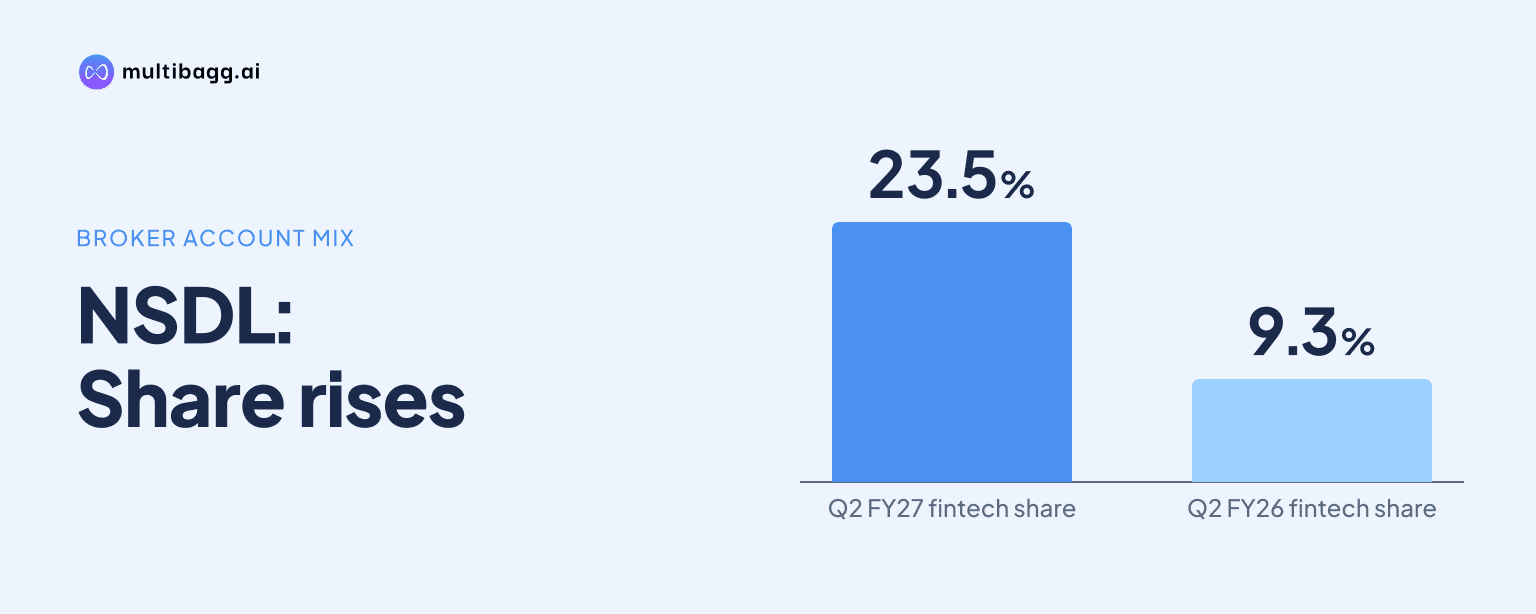
National Securities Depository Limited said fintech brokers sourced 23.5% of its incremental demat accounts in Q2 FY27, up from 9.3% in Q2 FY26, as it added 15.6 lakh net accounts and pursued retail-market-share recovery through new depository participants, or DPs.
Know National Securities Depository inside out
Results, valuation, peers and who's buying, in one view.
How much of NSDL's new account sourcing comes from fintech brokers?
NSDL said fintech brokers accounted for 23.5% of incremental demat-account sourcing at the end of Q2 FY27. This was 14.2 percentage points above the 9.3% contribution reported in Q2 FY26. Management attributed the change to NSDL's ability to attract new-age fintech brokers following technology investments.
The increase came as NSDL added 15.6 lakh net demat accounts during Q2 FY27, taking its total demat accounts to 4.72 crore. Its market share was 17.2% in Q2 FY27, compared with 17.6% in the immediately preceding quarter. For H1 FY27, however, market share was 17.4%, above 16.6% in H1 FY26.
The wider market also expanded faster in the quarter. India added nearly 90 lakh demat accounts in Q2 FY27, compared with 79 lakh in Q2 FY26, a year-on-year increase of 14.2%. Total Indian demat accounts crossed 24 crore, creating a larger flow of accounts for NSDL and other depositories to compete for.
Why is retail market share the priority for NSDL?
NSDL management said retail-market-share recovery is the company's number-one priority because it already has high market shares in institutional, foreign portfolio investor, bond, unlisted-company, e-voting and other value-added segments. Retail is therefore the part of the business where management sees a need to catch up.
Management said the task will take time because the top three DPs control about 60% to 65% of the market. NSDL is working with those three and with other DPs, but did not provide a timetable or a numerical market-share target. Its run-rate market share has moved from 9%, to 12%, to 14%, and recently between 16% and 18%.
NSDL added about 30 new DPs over the past 1.5 years, including fintechs and larger DPs, according to management. It had 320 DPs at the end of Q2 FY27, after adding four during the quarter and 10 in H1 FY27. Those DPs provide services in more than 2,000 cities and small towns.
Management said the earlier difficulty of persuading new DPs to join NSDL has eased, while the next stage depends on the new DPs scaling their own businesses. It said that outcome will depend on market movement and on how the new DPs gain share. The disclosure separates improved partner acquisition from a completed retail-share recovery.
Got a follow-up? Ask IRIS
Which products are contributing to NSDL's account additions?
NSDL said its YUva Plan for younger investors and its women's demat plan together accounted for about 45% of incremental demat-account additions in Q2 FY27. The company did not separately disclose account additions from either plan, but their combined contribution represented nearly half of quarterly additions.
Technology and integration work are part of NSDL's DP proposition. It said it had introduced more than 68 application programming interfaces, or APIs, for DPs across the current and earlier quarters. These APIs are intended to improve customer experience, service delivery and feedback across the depository ecosystem.
NSDL also reported a pilot launch of Demat 2.0, a distributed-ledger-technology platform for tokenized securities and real-time settlement through the Reserve Bank of India's Central Bank Digital Currency infrastructure. The Securities and Exchange Board of India sandbox pilot is currently restricted to bonds and institutional users, so it is not a current retail-account growth product.
The Demat 2.0 platform had seen three primary bond issuances worth a little over Rs 1,000 crore at the time of the November 2, 2026 call. Settlement for tokenized bonds can be instantaneous rather than the T+1, T+2 or T+3 cycle management described for conventional bond settlement. Management said secondary-market development remains a work in progress, with future steps subject to regulatory evaluation and market experience.
How do account gains compare with NSDL's other business metrics?
NSDL's account-sourcing progress came alongside expansion in issuer and service businesses. Its issuer base crossed 1.18 lakh, while its unlisted-issuer market share was 72.5% in Q2 FY27. It admitted 3,197 companies to its platform in the quarter, compared with a recent run rate of roughly 3,000 per quarter that management said had been broadly stable.
E-voting events rose to 3,160 in Q2 FY27 from 2,924 in Q2 FY26, while NSDL's market share in that business remained broadly stable at 52.4%. The comparison shows higher event activity without a disclosed market-share increase. NSDL also said it held 86% of value of custody, though it did not provide a prior-period comparison.
At the consolidated level, total income rose 34.8% year on year to Rs 582.6 crore in Q2 FY27 from Rs 432.2 crore in Q2 FY26. Profit after tax increased 10.9% to Rs 122.5 crore from Rs 110.4 crore. Revenue from operations grew 36.5% to Rs 545.9 crore.
Management said the difference between income growth and profit growth reflected an elevated investment cycle in technology resilience, cybersecurity, operational automation, artificial intelligence and critical talent. It said the pace of critical-talent investment has started moderating and that operating leverage could support margin normalisation as investments mature, without providing a specific forecast.
Conclusion
NSDL's fintech-broker share of incremental account sourcing rose to 23.5% in Q2 FY27 from 9.3% a year earlier, providing evidence that its new-DP strategy is gaining traction. Yet its 17.2% market share in Q2 FY27, down from 17.6% sequentially, and the concentration of 60% to 65% of the market with three DPs show why management characterises retail-share recovery as an ongoing process.
The next indicators are whether the approximately 30 DPs added in the past 1.5 years scale their businesses and whether NSDL's market share remains within or moves above the recent 16% to 18% run-rate range. Management said FY27 technology spending should be broadly similar to the prior year and that it expects to fine-tune its next financial year's action plan in the coming months.