










Maharaja & Speedex India Limited Caps OEM Revenue at 11%
Key highlights
- Speedex said no OEM customer should account for more than 10%-11% of its revenue.
- Speedex supplies 100% of purchases for some online-focused brands and 15%-40% for legacy buyers.
- Management said production runs of about 35,000 to 40,000 pieces are needed for economies of scale.
- Speedex expects a 50-50 split between OEM and own-brand revenue in March.
powered by IRIS
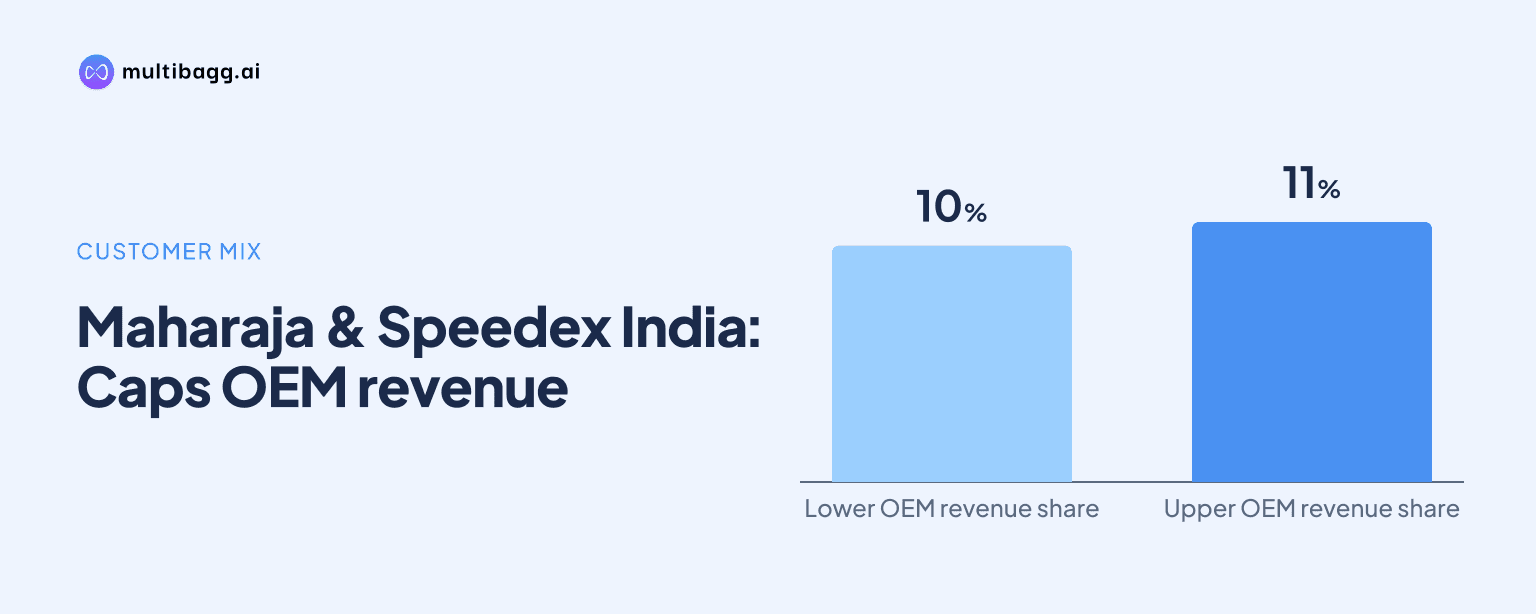
On its November 13, 2026 earnings call, Maharaja & Speedex India Limited said no original equipment manufacturer, or OEM, customer should contribute more than 10%-11% of revenue, although its original design manufacturing model supplies 100% of purchases for some online-focused brands and 15%-40% for legacy buyers.
Know Maharaja & Speedex India inside out
Results, valuation, peers and who's buying, in one view.
How does Speedex's ODM model work?
Speedex says its contract-manufacturing operation is original design manufacturing, or ODM, because it designs bottles internally and presents those products to buyers rather than generally producing a customer-provided design. Management said Speedex does not grant any buyer a monopoly over its bottle designs, allowing the same design to support ODM and own-brand sales.
The production model is designed around volume. Management said a run of about 35,000 to 40,000 pieces is needed to achieve economies of scale, and making fewer bottles would not be economically viable when operating above 90% efficiency. This threshold is why Speedex seeks designs that can be sold to more than one channel.
Management described a general planning assumption that about 50% of a newly designed bottle can be sold through ODM customers and the remaining 50% under the Speedex brand. It did not present that 50-50 split as the actual sales outcome for every product, but as the intended way to combine factory scale with its brand business.
What share of customer purchases does Speedex supply?
Speedex says it supplies between 15% and 100% of individual customers' purchasing, depending on the buyer and the product range. Management said some online-focused brands buy 100% of their supplies from Speedex because they use its specifically designed products, while legacy players buy basic products from other factories as well.
The 100% and 15%-40% figures describe buyer wallet share, not the contribution each customer makes to Speedex revenue. The comparison shows that online-focused customers can source their full requirement from Speedex, while legacy buyers use multiple suppliers for basic products and give Speedex a smaller portion of purchases.
Management said Speedex could raise its share at some lower-penetration customers to 40%-50% if it chose. However, that potential relates to the portion of a buyer's procurement that Speedex supplies, rather than the share of Speedex's own sales generated by that buyer.
Got a follow-up? Ask IRIS
Why is Speedex capping OEM customer concentration?
Speedex says it does not want any OEM customer to account for more than 10%-11% of its revenue, even where it could capture 40%-50% of that customer's purchases. Management described the limit as a conscious choice intended to restrict revenue dependence on a single OEM relationship.
The distinction matters because a customer can buy 100% of its products from Speedex without necessarily representing more than 10%-11% of Speedex revenue. Buyer wallet share measures procurement supplied to one customer, whereas customer concentration measures the portion of the company's total revenue received from that customer.
Speedex's non-exclusive design approach supports this policy. By retaining designs and targeting production runs of 35,000 to 40,000 pieces, it can sell similar products through several ODM relationships and its own brand instead of dedicating a design to one buyer. The call did not disclose the current revenue contribution of its largest OEM customer.
How is Speedex balancing OEM business with its own brand?
Speedex expects a 50-50 revenue split between OEM and its own brand in March, according to management's plan for that specific month. Management said it intends to carry the same mandate into the following year while increasing its own-brand presence where possible.
The own-brand plan includes increasing the offline distributor network to more than 150 distributors during the year. Management also said it aims for online business to contribute not less than 20% of monthly revenue by the end of the year by adding stock-keeping units, or SKUs, and selling through more platforms.
Speedex said it is present in more than 17 states but is prioritising deeper distribution in tier-two and tier-three cities rather than adding states immediately. Management said northern India is the target this year, with southern and western expansion expected by the end of the next year, while major pan-India marketing may begin after the first half of the next year.
Conclusion
Speedex's customer strategy combines high wallet shares in selected ODM relationships with a stated ceiling of 10%-11% of revenue from any one OEM customer. Its ability to supply 100% of some online-focused brands, versus 15%-40% for legacy players, reflects product and buyer differences rather than a uniform customer mix. The planned 50-50 OEM and own-brand split in March would broaden the sales base if management delivers it.
The next disclosed milestones are the target of more than 150 distributors this year, online sales of at least 20% of monthly revenue by year-end, and a potential major pan-India marketing programme after the first half of the next year. Future reporting on the largest customer's actual revenue contribution would show how the 10%-11% policy is operating in practice.