










Speedex targets 65% own-brand revenue within four years
Key highlights
- Speedex targets 65% of revenue from its own brand within three to four years, versus an implied current share of about 45-46%.
- Online sales rose from approximately 10% last year to 14.5% at the time of the H1 FY27 discussion.
- Speedex targets online sales of about 20-22% by the end of this year and around 30% by the end of next year.
- Speedex aims to increase own-brand distributors from 100 to more than 150 by the end of this year.
powered by IRIS
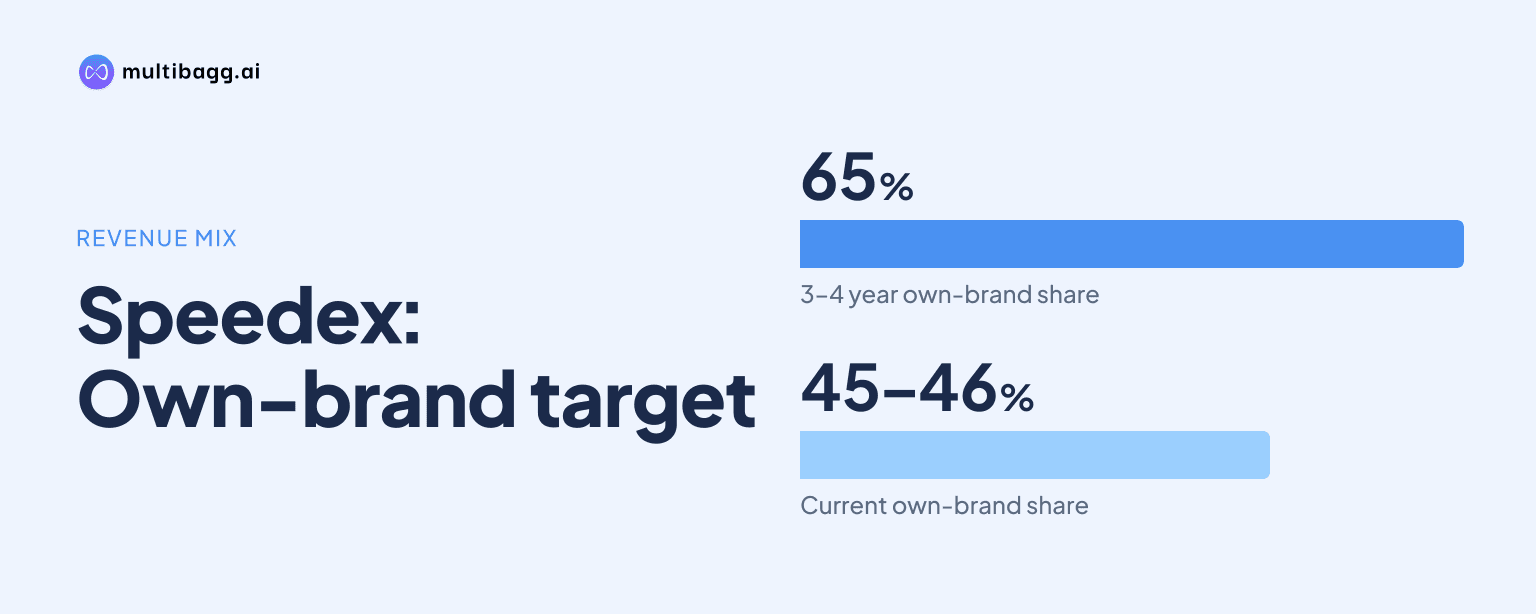
Speedex said in the first half (H1) of fiscal year 2027 (FY27) that it plans to lift own-brand sales to 65% of revenue within three to four years, from about 45-46%, while online sales had reached 14.5% of revenue from roughly 10% last year.
Know Maharaja & Speedex India inside out
Results, valuation, peers and who's buying, in one view.
How will Speedex change its revenue mix?
Speedex plans for its own brand to contribute 65% of revenue in the next three to four years, compared with approximately 45-46% currently. Original equipment manufacturing (OEM) and original design manufacturing (ODM) account for about 54-55% of the existing revenue mix, according to management.
The intended change is a rebalancing rather than an exit from OEM and ODM. Management said Speedex would continue serving third-party manufacturing customers while building its own brand through online, offline and, eventually, modern-trade channels. It said Speedex has more than 50 OEM and ODM customers and does not allow any one OEM customer to account for more than 10-10.5% of revenue.
Management gave a shorter timeframe in a separate response, saying it intended to reduce OEM and ODM's share to about 35% over the next two to three years. That target is consistent with the longer-term objective of raising own-brand sales to 65%, while retaining third-party manufacturing as a material sales channel.
Speedex's own-brand sales are not solely business-to-consumer (B2C) transactions. Management said most branded sales arise through its dealer and distributor network, while approximately 15-16% of own-brand sales come through the online B2C network. The mix target therefore depends on expanding both physical distribution and digital sales.
Why is Speedex increasing online sales?
Speedex is targeting online sales of approximately 20-22% of monthly business by the end of this year and around 30% by the end of next year. Online sales represented 14.5% of revenue at the time of the H1 FY27 discussion, up from approximately 10% of total business in the prior year.
Management said online sales generated an earnings before interest, tax, depreciation and amortisation (EBITDA) margin of around 21% in H1. That compared with approximately 20% for own-brand distributor-network sales and about 18% for OEM business, making online the highest-margin channel among the three figures disclosed.
Management said it would direct additional EBITDA margin generated through scale into brand marketing. It indicated that EBITDA margin could remain around 19-19.5% over the long run, even as it increases marketing expenditure to support the own-brand strategy.
The online expansion starts from three platforms: Amazon, Flipkart and Blinkit. Speedex said it had not yet launched its full product range across those channels and planned to complete those category launches by the end of the next quarter, while also pursuing listings on other platforms.
Management also cited an interim objective of online sales reaching about 25% of total revenue by the middle of next year. That milestone sits between the 20-22% year-end target and the approximately 30% target for the end of next year, with broader listings intended to support the progression.
Got a follow-up? Ask IRIS
How will distributors support Speedex's own brand?
Speedex aims to increase its own-brand distributor base from 100 to more than 150 by the end of this year. Management said these additions are intended to deepen distribution in Tier 2 and Tier 3 cities, extending the company beyond its existing reach in larger markets.
Speedex uses a three-month maturity test before counting a newly appointed distributor in its reported total. Management said a distributor added today is not included immediately, but is counted after operating for three months, so the more-than-150 target refers to relationships it considers established.
The distributor channel remains important because it generates the majority of own-brand sales, whereas online B2C activity represented about 15-16% of branded sales. The plan therefore combines distributor additions with an increase in online sales from 14.5% of total revenue toward 20-22% by the end of this year.
Management also identified modern trade as an untapped future channel. Speedex said it has no modern-trade business currently and expects to focus on it after capacity rises, following efforts to strengthen online and offline distribution for its own brand.
Can Speedex support the channel expansion with capacity?
Speedex said annual production capacity had increased from 62-63 lakh units to 72 lakh units through internal accruals and is planned to rise from 72 lakh units to 103 lakh units. Management said the 103 lakh-unit annual capacity could support revenue of about Rs 23 crore to Rs 24 crore per month, referring to total capacity rather than only the incremental addition.
Management's ballpark target is to increase capacity by about 40% annually and revenue by at least 50%. In H1 FY27, revenue grew 36% year on year, but management said it expected full-year revenue growth of more than 45% after a first-quarter facility shift and an approximately two-month ramp-up for capacity installed at the end of February.
Speedex said it starts installing an additional production line once existing facilities reach around 85-90% efficiency. Management said an additional line generally takes four to five months to install and estimated capacity could increase by a further 30-40% from the planned 103 lakh-unit level with minor modifications and about Rs 20 crore to Rs 25 crore of additional funding.
OEM and ODM demand is part of management's capacity rationale, although it said incremental capacity could be absorbed by both its own brand and third-party manufacturing. Management cited requests from customers for 30-50% of Speedex's capacity while maintaining a limit of about 10-11% of revenue for any single customer.
Conclusion
Speedex's disclosed strategy is to shift a business currently led by OEM and ODM, at about 54-55% of revenue, toward a 65% own-brand mix over three to four years. Online sales are a key part of that change because they rose from about 10% last year to 14.5% and delivered the highest disclosed H1 EBITDA margin, at around 21%, compared with 20% for distributor-led own-brand sales and 18% for OEM.
The next points to watch are Speedex's targets of more than 150 distributors by the end of this year, online sales of 20-22% by that point and around 30% by the end of next year. Management also plans to complete category launches on Amazon, Flipkart and Blinkit by the end of the next quarter, while further capacity additions would depend on facilities reaching 85-90% efficiency.