










Maharaja & Speedex: OEM leads its integrated drinkware model
Key highlights
- Maharaja & Speedex reported 54.9% of FY26 revenue from OEM work and 41.8% from the Speedex brand.
- Maharaja & Speedex said 88.9% of output was made in-house through two Sonipat units.
- Maharaja & Speedex had more than 220 SKUs and 101 distributors across 17 states and two Union Territories.
- Maharaja & Speedex reported H1 FY27 revenue of Rs 78.5 crore, up 36% year on year.
powered by IRIS
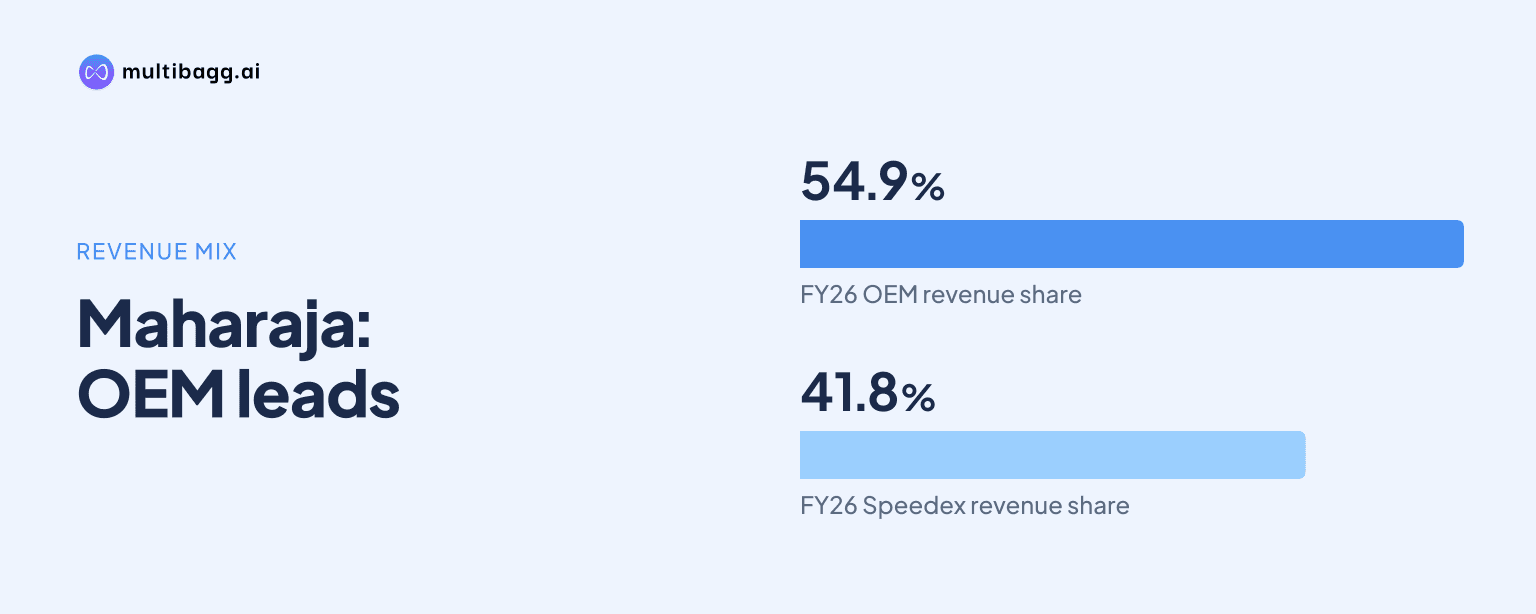
Maharaja & Speedex India Limited’s integrated model combined OEM sales representing 54.9% of FY26 revenue, its Speedex brand at 41.8%, and 88.9% in-house manufacturing through two Sonipat units. The company also reported 101 distributors, online sales through Amazon and Blinkit, and coverage of 17 states plus two Union Territories.
Know Maharaja & Speedex India inside out
Results, valuation, peers and who's buying, in one view.
What is Maharaja & Speedex’s integrated drinkware model?
Maharaja & Speedex combines four stated functions: the Speedex own brand, private-label original equipment manufacturing, or OEM, in-house production and omnichannel distribution. In FY26, Speedex served mass, premium and lifestyle price points, while the OEM business supplied private-label products to traditional and legacy players.
Manufacturing is undertaken through two Sonipat units operated by subsidiary Dewdrop Bottles, with 88.9% of output made in-house. The company’s distribution network included 101 distributors, plus Amazon and Blinkit sales through Speedex Online, spanning 17 states and two Union Territories. This structure places product creation, production and routes to market within the same platform.
Maharaja & Speedex also describes itself as an original design manufacturer, or ODM, rather than only an OEM supplier. Under that model, brands and distributors can select Maharaja & Speedex designs and source products from the company; the presentation says more than 50 brands use it to make their products.
How was Maharaja & Speedex’s FY26 revenue divided?
OEM work was Maharaja & Speedex’s larger disclosed FY26 revenue stream at 54.9%, compared with 41.8% from the Speedex own brand. The difference was 13.1 percentage points, showing that private-label sales exceeded the disclosed contribution from branded consumer products during FY26.
The two disclosed shares total 96.7% of FY26 revenue. Maharaja & Speedex does not identify the remaining 3.3% on its business-overview page, so the presentation does not establish whether that amount reflects another activity or a categorisation difference.
Maharaja & Speedex reported revenue from operations of Rs 78.5 crore in H1 FY27, against Rs 57.6 crore in H1 FY26 and Rs 65 crore in H2 FY26. That represented 36% year-on-year growth and 21% half-on-half growth, but the presentation does not assign the increase between OEM, Speedex or other activities.
How does Maharaja & Speedex link design to manufacturing?
Maharaja & Speedex says its ODM role allows brands and distributors to choose products from its own designs and intellectual property, or IP. The company cites sourcing trips as its mechanism for identifying fresh designs and says it has more than 220 stock-keeping units, or SKUs, across five drinkware categories.
Those categories are vacuum-insulated products, everyday bottles, kids and infants products, gym and serveware, and premium gifting. The listed product range runs from 60 millilitres to 2.2 litres, while the kids and infants range includes five patented feeding-bottle designs. Maharaja & Speedex also says these feeding-bottle products are certified by the Bureau of Indian Standards, or BIS.
Maharaja & Speedex says its production lines have been refined for five years and automate repeat work to improve consistency and output per shift. Management says its lines are about three years ahead of industry peers, a company assertion not independently benchmarked in the presentation, and says moulds and standard operating procedures enable new lines to become productive in four to five months.
The company’s 88.9% in-house manufacturing rate connects this design process to both Speedex products and OEM customer orders. However, Maharaja & Speedex does not disclose separate unit economics, revenue or margins for own-brand, OEM and ODM activities, so their individual financial contributions cannot be determined from the presentation.
Got a follow-up? Ask IRIS
What products, channels and capacity support Maharaja & Speedex?
Maharaja & Speedex supports its model with more than 220 SKUs, 101 distributors and a plan to reach 103 lakh units of annual installed capacity by March 2027. Its catalogue includes double-wall vacuum bottles and flasks, single-wall steel bottles, feeding bottles and food jars, shakers and tumblers, travel mugs, carafes and customised corporate-gifting products.
Installed capacity rose from 48 lakh units a year in January 2026 to 63 lakh units in March 2026, and then to 72 lakh units in November 2026. Maharaja & Speedex plans a further increase to 103 lakh units by March 2027, consisting of a 9-lakh-unit addition from internal accruals and 31 lakh units of initial public offering-funded lines.
Management links the added equipment to removing production bottlenecks and lifting output. The Rs 23 crore monthly revenue run-rate shown for March 2027 is a management projection rather than reported revenue, and the presentation identifies project execution, raw-material prices, consumer demand, competition and working-capital needs as factors that could affect results.
How has Maharaja & Speedex’s financial output changed?
Maharaja & Speedex reported H1 FY27 revenue from operations of Rs 78.5 crore, earnings before interest, tax, depreciation and amortisation, or EBITDA, of Rs 15.1 crore, and profit after tax, or PAT, of Rs 9.9 crore. Against H1 FY26, revenue rose 36%, EBITDA rose 52% and PAT rose 50%.
EBITDA margin was 19.2% in H1 FY27, compared with 17.2% in H1 FY26, an increase of 2 percentage points. H1 FY27 revenue also equalled 64% of FY26 full-year revenue of Rs 122.7 crore, although Maharaja & Speedex does not attribute the revenue or margin changes to any particular product category, customer channel or manufacturing initiative.
Compared with H2 FY26, H1 FY27 revenue increased from Rs 65 crore to Rs 78.5 crore, while EBITDA rose from Rs 12.5 crore to Rs 15.1 crore. PAT increased from Rs 8.5 crore in H2 FY26 to Rs 9.9 crore in H1 FY27, but the presentation does not provide segment-level profitability for OEM and Speedex sales.
Conclusion
Maharaja & Speedex’s disclosed FY26 mix shows an operating model broader than either branded drinkware sales or contract manufacturing alone: OEM represented 54.9% of revenue, Speedex represented 41.8%, and 88.9% of output was made internally. Its 220-plus SKU range, two Sonipat units and 101-distributor network provide the design, manufacturing and distribution components of that structure.
The next disclosed milestone is annual installed capacity of 103 lakh units by March 2027, including 31 lakh units of initial public offering-funded lines, alongside a projected Rs 23 crore monthly revenue run-rate. The key matter to watch is the execution and ramp-up of those lines, given management’s stated risks around raw-material prices, demand, competition and working-capital requirements.