










Wakefit repeat buyers generated 33.8% of H1FY27 revenue
Key highlights
- Wakefit repeat customers contributed 33.8% of revenue from operations in H1FY27, versus 35.3% in FY26.
- Existing customers represented 26.8% of Wakefit furnishings customers in H1FY27, up from 24.2% in FY26.
- Wakefit's own channels accounted for 71% in H1FY27, compared with 67% in FY26.
- Wakefit operated 205 COCO stores as of 30 September 2026, up from 139 in FY26.
powered by IRIS
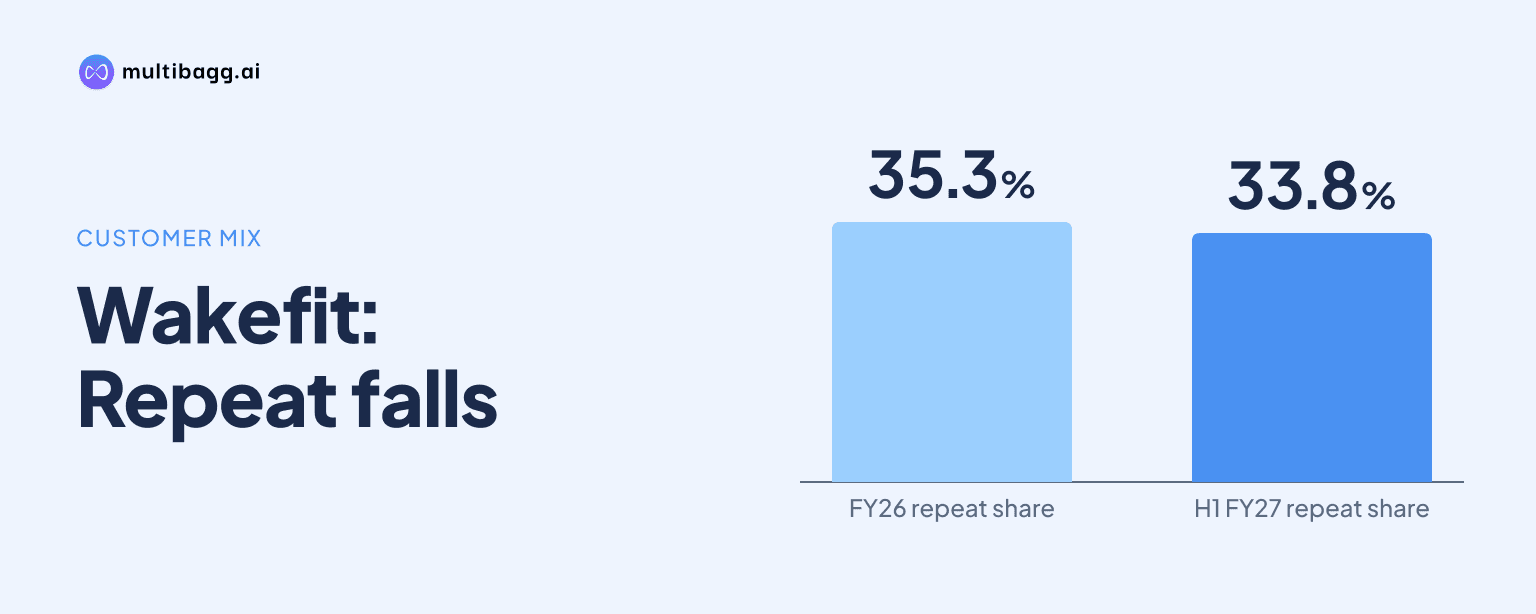
Wakefit reported that repeat customers contributed 33.8% of revenue from operations in H1FY27, measured as of 30 September 2026, compared with 35.3% in FY26. Existing customers also accounted for 26.8% of furnishings customers, up from 24.2%, showing greater disclosed cross-category participation in that segment.
Know Wakefit Innovations inside out
Results, valuation, peers and who's buying, in one view.
How much revenue did repeat customers contribute to Wakefit?
Repeat customers contributed 33.8% of Wakefit revenue from operations in H1FY27, 1.5 percentage points below the 35.3% reported for FY26. The H1FY27 share nevertheless exceeded the 28.9% reported in FY25, 29.8% in FY24 and 26.3% in FY23. The disclosed trend shows an increase in repeat-customer revenue contribution between FY23 and FY26, followed by a lower share in the first half of FY27.
Wakefit presents repeat engagement as part of a single-brand platform spanning mattresses, sleep solutions, furnishings and décor, and furniture. The company links this model to repeat sales, cross-selling, higher average order value, or AOV, and customer lifetime value. However, it does not disclose repeat-customer revenue in rupees, order frequency, AOV by customer cohort or customer lifetime value.
The comparison has a period limitation. FY26 is a full-year measure, whereas H1FY27 is a half-year figure measured as of 30 September 2026. As a result, the 33.8% statistic does not establish Wakefit's full-year FY27 repeat-revenue contribution or the absolute change in revenue generated by returning customers.
Is Wakefit cross-selling into furnishings and furniture?
Wakefit reported that 26.8% of furnishings customers in H1FY27 were existing customers of other categories, up 2.6 percentage points from 24.2% in FY26. This was the clearest disclosed increase in cross-category customer participation. More than one quarter of furnishings customers during the half year had previously bought another Wakefit category under the company's definition.
Furniture recorded a different movement. Existing customers of other categories represented 18.2% of furniture customers in H1FY27, compared with 18.4% in FY26, a 0.2-percentage-point decline. The furniture measure was 8.6 percentage points below the 26.8% furnishings measure, although Wakefit did not disclose customer numbers, prior purchase categories or revenue from cross-sold orders.
Wakefit's revenue mix remained led by mattresses, whose share increased to 63.7% in H1FY27 from 61.4% in FY26. Furniture accounted for 29.0%, down from 29.3%, while furnishings accounted for 7.3%, down from 9.3%. Therefore, the increase in existing-customer participation in furnishings occurred while furnishings' overall revenue mix declined by 2.0 percentage points.
Got a follow-up? Ask IRIS
Which channels support Wakefit's repeat-customer strategy?
Wakefit's own channels accounted for 71% in H1FY27, up from 67% in FY26, while external channels accounted for 29%, down from 33%. The company classifies COCO stores, its website and app as own channels. Multi-brand outlets, marketplaces and quick-commerce platforms form the external-channel group.
The COCO network reached 205 active stores across 137 cities, 22 states and three union territories as of 30 September 2026. The store count rose from 139 in FY26, 105 in FY25, 56 in FY24 and 23 in FY23. Wakefit says these stores offer product trials and hands-on interaction, and that COCO regular users have a higher AOV than website users, without disclosing either AOV figure.
External distribution also remained extensive, with 2,589 multi-brand outlet stores across 787 cities and 27 states or union territories as of 30 September 2026. Wakefit describes its customer journey as moving from discovery and in-store trial or online comparison to a purchase offline or online. The presentation does not quantify whether customers who begin in one channel subsequently purchase through another.
What infrastructure supports Wakefit's category expansion?
Wakefit operates five manufacturing facilities with total built-up area of more than 6.99 lakh square feet. Its largest site is the Hosur, Tamil Nadu facility for wood furniture, sofas and chairs, at 3.45 lakh square feet. Other facilities include a 1.25 lakh-square-foot Hosur mattress plant and a 1.21 lakh-square-foot Sonipat, Haryana site making mattresses and sofas.
The company says its manufacturing system uses robotic arms, roller belts, computer numerical control, or CNC, equipment and the Every Part Every Interval process to minimise wastage. Its product-development sequence includes conceptualisation, engineering, prototyping, two quality-control stages, production, pilot activity and launch. Wakefit does not quantify manufacturing capacity, wastage reduction or the contribution of individual facilities to category revenue.
Its logistics network comprised one 1.60 lakh-square-foot mother warehouse in Hosur, 10 inventory-holding points of 10,000 to 55,000 square feet, and 26 delivery points of 800 to 5,600 square feet as of 30 September 2026. Inventory points hold mattresses and marketplace-serviced categories, while delivery points act as last-mile hubs and bases for furniture installers. This network covers the company's mattress, furniture and accessories assortment.
Wakefit also lists the Zense SleepTech range, the Regula mattress temperature controller and the Track8 contactless sleep tracker among product initiatives. It said it was pilot testing personalised-mattress technology using firmness-customisation techniques. No launch date, sales target or forecast contribution from that pilot was disclosed.
Conclusion
Wakefit's 33.8% repeat-customer revenue contribution in H1FY27 indicates that returning buyers remained an important part of revenue from operations, despite the 1.5-percentage-point decline from FY26. Cross-category participation was higher in furnishings, where 26.8% of customers were existing buyers from other categories, than in furniture, where the comparable measure was 18.2%. Mattresses also increased to 63.7% of revenue mix in H1FY27.
The next disclosures to watch are whether Wakefit's planned expansion of COCO stores and website sales changes the 71% own-channel share, and whether data-driven category expansion lifts existing-customer participation in furniture and furnishings. Management's road map includes increasing customer lifetime value, brand salience and technology use for customer experience and operational efficiency, but it provides no numerical targets or timetable for these objectives.