










Wakefit Q2 revenue hits record Rs 451.99 crore despite later festival
Key highlights
- Wakefit reported record Q2 FY27 revenue of Rs 451.99 crore, up 19.9% year on year.
- Q2 FY27 gross margin declined to 53.9% from 57.7% as Polyol and TDI prices increased.
- Operating EBITDA rose 25.8% to Rs 30.50 crore and its margin increased to 6.7%.
- Wakefit had 205 COCO stores on 30 September 2026 after opening 41 in Q2 FY27.
powered by IRIS
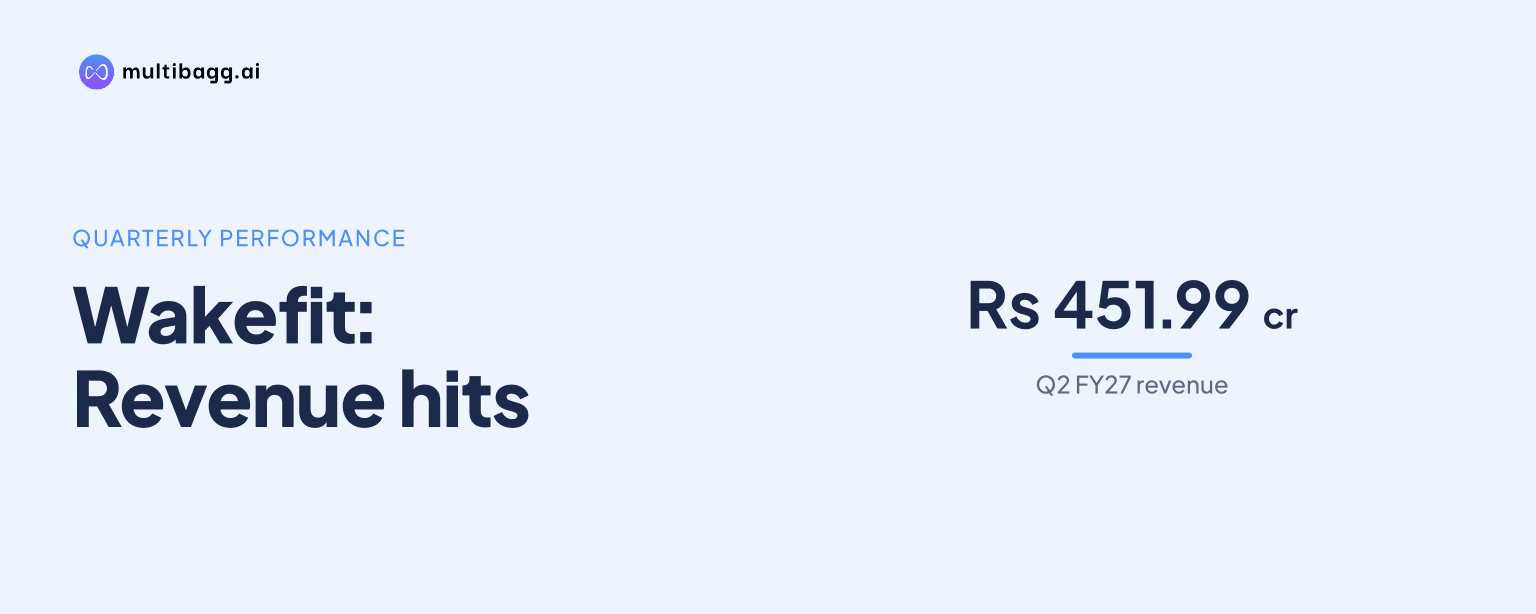
Wakefit Innovations Limited reported record Q2 FY27 revenue from operations of Rs 451.99 crore, up 19.9% year on year, despite festive sales beginning in the second week of October rather than late September a year earlier. Wakefit’s gross margin fell 3.8 percentage points to 53.9% as Polyol and TDI costs increased.
Know Wakefit Innovations inside out
Results, valuation, peers and who's buying, in one view.
Why did Wakefit report record Q2 FY27 revenue?
Wakefit reported record quarterly revenue because revenue from operations reached Rs 451.99 crore in Q2 FY27, compared with Rs 376.88 crore in Q2 FY26. Management said the festive selling season started in the second week of October in FY27, versus the last week of September a year earlier, shifting festive demand from Q2 into Q3.
The calendar movement means the two quarterly periods did not contain the same timing of festive demand. Management said H1 FY27 performance, viewed alongside Q3, would provide a better measure of underlying business momentum. H1 FY27 revenue reached Rs 856.90 crore, up 18.4% from Rs 724.00 crore in H1 FY26.
Mattress revenue grew 21.4% year on year in Q2 FY27, while furniture revenue grew 24.9%, according to management. Mattresses accounted for 62% of Q2 revenue, up from 61% in Q2 FY26, and furniture’s share rose to 30% from 28%; furnishings and décor declined to 8% from 11%.
How did raw-material costs affect Wakefit’s gross margin?
Wakefit’s gross margin declined because cost of goods sold rose faster than gross profit in Q2 FY27. Cost of goods sold increased to Rs 208.43 crore from Rs 159.43 crore, while gross profit rose 12.0% to Rs 243.56 crore from Rs 217.45 crore, resulting in a gross margin of 53.9% versus 57.7% a year earlier.
Management attributed the margin decline to elevated crude-linked Polyol and toluene diisocyanate, or TDI, prices, including further increases in recent months. It also cited geopolitical disruptions in West Asia that affected raw-material availability and logistics across the industry. Wakefit said it made calibrated price increases over the last two quarters to balance affordability with absolute profitability.
The half-year comparison showed a smaller margin change. H1 FY27 gross profit increased 15.5% to Rs 474.65 crore from Rs 411.07 crore, but gross margin declined to 55.4% from 56.8%. The Q2 FY27 margin was therefore 1.5 percentage points below the H1 FY27 margin.
What happened to Wakefit’s operating profit and net profit?
Wakefit increased reported earnings before interest, tax, depreciation and amortisation, or EBITDA, excluding other income, by 21.5% to Rs 50.15 crore in Q2 FY27. Profit before tax rose 66.3% to Rs 26.54 crore, while reported profit after tax, or PAT, was Rs 15.89 crore compared with Rs 15.96 crore in Q2 FY26 after the company began recording tax in FY27.
Operating EBITDA, defined by Wakefit as EBITDA before Ind AS 116 lease adjustments, employee stock option plan charges, and specified non-operating or one-time items, reached Rs 30.50 crore. Its margin increased to 6.7% from 6.4%, while reported EBITDA margin excluding other income edged up to 11.1% from 11.0%.
The difference between reported PAT and PAT excluding deferred tax was significant in Q2 FY27. Wakefit recorded a deferred-tax charge of Rs 6.43 crore, compared with Rs 52 lakh in Q2 FY26, and said the charge was non-cash, driven by timing differences and the unwinding of deferred tax assets on carried-forward losses. PAT excluding deferred tax rose to Rs 22.32 crore, or 4.9% of revenue, from Rs 15.96 crore, or 4.2%.
For H1 FY27, operating EBITDA increased 39.0% to Rs 67.33 crore and its margin rose to 7.9% from 6.7%. Employee-benefit expense rose 30.0% year on year to Rs 54.53 crore in Q2 FY27, which Wakefit attributed to leadership and network hiring, annual salary revisions and Rs 2.55 crore of employee stock option costs.
Got a follow-up? Ask IRIS
How are Wakefit’s channels and store network changing?
Wakefit is deriving a larger share of sales from its own channels while expanding its physical network. Own channels contributed 71.1% of H1 FY27 revenue and represented 70% of Q2 FY27 sales, compared with 60% in Q2 FY26. External channels consequently accounted for 30% of quarterly sales, down from 40% a year earlier.
Repeat customers contributed 32.4% of Q2 FY27 revenue, according to management. At the category level, H1 FY27 revenue mix was 64% mattresses, 29% furniture and 7% furnishings and décor, compared with 61%, 29% and 10%, respectively, in H1 FY26.
Wakefit added 41 company-owned, company-operated, or COCO, stores in Q2 FY27 and 68 in H1 FY27, reaching 205 active COCO stores across 137 cities as of 30 September 2026. Its multi-branded outlet network increased to 2,589 stores across 787 towns and cities from 2,250 stores across 701 towns and cities in June 2026.
Management said planned FY27 capital expenditure of about Rs 100 crore to Rs 120 crore remained on track, with about 80% allocated to retail expansion, particularly the jumbo-store format. Construction of Wakefit’s first jumbo store in Bengaluru was progressing, and management targeted a Q2 FY28 launch. The presentation also reported retail-channel growth of about 24% in Q2 FY27 and 22% in H1 FY27.
Conclusion
Wakefit’s Q2 FY27 result combined record revenue of Rs 451.99 crore with higher operating EBITDA and profit before tax, even as festive demand shifted beyond the quarter. The principal trade-off was gross margin: revenue increased 19.9%, but margin declined to 53.9% as higher Polyol and TDI costs lifted cost of goods sold faster than gross profit.
The next period to watch is Q3 FY27, when management expects the later festive demand to be reflected. Management’s disclosed milestones include executing its Rs 100 crore to Rs 120 crore FY27 capital-expenditure plan, with about 80% directed to retail expansion, and opening the Bengaluru jumbo store in Q2 FY28.