










Wakefit targets Rs 100-120 crore FY27 retail expansion capex
Key highlights
- Wakefit plans around Rs 100-120 crore of FY27 capital expenditure, with approximately 80% allocated to retail expansion.
- Wakefit added 68 COCO stores in H1FY27 and had 205 active outlets across 137 cities at 30 September 2026.
- Owned channels contributed 71.1% of Wakefit's H1FY27 revenue, compared with 65% in H1FY26.
- Wakefit reported H1FY27 revenue of Rs 856.90 crore, up 18.4% year on year.
powered by IRIS
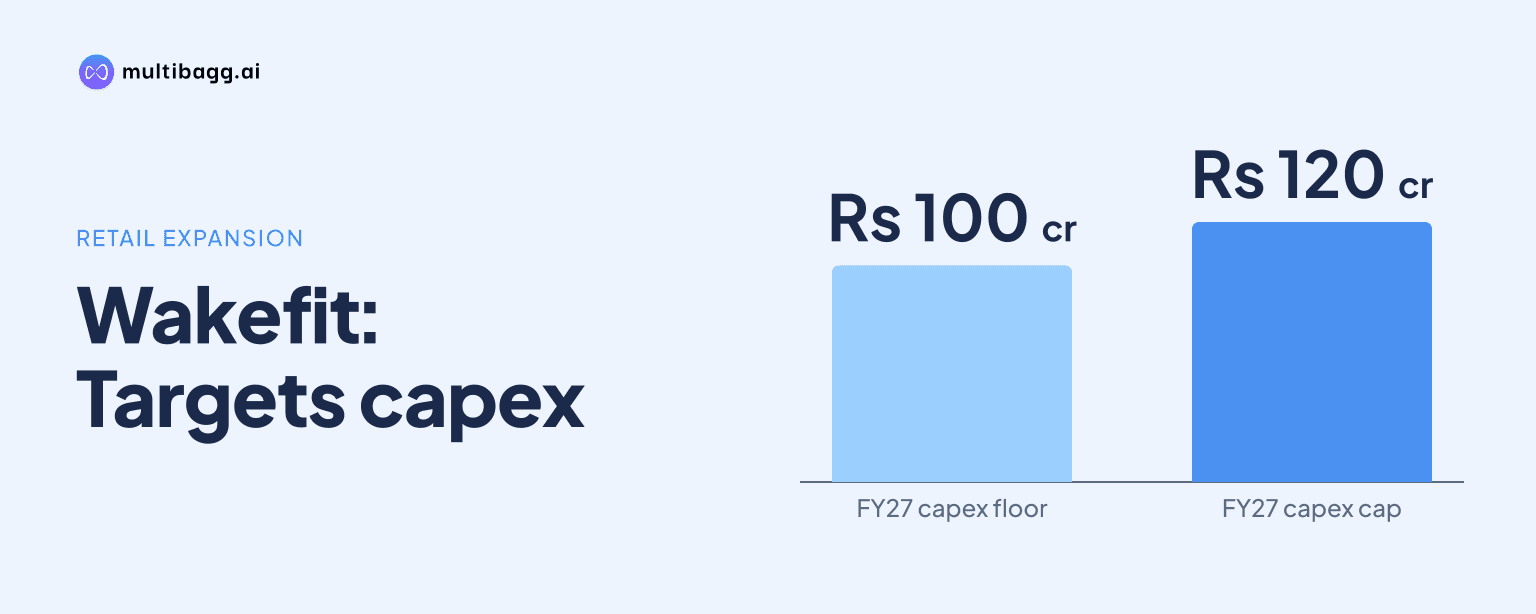
Wakefit plans about Rs 100-120 crore of capital expenditure in FY27, with approximately 80% directed to retail expansion, after adding 68 COCO stores in H1FY27 and reaching 205 active outlets across 137 cities as of 30 September 2026. Management is targeting a Q2 FY28 launch for its first Bengaluru jumbo store.
Know Wakefit Innovations inside out
Results, valuation, peers and who's buying, in one view.
How much will Wakefit spend on FY27 retail expansion?
Wakefit plans FY27 capital expenditure of around Rs 100-120 crore, and management says approximately 80% will be allocated to retail expansion, particularly its jumbo-store format. The presentation does not provide a project-level capital split by city, store format or individual outlet, but identifies retail as the principal use of the FY27 programme.
Management said construction of Wakefit's first jumbo store in Bengaluru is progressing and that it is targeting a Q2 FY28 launch. The stated timeline makes the Bengaluru opening the next disclosed physical-retail milestone after the network reached 205 COCO stores at 30 September 2026.
The retail allocation comes alongside Wakefit's existing manufacturing base of five facilities with more than 6.99 lakh square feet of total built-up area. Those facilities cover mattresses, sofas, wood furniture, chairs, accessories, fabrication and research and development activities across Sonipat, Bengaluru and Hosur.
How fast did Wakefit's COCO store network expand?
Wakefit added 68 COCO stores in H1FY27, including 41 additions in Q2FY27, taking its active network to 205 outlets as of 30 September 2026. The network then covered 137 cities in 22 states and three Union Territories, according to the presentation.
The store base has risen from 23 COCO stores in FY23 to 56 in FY24, 105 in FY25, 139 in FY26 and 205 in H1FY27. The increase of 66 outlets between the FY26 and H1FY27 reported closing counts shows the scale of the six-month expansion, while management separately reported 68 store additions during H1FY27.
Wakefit describes COCO stores as experience centres where customers can trial products and engage with trained staff. The company says average order value, or AOV, is higher for COCO regular users than for website users, although it does not disclose either AOV amount, the number of comparable users or the size of the difference.
Management has identified productivity at existing stores as a focus alongside expanding the retail network and product catalogue. The presentation reports retail-channel growth of about 24% in Q2FY27 and about 22% in H1FY27, but does not disclose revenue per store, store-level profit or store payback periods.
What share of Wakefit revenue comes from owned channels?
Wakefit's owned channels contributed 71.1% of H1FY27 revenue, according to management, compared with 65% in H1FY26 and 67% in FY26. The channel-mix table rounds the H1FY27 share to 71%, while external channels represented the remaining 29%.
Owned channels include the 205 COCO stores, Wakefit's website and its app. External channels include multi-branded outlets, marketplaces and quick-commerce platforms, giving the company both direct sales routes and third-party distribution points.
The external physical network remained larger by outlet count. Wakefit had 2,589 multi-branded outlets, or MBOs, across 787 cities at 30 September 2026, compared with 2,250 outlets across 701 cities as of June 2026.
Category mix also shifted in H1FY27. Mattresses accounted for 64% of sales, up from 61% in H1FY26, furniture remained at 29%, and furnishings and décor declined to 7% from 10%; management said Q2FY27 mattress revenue grew 21.4% year on year and furniture revenue increased 24.9%.
Got a follow-up? Ask IRIS
What financial results accompany Wakefit's retail plan?
Wakefit reported revenue from operations of Rs 856.90 crore in H1FY27, up 18.4% from Rs 724 crore in H1FY26. Q2FY27 revenue was Rs 451.99 crore, up 19.9% from Rs 376.88 crore, which management described as the company's highest-ever quarterly revenue.
Operating earnings before interest, tax, depreciation and amortisation, or operating EBITDA, increased 39.0% to Rs 67.33 crore in H1FY27 from Rs 48.43 crore a year earlier. The operating EBITDA margin rose to 7.9% from 6.7%, while gross margin declined to 55.4% from 56.8% as cost of goods sold increased to Rs 382.26 crore from Rs 312.94 crore.
Profit before tax increased 76.7% to Rs 62.85 crore in H1FY27 from Rs 35.57 crore in H1FY26. Reported profit after tax, or PAT, rose 10.4% to Rs 39.27 crore, while PAT excluding deferred tax rose 49.0% to Rs 53 crore from Rs 35.57 crore.
Wakefit recorded tax of Rs 23.58 crore in H1FY27, compared with no tax in H1FY26. The company reported a deferred-tax charge of Rs 13.73 crore for the half year and said the movement reflected the reversal of timing differences and the unwinding of deferred-tax assets on carried-forward losses.
What could affect Wakefit's store rollout and margins?
Wakefit said crude-linked raw materials, particularly Polyol and TDI, remained elevated in Q2FY27, with further price increases in recent months. Management said geopolitical disruption in West Asia affected raw-material availability and industry logistics, and that Wakefit made calibrated price increases over the last two quarters.
The cost pressure coincided with a Q2FY27 gross margin of 53.9%, down from 57.7% in Q2FY26, although gross profit increased 12.0% to Rs 243.56 crore. Employee-benefit expense rose 30.0% to Rs 54.53 crore in Q2FY27, including Rs 2.55 crore of employee stock option plan expense against Rs 0.36 crore a year earlier.
Repeat customers contributed 33.8% of revenue in H1FY27, compared with 35.3% in FY26 and 28.9% in FY25. In Q2FY27, management separately reported that repeat customers contributed 32.4% of revenue, while Wakefit said it had crossed 1 crore lifetime orders.
Quarterly comparisons are also affected by festive timing, according to management. Festive sales started in the last week of September in the prior year but began in the second week of October in the current year, shifting festive demand to Q3FY27; management said H1FY27 should be assessed together with Q3FY27 for underlying business momentum.
Conclusion
Wakefit's Rs 100-120 crore FY27 capital plan places physical retail at the centre of its expansion, with around 80% allocated to store growth and jumbo formats. The strategy follows 68 COCO additions in H1FY27, a 205-store network, Rs 856.90 crore of half-year revenue and a rise in owned channels to 71.1% of sales.
The next disclosed event is the targeted Q2 FY28 opening of Wakefit's first Bengaluru jumbo store. Investors can watch the pace of COCO additions after the 41 stores opened in Q2FY27, management's stated effort to improve existing-store productivity, and the effect of Polyol and TDI costs on gross margin.