










Manipal Plans About 650 Beds Before Mumbai Starts in FY29
Key highlights
- Manipal plans about 650 additional beds through FY28, including 100 Kinder beds beyond its 550-bed core programme.
- Manipal expects 440-500 H2 beds from greenfield and brownfield projects.
- Manipal said major Mumbai capacity additions will begin from FY29.
- Manipal's aggregate occupancy rose to 70.7% in Q2 from 65% in Q1.
powered by IRIS
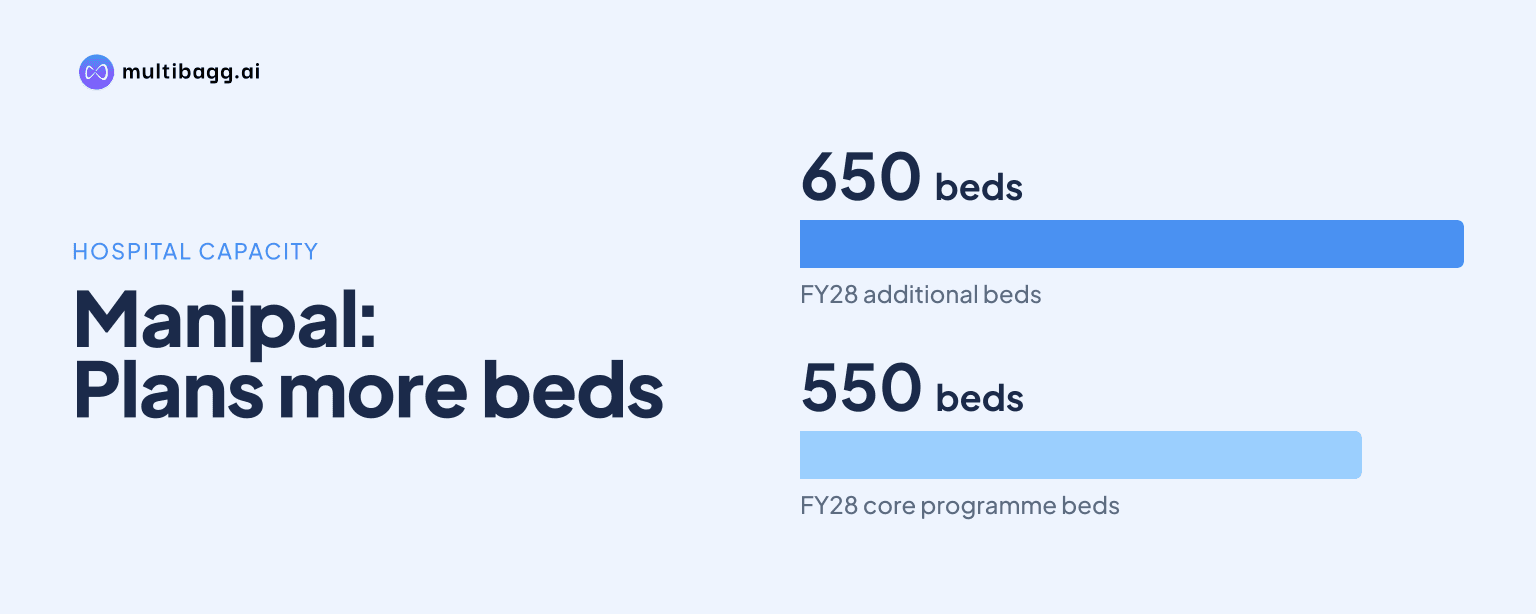
Manipal Hospitals plans about 650 additional beds through FY28, including 440-500 beds in H2, before its larger Mumbai capacity additions begin from FY29. Management said the near-term plan comprises around 550 beds across H2 and FY28, plus a separate 100-bed Kinder project due by the end of Q2 FY28.
Know Manipal Health Enterprises inside out
Results, valuation, peers and who's buying, in one view.
How many beds will Manipal add through FY28?
Manipal plans about 650 additional beds through FY28, based on management's approximately 550-bed H2-plus-FY28 programme and a separate 100-bed Kinder addition. Management said the 550 beds were part of its planned additions, while Kinder was over and above that figure and is expected by the end of Q2 FY28.
The programme is weighted toward H2 rather than FY28. Management expects 440-500 beds in H2 through greenfield and brownfield projects, followed by around 100 beds from a brownfield project in FY28. The stated H2 range and FY28 project add up broadly to the approximately 550-bed total disclosed for both periods.
The figures are approximate rather than a final project-by-project schedule. The key distinction is that the Kinder facility is not included in the 550-bed plan, which takes the disclosed near-term capacity programme to about 650 beds through FY28.
When will Manipal's larger Mumbai expansion begin?
Manipal said its major capacity additions will start coming from FY29, when Mumbai comes on stream. Management did not disclose a bed count, construction milestone or specific commissioning date for Mumbai during the call.
This schedule separates the roughly 650 beds planned through FY28 from the next expansion phase. H2 greenfield and brownfield additions, the FY28 brownfield project and Kinder are the identified nearer-term contributors, while Mumbai is the stated driver of larger additions from FY29.
Management's comments establish a timing marker but not a quantified Mumbai pipeline. Readers therefore have disclosed bed figures for the H2 and FY28 programme, but not a basis to calculate the size of the FY29 Mumbai contribution.
Which projects will add beds before FY28 ends?
Manipal expects to add around 50 beds at Hadapsar in Q3 of the current financial year, after reporting no additional beds in the Sahyadri cluster during Q2. The Hadapsar capacity is therefore a pending Q3 addition rather than beds already operating during Q2.
The company also said the Nashik Lenad block had been added in March of the previous year. That places Nashik capacity before the current Q2 period, unlike Hadapsar, and shows why the H2 range should not be interpreted as beds that were already available at the end of Q2.
A Raipur greenfield hospital is expected to come on stream in Q4 of the current year. Management described continued interest in Tier 2 and Tier 3 markets, citing Mysore, Mangalore, Patiala, Rangapani and Siliguri, but did not disclose a separate bed count for Raipur or those locations in this call.
Got a follow-up? Ask IRIS
Does Manipal have room to grow before new beds open?
Manipal reported aggregate occupancy of 70.7% in Q2, up from 65% in Q1, without additional capital expenditure to build capacity. Management said it sees aggregate occupancy of around 80% as achievable, suggesting existing facilities can absorb further patient volumes before more capacity investment is required.
Some beds at newer greenfield hospitals, including Kanakapura, have not yet been operationalised and will be activated as local volumes rise. Management also said roughly 3,800 licensed beds are management beds handled for MAHE, or Manipal Academy of Higher Education, and distinguished these from its operating network.
Management linked capacity efficiency to a 2.8-day average length of stay and government business of around 13%-14%. It said these features support faster bed turnover, while the increase from 65% occupancy in Q1 to 70.7% in Q2 occurred before the scheduled H2 and FY28 projects enter service.
What could affect Manipal's hospital ramp-up?
Manipal said clinician recruitment is important to the ramp-up of new facilities. At Electronic City, it reported an earnings before interest, tax, depreciation and amortisation, or EBITDA, loss of Rs 13 crore in Q2 after opening the facility toward the end of July or in the first week of August.
Management said September revenue at Electronic City was more than double July revenue, and that a senior oncology team was due to join later in the month. The company said the rest of the clinical team was already in place, but did not provide a date for the hospital to reach profitability.
At Sahyadri, EBITDA margin rose from 15.5% in FY26 to 17.5% in Q1 and 19.5% in Q2. Management attributed the increase to clinician additions, more complex programmes, procurement benefits, digital revenue and operating efficiencies; digital contribution to Sahyadri revenue increased from about 1% to 11%, alongside 300 doctor profiles created online.
Conclusion
Manipal's disclosed plan calls for about 650 additional beds through FY28, led by 440-500 H2 beds, a roughly 100-bed FY28 brownfield project and 100 Kinder beds outside the 550-bed core programme. At the same time, occupancy rose by 5.7 percentage points from 65% in Q1 to 70.7% in Q2, giving the company room to raise volumes within existing facilities.
The next disclosed milestones are the around-50-bed Hadapsar addition in Q3, the Raipur greenfield opening expected in Q4 and the 100-bed Kinder facility targeted for the end of Q2 FY28. Management identifies Mumbai coming on stream in FY29 as the start of the next major capacity wave, but its bed count and commissioning timetable remain undisclosed.