










Manipal Health Reports 37% Q2 Revenue Growth to ₹3,399 Crore
Key highlights
- Manipal Health reported Q2 FY27 revenue of ₹3,399 crore, up 37.3% year on year.
- Q2 FY27 EBITDA rose 29.8% to ₹882 crore, with a 26% network EBITDA margin.
- Average network occupancy increased to 70% in Q2 FY27 from 65% in Q1 FY27.
- Reported Q2 FY27 net profit was ₹285 crore, down 10.3% year on year.
powered by IRIS
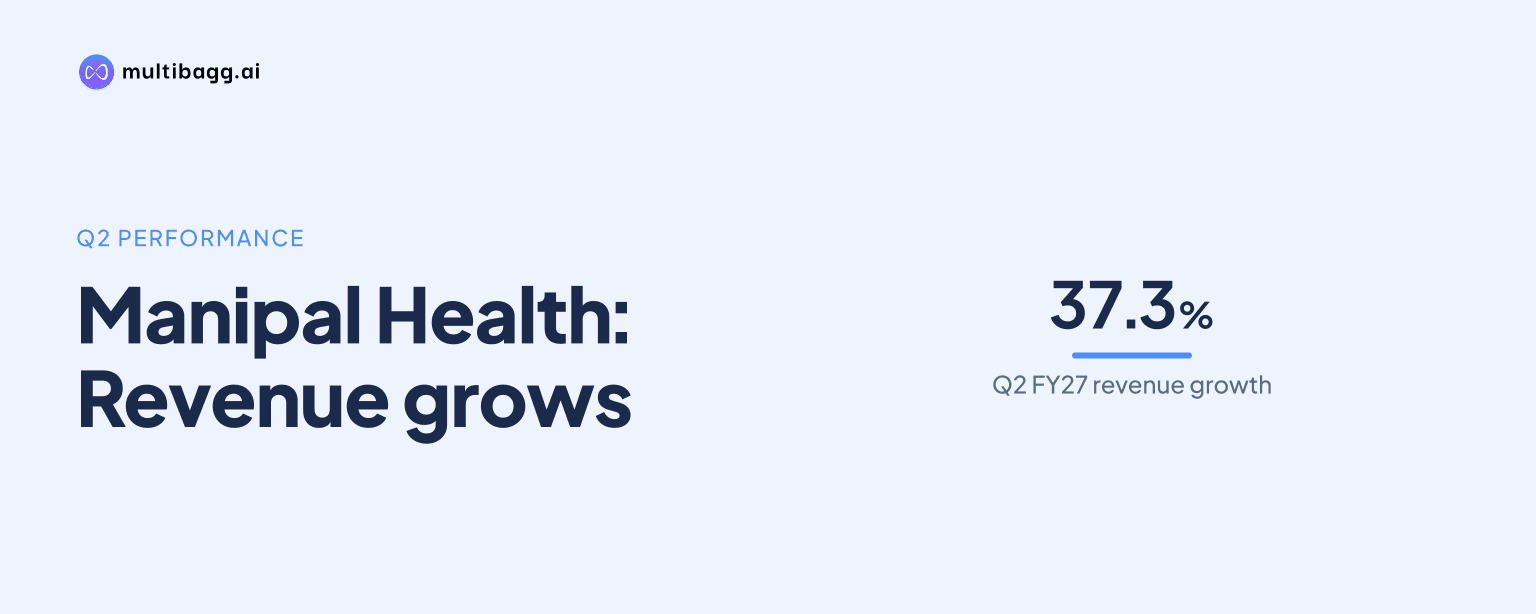
Manipal Health Enterprises Limited reported Q2 FY27 revenue of ₹3,399 crore, up 37.3% year on year, while EBITDA rose 29.8% to ₹882 crore and network occupancy reached 70%. Higher patient volumes, high-acuity specialty care and Sahyadri Hospitals contributed to the quarter’s operating performance.
Know Manipal Health Enterprises inside out
Results, valuation, peers and who's buying, in one view.
What were Manipal Health’s Q2 FY27 financial results?
Manipal Health reported revenue from operations of ₹3,399 crore for Q2 FY27, compared with growth of 37.3% year on year. EBITDA increased 29.8% to ₹882 crore, producing a network EBITDA margin of 26% for the quarter.
The company described the period as its strongest Q2 to date. Revenue growth was volume-led rather than being presented as a price-led increase, with management citing improved occupancy and higher activity in high-acuity specialties. The results included the contribution of Sahyadri Hospitals.
What drove the revenue growth at Manipal Health?
Higher inpatient and outpatient volumes were the primary drivers of Manipal Health’s revenue growth. Inpatient volumes increased about 35% year on year, while outpatient volumes rose 27%, according to management’s comments on the November 13 earnings call.
Average occupancy across the network rose to 70% in Q2 FY27 from 65% in Q1 FY27. This increase indicates greater utilisation of hospital capacity during the quarter. Management also identified growth in high-acuity specialty care as a contributor to the operating performance.
Sahyadri Hospitals was included in the reported network performance. Manipal Health said EBITDA margin excluding Sahyadri was 27%, compared with the 26% network margin including Sahyadri. This points to a lower margin contribution from the acquired network than the rest of the business during the quarter, although management highlighted improving Sahyadri margins as an important operating development.
How did Manipal Health perform across its hospital regions?
Manipal Health reported revenue growth across its key operating regions, with East India recording the largest reported increase because of the Sahyadri-linked consolidation effect in the disclosed regional data. Karnataka remained the company’s largest reported regional revenue contributor in Q2 FY27.
Karnataka revenue rose to ₹1,495 crore from ₹1,221 crore a year earlier. Maharashtra and Goa generated ₹692 crore, compared with ₹592 crore, while Rest of India revenue increased to ₹576 crore from ₹449 crore. East India revenue was ₹574 crore, compared with ₹153 crore in the previous-year period.
Management also noted that volumes under government schemes in Eastern markets had declined. The company did not provide a quantified revenue effect from this trend during the call, but the comment is relevant because scheme-funded patient volumes can affect hospital mix and utilisation in the region.
Got a follow-up? Ask IRIS
Why did reported net profit decline despite EBITDA growth?
Reported net profit was ₹285 crore in Q2 FY27, down 10.3% year on year, even as revenue and EBITDA rose. The company separately reported adjusted profit after tax, excluding exceptional items, of ₹380 crore, up 21.6% year on year.
Manipal Health also disclosed a profit after tax figure of ₹455 crore when excluding Sahyadri NCD interest, an increase of 45.6% year on year. These measures show that the reported profit figure and adjusted profit measures moved differently during the quarter. The available call summary does not specify a full reconciliation of every factor behind the decline in reported net profit.
For investors, the difference between reported and adjusted profit figures makes the composition of interest costs and exceptional items important when assessing earnings. EBITDA continued to grow, but the reported net-profit decline means operating growth did not translate directly into a higher reported bottom line for the quarter.
What did management say about margins and future guidance?
Management did not give EBITDA guidance for the remainder of FY27. It indicated that volume growth, occupancy and the recovery in Sahyadri’s margins were central operating factors, without putting a specific margin or earnings target on record.
For the first half of FY27, Manipal Health reported revenue of ₹6,490 crore, up about 37.7% year on year. H1 EBITDA was ₹1,631 crore, up 28.2% on a reported basis. The company said H1 EBITDA growth was 29.8% excluding a prior-year one-off gain.
The absence of formal EBITDA guidance leaves investors focused on operational indicators disclosed in subsequent quarters, including patient volumes, occupancy, regional scheme volumes and Sahyadri’s margin trajectory. These factors were specifically discussed by management and are more relevant to the near-term earnings profile than unsupported assumptions about future pricing or demand.
How does the pledge release affect Manipal Health investors?
Promoter entity MEMG International India Pvt Ltd disclosed releases of pledges over 72,50,000 shares and 72,42,951 shares of Manipal Health. Together, the two disclosed releases cover 1,44,92,951 shares.
A pledge release changes the disclosed encumbrance status of those shares, but the supplied information does not state a sale, a change in promoter ownership, or the financial terms associated with the release. Investors can distinguish this disclosure from the operating results, while monitoring subsequent exchange filings for any further changes in pledged shares or promoter holdings.
Conclusion
Manipal Health’s Q2 FY27 results showed strong volume-led operating growth, with revenue rising 37.3% to ₹3,399 crore and EBITDA increasing 29.8% to ₹882 crore. Higher occupancy, growth in inpatient and outpatient activity, and Sahyadri’s inclusion supported the quarter, although reported net profit fell 10.3% to ₹285 crore.
The next areas to watch are Sahyadri’s margin recovery, the effect of lower government-scheme volumes in Eastern markets, network occupancy and the company’s next quarterly disclosures. Management did not issue EBITDA guidance, so reported operational trends and any updates on regional performance will remain important.