










Manipal phases bed openings at Raipur and Mumbai hospitals
Key highlights
- Manipal plans to initially commission about one-third of beds at its 602-bed Juhu hospital in Mumbai.
- Raipur has 350 beds in Phase 1 and potential to expand to more than 500 beds.
- Manipal's newer Bengaluru hospitals are about 200 to 215 beds each, with 150 beds in Phase 1.
- Kanakapura and Yelahanka had around 100 occupied beds each after adding 150 beds apiece.
powered by IRIS
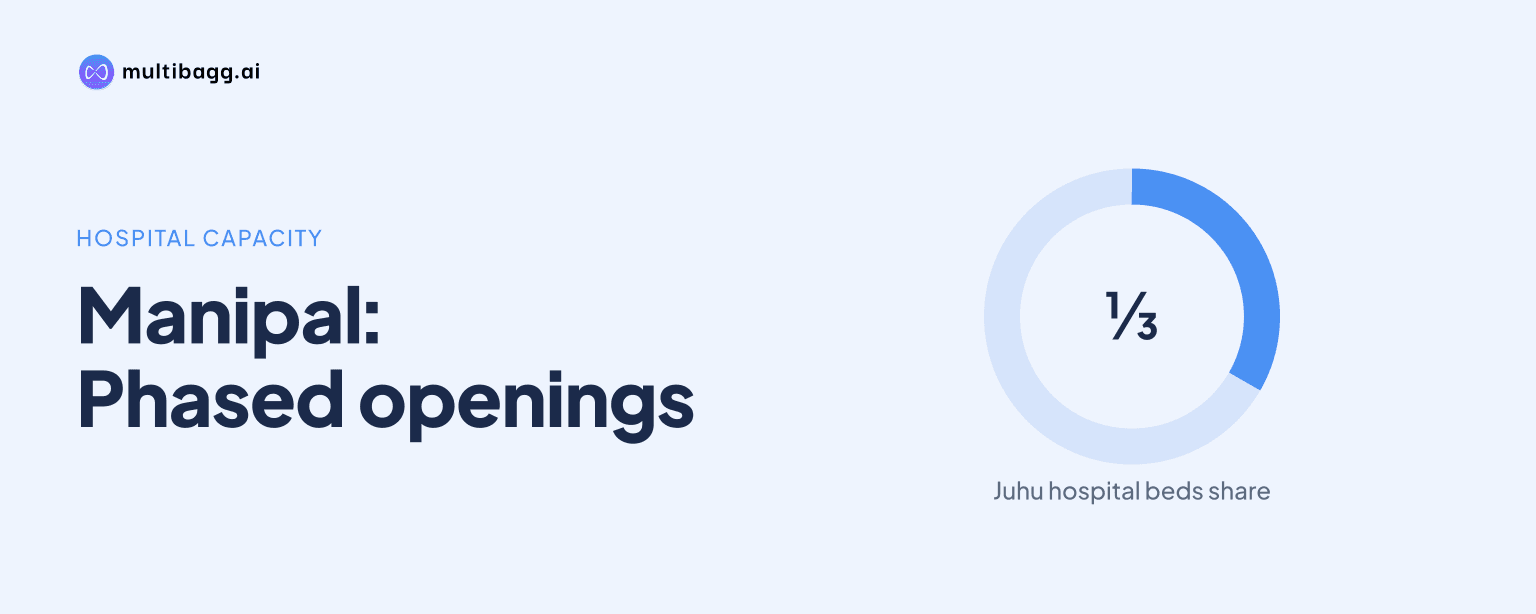
Manipal Health Enterprises will initially commission roughly one-third of beds at its 602-bed Juhu hospital in Mumbai and 350-bed Phase 1 Raipur hospital, adding floors as occupancy develops. Management said these new-market facilities may take longer to break even than Bengaluru hospitals because Manipal must build local patient, clinician and brand networks.
Know Manipal Health Enterprises inside out
Results, valuation, peers and who's buying, in one view.
How will Manipal commission beds in Raipur and Mumbai?
Manipal will open roughly one-third of available beds initially in both Raipur and Mumbai, while ensuring that every intended specialty is available from the first day. Management said the approach applies to large-format hospitals, where additional floors will be commissioned as the beds already opened begin to fill.
Raipur has a 350-bed Phase 1 profile and scope to expand to more than 500 beds, while the Juhu project in Mumbai has capacity for 602 beds. Manipal did not provide an opening date or a precise initial bed count for either hospital. The stated one-third approach means initial operational capacity will be below the eventual 350-bed Phase 1 Raipur scale and 602-bed Mumbai scale.
The staged model concerns bed capacity and floors rather than a narrower clinical offering. Dilip Jose said no specialty Manipal intends to offer would be absent on day one. The company will therefore offer its planned specialties while phasing the number of beds made available at launch.
Why will Manipal use a different model outside Bengaluru?
Manipal will treat Mumbai and Raipur as single-hospital entry markets, unlike Bengaluru, where its dense network allows clinician interoperability and shared operating processes. Karthik Rajagopal said these network benefits are available in Bengaluru because Manipal is already highly intensified there, but may not be available in cities where it initially has only one hospital.
Mumbai will require a broader market-building effort rather than a micro-market strategy, according to Rajagopal. Management said the citywide business funnel, marketing approach and clinical recruitment strategy will differ from the more focused neighbourhood approach used in a densified market. Raipur will similarly require an entry strategy distinct from Manipal's established home markets.
Sameer Agarwal said Bengaluru provides a brand advantage because Manipal has 14 or 15 hospitals there. In Mumbai, management said it will need to build that institutional presence from one hospital. The company also noted that doctor practices and doctor costs in Mumbai differ from Bengaluru, which is one reason management does not expect the new-market facility to reach break-even at the same speed as Bengaluru projects.
The comparison is therefore not simply between a 602-bed hospital and smaller assets. It is between a new-market hospital that must develop referral, clinician and patient-acquisition channels, and a Bengaluru facility that can operate within an existing network. Management described short-term pressure from this ramp-up but said the longer-term priority is building the institution around Manipal processes and patient-care policies.
Got a follow-up? Ask IRIS
How does the Bengaluru rollout differ from Raipur and Mumbai?
Manipal's three newer Bengaluru hospitals are smaller and more standardised, at about 200 to 215 beds each, so management expects only two commissioning phases rather than the additional phase that may be needed in Raipur and Mumbai. The Bengaluru projects are Yelahanka, Kanakapura and Electronic City, which management described as identical in broad size and scale.
For those Bengaluru facilities, Manipal said it can open 150 beds in Phase 1 and add the remaining roughly 60 beds in Phase 2. By contrast, Raipur and Juhu are larger-format projects that may need one extra phase. The company did not state the total number of phases for either new-market hospital, but linked the difference directly to their larger capacity profiles.
The Bengaluru hospitals also show the operating context management wants to distinguish from Mumbai and Raipur. On the call, Dilip Jose said 150 beds had been added at both Kanakapura and Yelahanka, while occupancy was around 100 at each location. He also said both facilities had already reached earnings before interest, tax, depreciation and amortisation, or EBITDA, margins of 24% to 25%.
That performance is not a target or forecast for Mumbai and Raipur. Management explicitly said the new markets would not necessarily break even at Bengaluru's faster pace. The planned one-third initial commissioning in the two larger hospitals is designed to make later floor openings dependent on demand for the beds already in service.
What will determine the pace of Manipal's expansion?
Manipal will add capacity in Raipur and Mumbai when the initially commissioned beds fill, making occupancy development the stated trigger for further floor openings. Management did not disclose occupancy targets, a break-even date or a timetable for subsequent phases. It instead described progressive commissioning after early capacity begins to be utilised.
Clinical recruitment, marketing and local patient acquisition will be central to that pace. Rajagopal said Mumbai's larger catchment strategy would differ from the neighbourhood-led approach in a dense market, while Agarwal highlighted the need to build the Manipal institution in a new city. These are operational plans disclosed by management, not quantified forecasts of revenue or profitability.
Manipal framed the approach within its continuing focus on tertiary and quaternary care rather than physical pharmacy or diagnostic-chain adjacencies. On the same call, management said telehealth completed about 38,000 consultations in the first half, including 32,000 specialty consultations, and that it was pursuing home care and digital health to extend care outside hospitals. These initiatives are separate from the 350-bed Raipur Phase 1 and 602-bed Juhu projects.
Conclusion
Manipal's Raipur and Mumbai entries are deliberately staged: roughly one-third of capacity will be operational at launch, every planned specialty will be offered, and additional floors will follow utilisation. The strategy differs from the 200-to-215-bed Bengaluru projects because the 350-bed Phase 1 Raipur hospital and 602-bed Juhu hospital enter markets without the immediate support of Bengaluru's 14-to-15-hospital network.
The next point to watch is whether the initial beds fill quickly enough to support further commissioning, as management identified occupancy as the condition for opening more floors. Investors will also be watching how Manipal builds local clinical recruitment, marketing and patient funnels in Mumbai and Raipur, while management has cautioned that break-even may take longer than at its Bengaluru facilities.