










Speedex says BIS and duties make bottle imports uneconomic
Key highlights
- Speedex said anti-dumping duties increased bottle import costs by at least 20-25%.
- First-half FY27 revenue rose 36% year on year to Rs 78.5 crore and EBITDA margin reached 19.2%.
- Speedex plans to increase annual bottle capacity from 72 lakh to about 103 lakh units in Q4 FY27.
- Outsourced items fell from 11-12% to 6.5% in first-half FY27.
powered by IRIS
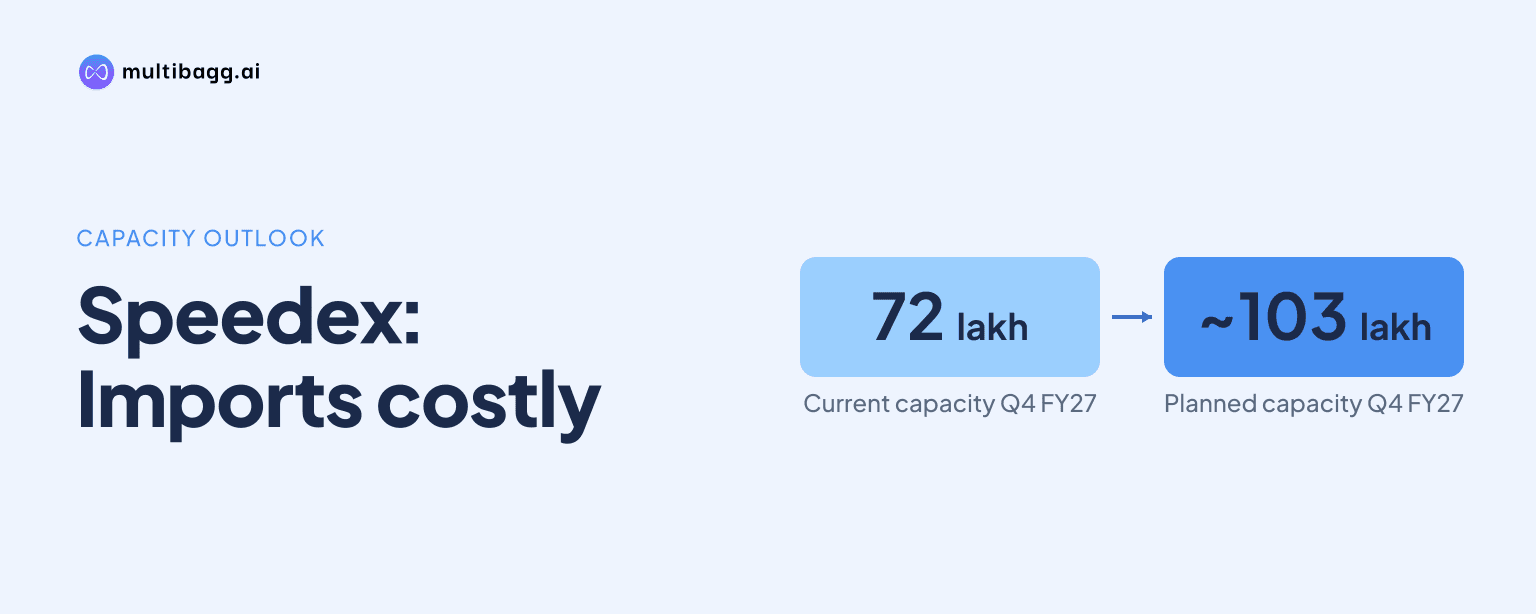
Maharaja & Speedex India Limited said on November 13, 2026 that anti-dumping duties have raised imported bottle costs by at least 20-25%, while Bureau of Indian Standards requirements, freight and currency costs have strengthened the case for Indian supply. Speedex plans to raise annual capacity from 72 lakh bottles to about 103 lakh bottles in Q4 FY27.
Know Maharaja & Speedex India inside out
Results, valuation, peers and who's buying, in one view.
Why are imported bottles becoming less viable in India?
Speedex said anti-dumping duties, Bureau of Indian Standards, or BIS, quality norms, and higher freight and dollar costs have made imported bottles less viable. Management said the duties alone increased import costs by at least 20-25%, while BIS norms were intended to prevent cheap imports from China and other countries.
The change followed the introduction of BIS requirements and anti-dumping duties in most of Speedex’s categories in 2025, according to management. Before its manufacturing operation began in 2021, the company sourced steel bottles from China under the Speedex brand from 2018 and used regional original equipment manufacturers, or OEMs, to obtain pricing and scale advantages.
Management said the combined impact extends beyond formal imports. It said the unorganised channel has also become costlier because of the higher dollar and oil-linked freight costs, although Speedex did not disclose industry import volumes or a comparison of domestic and imported selling prices.
Speedex said some buyers use one or two overseas countries that are not subject to the same anti-dumping duty. However, management said those sources have limited supply and higher costs than Indian production, and are mainly used where specific stock-keeping units, or SKUs, are unavailable from domestic suppliers.
How does Speedex plan to capture domestic supply demand?
Speedex plans to capture domestic supply demand by expanding its manufacturing range and capacity for brands that previously sourced bottles from China. Management said the company has more than 200 SKUs across stainless-steel bottles ranging from 60 millilitres to 2,200 millilitres, and operates in more than 17 states with a pan-India online presence.
Management said some legacy brands that formerly imported more than 200 SKUs are now operating with no more than 20-25 SKUs because Indian manufacturing capacity and product variety remain limited. Speedex said it can manufacture a wider range economically, while new producers may concentrate on the 20-30% of SKUs that can support larger production runs.
Speedex also cited five design patents and products including stainless-steel feeding bottles and gym shakers. Management described the company as the only large organised player in those categories, a competitive assessment not supported by independently reported market data in the call transcript.
The company said its market share is currently 2% and management’s long-term vision is to reach 10% by FY31. Management linked that ambition to local supply constraints, product development and capacity additions rather than to a disclosed industry market-size forecast.
What results support Speedex’s in-house manufacturing strategy?
Speedex reported first-half FY27 revenue from operations of Rs 78.5 crore, up 36% year on year, while earnings before interest, tax, depreciation and amortisation, or EBITDA, rose 52% to Rs 15.1 crore. EBITDA margin increased to 19.2% from 17.2%, and profit after tax rose 50% to Rs 9.9 crore.
Management attributed part of the margin change to lower outsourcing. Speedex said it had earlier outsourced 11-12% of its items but reduced that share to 6.5% in first-half FY27 after adding capacity, which management said contributed a couple of percentage points to gross-margin improvement.
Speedex said value-added and novelty products contributed more than 23% of its mix, compared with around 19% earlier, while an approximately 8% price increase also supported gross margin. Management also said bringing printing, colouring and internal polishing in-house added around 1.5% to gross margin, although these activities increased other expenses as work moved from outside processors into the company.
Got a follow-up? Ask IRIS
What capacity targets underpin Speedex’s import-substitution plan?
Speedex plans to increase annual bottle capacity from 72 lakh units to about 103 lakh units when a 31 lakh-unit initial public offering-funded expansion goes live in Q4 FY27. Management said capacity had already risen from about 62-63 lakh bottles to 72 lakh bottles through internal accruals.
The company reported monthly revenue of about Rs 16 crore in November 2026. Management said newly installed lines generally take about two months to achieve 85-90% efficiency; lines added in February reached 90% efficiency by the first week of May and were at 95% efficiency at the time of the call.
Management estimated that 62 lakh-bottle capacity could support revenue of about Rs 180-190 crore. It said total capacity of 103 lakh bottles could support monthly revenue of approximately Rs 23-24 crore, clarifying that this figure referred to the complete expanded capacity rather than the incremental 31 lakh bottles.
Speedex’s management gave ballpark targets of approximately 40% annual capacity growth and at least 50% revenue growth, while stating that it expected revenue growth of more than 45% in FY27. Those are management targets, and the transcript did not provide a detailed calculation connecting capacity additions to the full-year revenue outcome.
What factors could constrain Speedex’s domestic supply opportunity?
Speedex said an additional manufacturing line takes about four to five months to install, meaning supply may not immediately meet demand for locally produced bottles. Management also acknowledged that some SKUs are still imported because domestic alternatives are unavailable, even when overseas sourcing costs more.
The company plans more back-to-school hydration SKUs in the second half of FY27. Management also said it is seeking sourcing partners for bento and tiffin boxes, with a potential launch in the second half of the following year before considering manufacturing lines after the category exceeds 5% of total revenue.
Speedex said it has space for a further 30-40% capacity increase beyond 103 lakh bottles with modifications to its existing operations. Management estimated that such an expansion would require around Rs 20-25 crore, but said it could not yet state an exact peak capacity and may provide greater clarity by the end of the year.
The company’s contract manufacturing mix also remains relevant to its supply strategy. Original design manufacturing, or ODM, and OEM represented about 53-55% of revenue in first-half FY27, while management said it does not intend for any one customer to account for more than 10-11% of total revenue.
Conclusion
Speedex’s central argument is that the 2025 regulatory change has altered bottle-sourcing economics. Management says anti-dumping duties, BIS requirements, freight and currency costs have reduced the advantage of imported supply, while the company’s first-half FY27 revenue of Rs 78.5 crore and lower outsourcing share of 6.5% show the role of expanded in-house production in its operating model.
The next disclosed milestones are the Q4 FY27 start-up of the 31 lakh-unit expansion, the ramp-up of total capacity to 103 lakh bottles, and management’s expectation of more than 45% FY27 revenue growth. Speedex also plans back-to-school SKUs in the second half of FY27 and is evaluating a bento and tiffin-box launch in the second half of the following year.