










Manappuram Finance Limited pauses microfinance, review set for 2028
Key highlights
- Manappuram Finance paused microfinance credit disbursals and will reassess the business in April 2028.
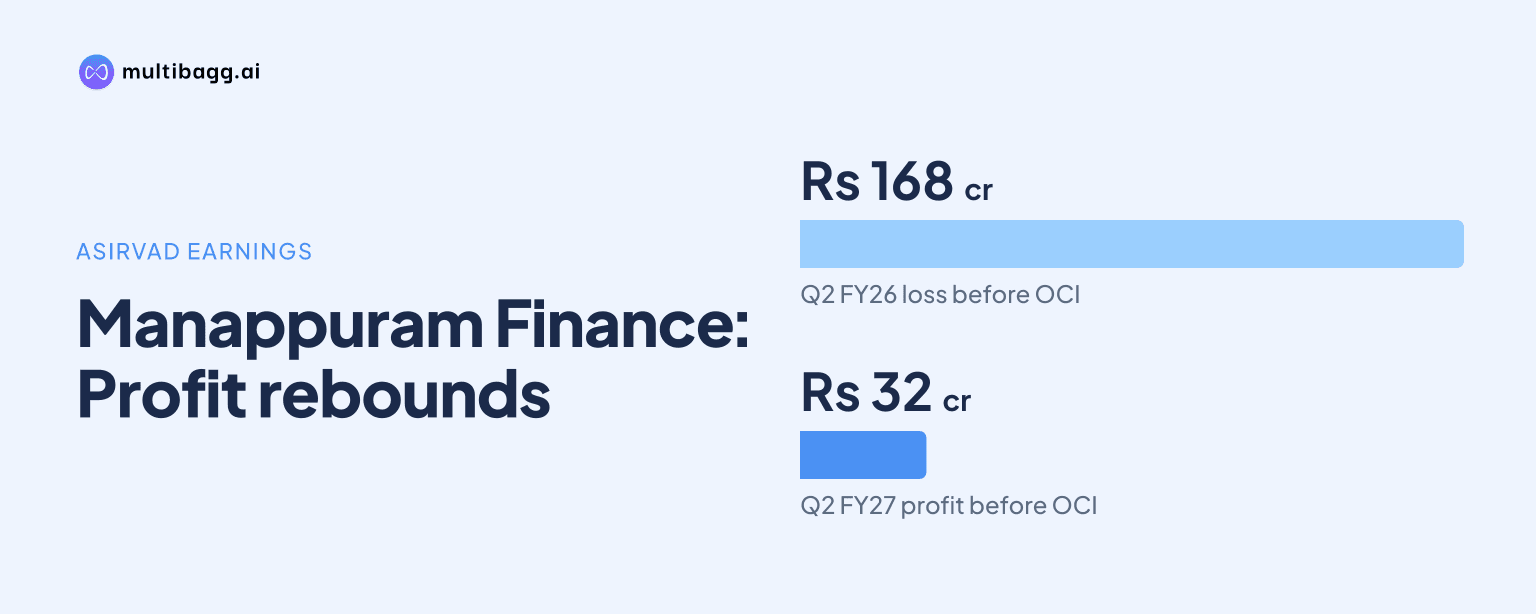
- Asirvad reported Rs 32 crore of Q2 FY27 profit before OCI, versus a Rs 168 crore loss in Q2 FY26.
- Asirvad's net NPA declined to 1.1% in Q2 FY27 from 1.4% in Q1 FY27.
- Gold loans accounted for 83% of Rs 73,303 crore consolidated AUM in Q2 FY27.
powered by IRIS
In Q2 FY27, Manappuram Finance Limited paused microfinance credit disbursals and set an April 2028 reassessment, despite Asirvad Microfinance reporting Rs 32 crore of profit before other comprehensive income. The company said collections, asset quality and an orderly run-down of the existing book would take priority after two years of sector stress.
Know Manappuram Finance inside out
Results, valuation, peers and who's buying, in one view.
Why has Manappuram Finance paused microfinance disbursals?
Manappuram Finance has paused microfinance credit disbursals to strengthen collections, protect asset quality and run down the existing portfolio in an orderly manner. Chairman and Managing Director V.P. Nandakumar disclosed the plan on the November 12, 2026 earnings call and said the business would be reassessed in April 2028.
Management said the microfinance sector had been working through stress for the past two years, although industry assessments pointed to improving collections and a gradual recovery in disbursements. It said conditions remained uneven across regions and institutions, requiring tighter borrower assessments, greater collection intensity, recalibrated customer acquisition and responsible lending practices.
The pause creates a timing question because Asirvad reported Rs 1,461 crore of microfinance disbursements in Q2 FY27, up from Rs 1,055 crore in Q1 FY27. The call did not state when the pause began, whether the Q2 figure included lending before the decision, or whether any exceptions to the suspension are permitted.
What did Asirvad report in Q2 FY27?
Asirvad reported Rs 32 crore of profit before other comprehensive income in Q2 FY27, compared with Rs 21 crore in Q1 FY27 and a loss of Rs 168 crore in Q2 FY26. For the first half of FY27, profit was Rs 53 crore, versus a loss of Rs 436 crore in the first half of the previous year.
Asirvad's assets under management, or AUM, stood at Rs 7,919 crore at September 30, 2026, including Rs 2,508 crore of gold-loan AUM. The gold-loan portion rose 10% quarter on quarter and 28.5% year on year, so the disclosed Rs 7,919 crore total should not be treated as a microfinance-only portfolio.
The share of the new microfinance book rose to 79% in Q2 FY27 from 68% in Q1 FY27 and 23% in Q2 FY26. Net non-performing assets, or net NPA, declined to 1.1% from 1.4% in the preceding quarter, while Asirvad's capital-to-risk-weighted-assets ratio stood at 29.2% on September 30, 2026.
The reported profit and lower net NPA ratio did not change management's operating stance. Manappuram Finance said the April 2028 review, rather than one profitable quarter or a 30-basis-point sequential decline in net NPA, would determine its next assessment of the business.
Got a follow-up? Ask IRIS
How does the pause change Manappuram Finance's lending mix?
Manappuram Finance's group growth is being led by gold loans while microfinance shifts to collections and portfolio protection. Consolidated AUM reached Rs 73,303 crore in Q2 FY27, up 5.3% sequentially and 60.1% year on year, while gold-loan AUM was Rs 60,640 crore, up 6.4% sequentially and 92.5% year on year.
Gold loans represented 83% of consolidated AUM in Q2 FY27, compared with 82% in Q1 FY27 and 69% a year earlier. The 14-percentage-point increase from Q2 FY26 reflects the faster expansion of secured gold lending relative to the diversified businesses, including the now-paused microfinance operation.
In the standalone business, gold-loan AUM was Rs 58,097 crore at the end of Q2 FY27, up 6.3% from Q1 FY27 and 92.2% from a year earlier. Management expects gold-loan AUM to grow 25% to 30% in FY27, supported by branch expansion and digital channels, while retaining appraisal, loan-to-value and custody standards.
Manappuram Finance plans to add around 500 branches by March 2027 to its consolidated network of 5,375 branches. Management said nearly 100 branches had opened in the first half of FY27 and another 250 were in progress, but this distribution plan does not alter the separate microfinance plan to halt credit disbursals.
What asset-quality issues is Manappuram Finance managing?
Manappuram Finance is prioritising collection activity, underwriting and provisioning across its non-gold businesses rather than pursuing rapid expansion. Standalone gross non-performing assets, or GNPA, rose to 1.79% at September 30, 2026 from 1.56% in the preceding quarter, while standalone credit cost was 1.4%.
The standalone gold-loan portfolio's average loan-to-value ratio was 64.5% in Q2 FY27, compared with 65.6% in Q1 FY27. Management said gold-loan stage 3 assets were 1% and stage 2 assets were in single digits as a percentage of AUM, citing collateral appraisal, custody and auction procedures as risk-management mechanisms.
Vehicle finance had AUM of Rs 2,169 crore in Q2 FY27, down 15.3% sequentially and 46.5% year on year, while GNPA increased to 16.9% from 13.4% in Q1 FY27. Loans to micro, small and medium enterprises had AUM of Rs 3,361 crore and GNPA of 6.4%, up from 5.9% in the prior quarter.
Housing-finance AUM was Rs 1,814 crore, down 1.7% sequentially and 4.5% year on year, although Q2 FY27 disbursements rose to Rs 121 crore from Rs 103 crore in Q1 FY27. Management said housing finance and MSME lending would focus on disciplined underwriting, operating efficiency and sustainable risk-adjusted returns rather than rapid expansion.
Conclusion
Manappuram Finance's microfinance decision separates Asirvad's reported quarterly recovery from the group's longer-term operating approach. Asirvad moved from a Rs 168 crore loss in Q2 FY26 to a Rs 32 crore profit in Q2 FY27 and reduced net NPA to 1.1%, but management has chosen collections and book reduction over new credit. Gold loans, at 83% of Rs 73,303 crore consolidated AUM, remain the principal source of growth.
The next disclosed milestones are the planned addition of around 500 branches by March 2027, management's FY27 gold-loan growth expectation of 25% to 30%, and the April 2028 reassessment of microfinance. The key unresolved matters are the start date and scope of the disbursal pause, and management did not disclose a target portfolio size, collection threshold or asset-quality condition for restarting microfinance lending.