










Manappuram Finance Stage 2 stress reaches 5% in Q2 FY27
Key highlights
- Manappuram reported Stage 2 gold-loan stress of about 5% in Q2 FY27, versus about 0.5% in Q1 FY27.
- Manappuram’s gold GNPA ratio was 1.04% in Q2 FY27, while gold Stage 3 was about 1%.
- Manappuram’s standalone gold-loan AUM was Rs 58,097 crore, up 6.3% quarter on quarter and 92.2% year on year.
- More than 90% of Manappuram’s gold-loan book was in bullet schemes, while monthly or quarterly products were about 8% to 10%.
powered by IRIS
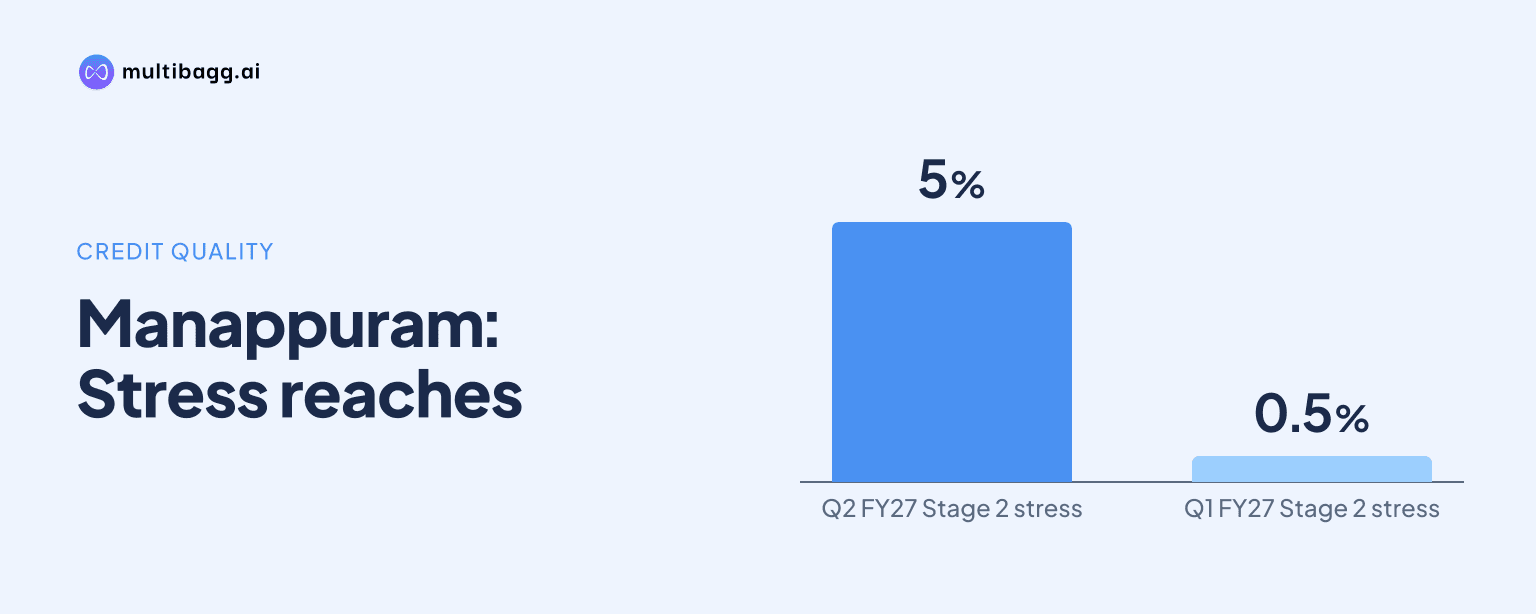
Manappuram Finance said Stage 2 stress in its gold-loan assets under management reached about 5% in Q2 FY27, compared with about 50 basis points in Q1 FY27, after introducing shorter-tenure and equated monthly instalment products. Management attributed the increase to customer adjustment and said collections after September 2026 provided encouraging early indications.
Know Manappuram Finance inside out
Results, valuation, peers and who's buying, in one view.
Why did Manappuram’s Stage 2 gold-loan stress rise?
Manappuram said the increase resulted largely from customer behaviour after regulatory changes took effect in April and the company introduced shorter-tenure and equated monthly instalment, or EMI, gold-loan products. Customers had previously been accustomed to the traditional one-year bullet loan, under which the repayment pattern differs from products with shorter maturities or scheduled instalments.
The rise occurred even though the newer structures remain a small share of the gold portfolio. Management said more than 90% of the gold-loan book remained in bullet schemes, while monthly or quarterly payment schemes accounted for about 8% to 10%. The company said the EMI and shorter-tenure products were introduced in Q1 FY27, leaving a limited payment history by Q2 FY27.
The Stage 2 movement was substantially larger than the disclosed gold gross non-performing asset, or GNPA, ratio of 1.04% in Q2 FY27. Management also put gold-loan Stage 3 at about 1%. At the standalone entity level, which includes businesses beyond gold lending, GNPA was 1.79% at September 30, 2026, compared with 1.56% in the preceding quarter.
Manappuram also reported a lower average loan-to-value, or LTV, ratio in the gold book. Average LTV was 64.5% in Q2 FY27, against 65.6% in Q1 FY27. Management described the average as around 65% and did not disclose the LTV distribution of the Stage 2 portfolio or the proportion above 80% LTV.
How is Manappuram addressing the higher Stage 2 balance?
Manappuram is increasing customer contact, sending notices and educating borrowers on the differences between the traditional bullet product and newer repayment structures. Management said many customers had returned to pay in full or in part, regularising outstanding amounts and reducing the need to take the pledged gold to auction.
The company said it plans to move customers with no clear certainty of short-term redemption towards one-year loans. It will retain shorter-tenure products for customers with a defined short-term funding requirement, but said it does not induce customers to take such loans. Management expects the proportion of short-term products to decline as more borrowers are directed to the one-year format.
Management said it expected the adjustment to normalise probably over the next couple of quarters as customers become familiar with the new products. It later qualified that view, saying early collection trends after September were encouraging but that a normalised Stage 2 level was difficult to predict because accounts would continue to enter Stage 2 on a rolling basis.
Gold-loan auctions totalled about Rs 100 crore in Q2 FY27, against Rs 13 crore in Q1 FY27, taking first-half auctions to Rs 115 crore. Management did not directly attribute those auction amounts to the new products, but said the default option was very low and that customer payments had often prevented an auction path.
Got a follow-up? Ask IRIS
How exposed is Manappuram to gold loans and new products?
Manappuram’s standalone gold-loan AUM was Rs 58,097 crore at the end of Q2 FY27, up 6.3% quarter on quarter and 92.2% year on year. Gold loans represented 91% of standalone AUM of Rs 63,733 crore, compared with 90% in the prior quarter and 80% a year earlier, making gold-book collection performance central to standalone asset quality.
The wider group had gold loans accounting for 83% of consolidated AUM in Q2 FY27, compared with 82% in Q1 FY27 and 69% a year earlier. Standalone outstanding gold-loan customers reached 27.2 lakh after the company added 3.15 lakh new customers during the quarter, an increase of 2.9% quarter on quarter and 11.7% year on year.
The traditional bullet product remains the principal structure in the portfolio. Management said 60% to 65% of customers historically paid interest promptly despite no regular contractual payment schedule on bullet loans, and it said it had not seen a change in that customer behaviour. By contrast, the 8% to 10% monthly or quarterly payment category requires additional borrower education.
Online gold loans represented about 91% of the gold-loan book in Q2 FY27. Management said branches were growing without adding more staff and that digital servicing had enabled lower branch manpower, while the company continued work towards opening 500 branches during FY27.
What do provisions and growth targets indicate?
Manappuram said its standalone provisions of Rs 220 crore in Q2 FY27 were largely driven by gold, but it did not quantify the gold and non-gold split. It also said Rs 14 crore of asset reconstruction company sale loss was reclassified to provisions and that it had taken prudent management overlays above expected credit loss, or ECL, provisions.
Management said 70 to 80 basis points of a 1.79% cost measure discussed during the call represented overlays. The opening remarks reported standalone credit cost of 1.4%, and the transcript did not reconcile that figure with the later 1.79% measure. Management also declined to quantify the cumulative overlays held on the balance sheet.
Standalone profit after tax before other comprehensive income and minority interest was Rs 665 crore in Q2 FY27, up 20% sequentially and 77% year on year. Management reiterated an expectation of 25% to 30% AUM growth in FY27 and said it expected gold-loan AUM growth of around 30%, despite describing growth outside the first quarter as more moderate at 5% to 6%.
Management expects combined gross yield on EMI and bullet products to remain in the 17.5% to 18.5% range. It also said that, over three years, gold-loan yield could be around 17%, while noting that borrowing costs, policy and other external factors could change that outcome.
Conclusion
Manappuram’s Q2 FY27 Stage 2 ratio of about 5% marked a sharp increase from about 50 basis points in Q1, while the gold GNPA ratio was 1.04% and average LTV declined to 64.5%. Management attributes the change to repayment behaviour on recently introduced products rather than to a disclosed deterioration in the predominantly bullet-based book.
The next issue is whether collections and product redesign reduce the Stage 2 balance over the next couple of quarters. Management plans to direct uncertain short-tenure borrowers to one-year loans, retain short-term products for defined needs and pursue 25% to 30% FY27 AUM growth, but it has not provided a target for the normalised Stage 2 ratio.