










Manappuram Finance Q2 FY27 Profit Rises 223% as Gold AUM Grows
Key highlights
- Manappuram Finance reported Q2 FY27 PAT of ₹701 crore, up 223% year on year.
- Consolidated AUM reached ₹73,303 crore, up 60.1% year on year.
- Gold-loan AUM rose 92.5% year on year to ₹60,640 crore.
- Gold loans accounted for 83% of consolidated AUM in Q2 FY27.
powered by IRIS
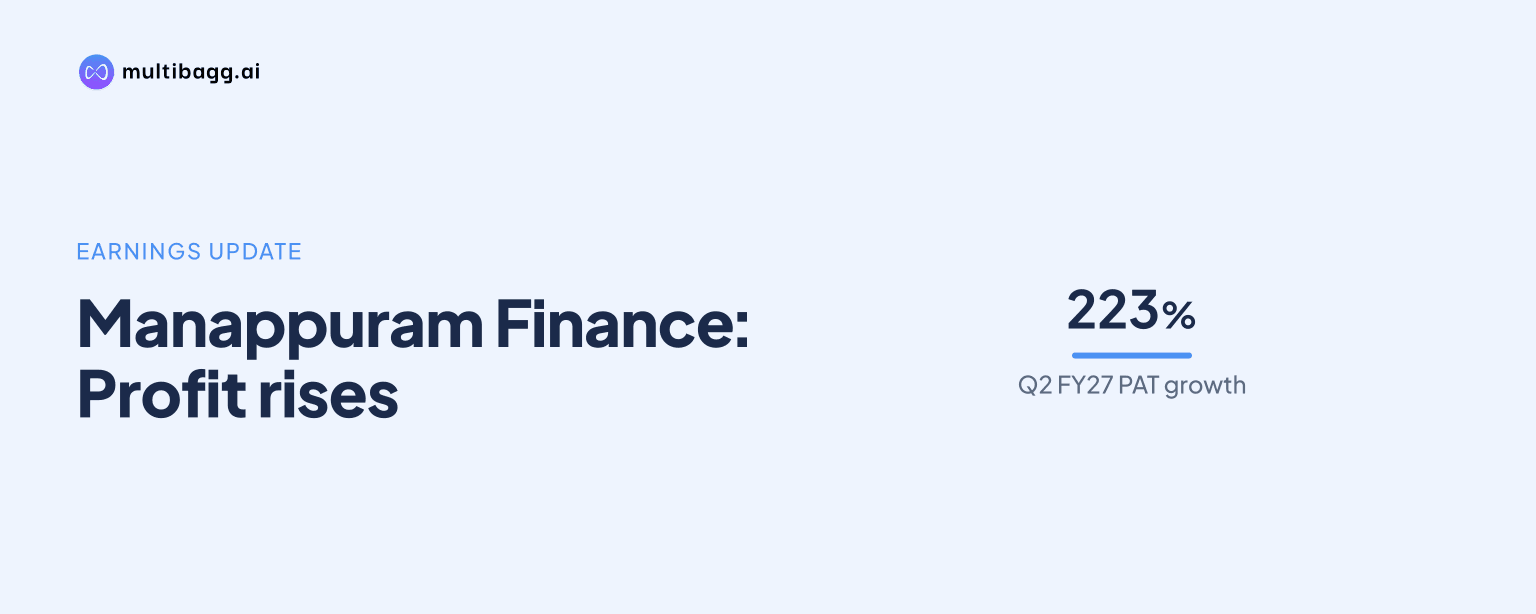
Manappuram Finance Limited reported Q2 FY27 consolidated profit after tax before OCI and minority interest of ₹701 crore, up 223% year on year, supported by a 92.5% rise in gold-loan assets under management to ₹60,640 crore. The result highlights the growing weight of gold lending in the group's consolidated portfolio.
Know Manappuram Finance inside out
Results, valuation, peers and who's buying, in one view.
What did Manappuram Finance report for Q2 FY27?
Manappuram Finance reported consolidated profit after tax of about ₹701 crore for the quarter ended September 30, 2026, compared with ₹217 crore in the corresponding quarter a year earlier. The company said profit was also 20% higher sequentially from ₹585 crore in Q1 FY27. Its reported operating margin was 70.8%.
Revenue reporting differed across the supplied result summaries. Revenue from operations was stated at ₹3,362 crore, up 47.9% year on year, while the investor-presentation-based figure for consolidated revenue was ₹3,356 crore, up 46.2% year on year. The earnings-call material separately referred to consolidated revenue of ₹3,356 crore and a 10.2% year-on-year increase. Investors should refer to the company's detailed quarterly financial statements for reconciliation across these disclosures.
How did gold loans drive Manappuram Finance's quarterly performance?
Gold loans drove Manappuram Finance's growth, with gold-loan AUM reaching ₹60,640 crore at the end of Q2 FY27. This was 6.4% higher than the preceding quarter and 92.5% above the level a year earlier, according to the management presentation and earnings-call remarks.
Consolidated AUM stood at ₹73,303 crore, increasing 5.3% quarter on quarter and 60.1% year on year. Gold loans represented 83% of consolidated AUM, compared with 82% in Q1 FY27 and 69% a year earlier. The change shows that the faster expansion of the gold-loan portfolio has increased its contribution to the group relative to other lending businesses.
Management described gold lending as the key growth driver, citing customer demand. It retained FY27 loan-growth guidance of 25% to 30% and indicated an expectation of around 30% growth in gold-loan AUM for the year. These are management targets rather than reported outcomes.
What issues did investors focus on during the earnings call?
Investors focused on asset quality in the gold-loan portfolio and the outlook for funding costs. Earnings-call summaries cited in the supplied material said gold-loan Stage 2 assets were around 5%, compared with around 0.5% a year earlier. The material did not provide a quantified amount for any overlays.
Funding costs were another point of attention. Management indicated that exit borrowing cost could be near 9%, representing an increase of 25 to 30 basis points. Borrowing costs matter for a non-bank lender because they can influence net interest margins, particularly when the loan book is expanding rapidly.
The supplied materials also noted that Asirvad Micro Finance's older book was shrinking and that branches had been consolidated from 1,503 to 1,428. The reported return to profit in microfinance contributed to consolidated earnings, but the available material does not provide a detailed segment-wise profit bridge.
Got a follow-up? Ask IRIS
What does the quarter mean for shareholders and the lending sector?
For shareholders, the quarter provides evidence that the scale-up in gold loans translated into higher consolidated profit. PAT of ₹701 crore was more than three times the previous year's ₹217 crore, while total AUM crossed ₹73,000 crore. The concentration of 83% of AUM in gold loans also means future financial performance will be closely linked to demand, portfolio quality and funding conditions in that business.
For the wider non-bank financial company sector, the result reflects continued demand for secured, collateral-backed credit. Manappuram Finance's portfolio mix has shifted substantially toward gold loans over the past year, with their AUM share rising from 69% to 83%. The company said India's medium- to long-term financial-services opportunity remains significant, although that statement did not include a revised long-term financial target.
Management also referred to an expansion plan of around 500 branches by March 2027. The available materials do not specify whether this number represents new branches, a target for a particular business line, or the final group branch count. Investors will need fuller company disclosures to assess the cost and earnings implications of the stated plan.
Why are revenue disclosures and asset quality important to track?
The supplied data contains differing revenue figures and growth rates for the same quarter. The ₹3,362 crore revenue-from-operations figure and the ₹3,356 crore consolidated-revenue figure may reflect differences in reporting presentation, but the provided extracts do not explain the variation. Comparing the company’s statutory quarterly results, investor presentation and earnings-call material will be necessary before drawing conclusions from the revenue trend.
Asset quality deserves similar attention because Stage 2 assets were reported to have risen sharply from the prior-year level. Stage 2 classification does not by itself establish a credit loss, but it indicates loans that have seen a significant increase in credit risk. The extent of any provisions or management overlays was not quantified in the supplied call summaries.
Conclusion
Manappuram Finance delivered a strong Q2 FY27 profit increase, led by rapid gold-loan growth. Consolidated PAT reached ₹701 crore, gold-loan AUM rose to ₹60,640 crore, and gold loans accounted for 83% of group AUM. The quarter also showed the increasing importance of the secured lending franchise to the group's earnings and balance sheet.
The next areas to watch are delivery against the 25% to 30% FY27 loan-growth guidance, the stated plan for around 500 branches by March 2027, borrowing-cost movement toward the indicated 9% exit level, and further disclosure on Stage 2 assets and provisions.