










Manappuram Finance says online loans can lower branch costs
Key highlights
- Manappuram said about 91% of its gold-loan book was online in Q2 FY27.
- Manappuram plans to add around 500 branches by March 2027 to a consolidated network of 5,375 branches.
- Standalone gold-loan AUM was Rs 58,097 crore in Q2 FY27, up 92.2% year on year.
- Management said Stage 2 gold loans were about 5% of gold AUM in Q2 FY27.
powered by IRIS
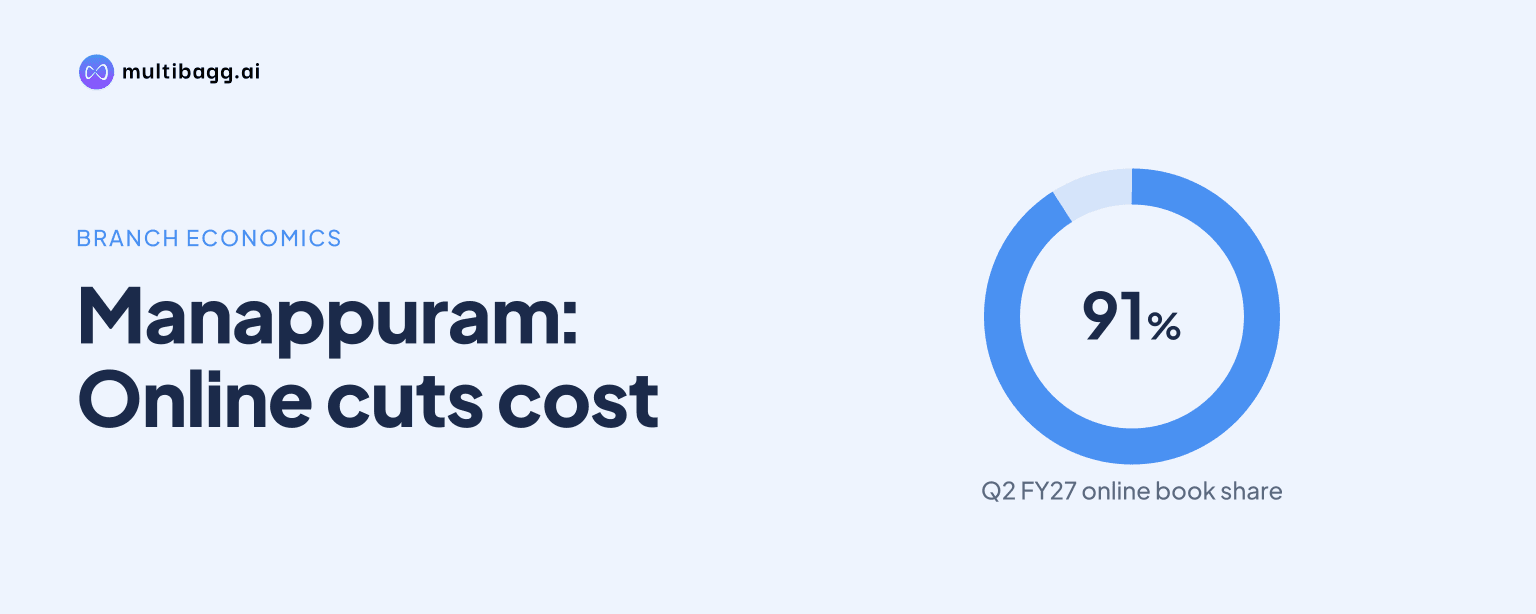
Manappuram said in Q2 FY27 that online gold loans made up about 91% of its gold-loan book, a level management expects will reduce operating-expense and employee-cost ratios to assets under management while it adds around 500 branches by March 2027. The plan rests on technology-led servicing and field-staff rationalisation.
Know Manappuram Finance inside out
Results, valuation, peers and who's buying, in one view.
How does online gold-loan servicing lower Manappuram's costs?
Manappuram said its online gold loan, or OGL, book accounted for about 91% of total gold-loan AUM in Q2 FY27, providing the mechanism for its cost plan. Management said existing branches were growing without adding people and that branch manpower had already been reduced without affecting customer service as OGL use increased.
Management's stated expectation is that operating expenses, or opex, as a ratio to AUM will decline despite the branch rollout. It also said employee cost as a ratio to AUM would decline because it is rationalising field employees. Manappuram did not disclose its current opex-to-AUM ratio, employee-cost-to-AUM ratio, branch-level staffing numbers or a quantified savings target during the call.
The strategy applies to a gold book that has become a larger part of the standalone business. Gold loans represented 91% of standalone AUM in Q2 FY27, compared with 90% in Q1 FY27 and 80% a year earlier. Standalone gold-loan AUM reached Rs 58,097 crore, growing 6.3% quarter on quarter and 92.2% year on year, faster than total standalone AUM growth of 4.5% sequentially.
Can Manappuram open 500 branches without materially raising employee costs?
Manappuram said it does not expect employee costs to increase much from adding around 500 branches because OGL and technology enable workforce rationalisation. The group plans to add those branches by March 2027 to its consolidated network of 5,375 branches, while continuing process and technology improvements in customer servicing.
Management said nearly 100 branches had opened by the Q2 FY27 call, after an analyst noted that 70 had been added in the first six months ended September 30, 2026. It said work on another 250 branches was in full swing and that these outlets were expected to open within the next couple of months. Management reiterated that it was confident of meeting the 500-branch target.
The branch programme supports management's guidance for gold-loan AUM growth of 25% to 30% in FY27. Management later said it expected growth of around 30% for the year, while noting that quarterly growth can vary seasonally. Consolidated gold-loan AUM was Rs 60,640 crore in Q2 FY27, up 6.4% quarter on quarter and 92.5% year on year.
Gold lending's larger share makes execution of this operating model relevant to group costs. Gold loans formed 83% of consolidated AUM in Q2 FY27, up from 82% in Q1 FY27 and 69% a year earlier. Consolidated AUM stood at Rs 73,303 crore, up 5.3% sequentially and 60.1% year on year, showing that gold lending grew faster than the consolidated portfolio during the quarter.
Got a follow-up? Ask IRIS
What operating evidence supports Manappuram's digital expansion plan?
Manappuram's evidence is the scale of the online channel and customer additions rather than a separately disclosed digital saving. It added 3.15 lakh gold-loan customers in Q2 FY27, taking outstanding customers to 27.2 lakh, up 2.9% quarter on quarter and 11.7% year on year. Management linked the 91% OGL share to its ability to expand branches without matching staff additions.
The business also maintained a lower average loan-to-value, or LTV, ratio during the period of customer growth. Average gold-loan LTV was 64.5% in Q2 FY27, compared with 65.6% in Q1 FY27. Management said its FY27 gold-loan growth plan would continue to operate under the same appraisal, LTV and custody standards.
Standalone profitability rose alongside the gold-book expansion. Standalone profit after tax before other comprehensive income and minority interest was Rs 665 crore in Q2 FY27, up 20% quarter on quarter and 77% year on year. On a consolidated basis, profit after tax before other comprehensive income and minority interest was Rs 701 crore, up 20% sequentially and 223% year on year.
Other segments show why gold lending remains the primary focus of the stated efficiency plan. Vehicle-finance AUM was Rs 2,169 crore, down 15.3% quarter on quarter, while home-loan AUM was Rs 1,814 crore, down 1.7% sequentially. Manappuram said vehicle-finance disbursements were paused and the existing book was being run down in an orderly manner.
What could affect Manappuram's cost-reduction plan?
The main disclosed issue is customer repayment behaviour in newer gold-loan products. Management said Stage 2 gold loans were about 5% of gold AUM in Q2 FY27, compared with close to 50 basis points in Q1 FY27. It attributed the increase largely to customer adjustment following April regulatory changes and the launch of shorter-tenor and equated monthly instalment products.
Management said additional customer contact and education had led many affected borrowers to pay in full or in part and regularise their balances. It expected Stage 2 levels to normalise over the next couple of quarters as customers become familiar with the products. Gold gross non-performing assets, or GNPA, were about 1.04% in Q2 FY27, compared with total standalone GNPA of 1.79%.
Funding costs could also affect the economics of growth even if operating ratios decline. Standalone borrowing cost fell by 2 basis points in Q2 FY27, but the chief financial officer said the Q4 exit cost could move towards the 9% range. He said this implied an increase of about 25 to 30 basis points from the Q2 level in the prevailing rate environment.
Manappuram reported capital adequacy of 22.36% as of September 30, 2026, versus the applicable regulatory requirement of 15%. Management also said the portfolio LTV of 64.5% was within regulatory limits. These measures frame its plan to pursue 25% to 30% gold-loan AUM growth while monitoring collections, customer behaviour and funding conditions.
Conclusion
Manappuram's position is that a gold-loan book that is about 91% online can support physical expansion while lowering opex-to-AUM and employee-cost-to-AUM ratios. The operating argument is supported by Rs 58,097 crore of standalone gold-loan AUM and 3.15 lakh new gold-loan customers in Q2 FY27, although management did not quantify the starting cost ratios or expected savings.
The next disclosed milestones are the addition of around 500 branches by March 2027, including another 250 outlets that management said were expected within a couple of months, and the expected normalisation of Stage 2 gold loans over the next couple of quarters. Management's FY27 target of 25% to 30% gold-loan AUM growth will also be assessed against its expectation that Q4 borrowing costs could rise by 25 to 30 basis points.