










Manappuram Finance gold-loan Stage 2 stress reaches 5%
Key highlights
- Manappuram reported Stage 2 loans of about 5% of gold AUM, versus close to 0.5% in Q1 FY27.
- More than 90% of Manappuram's gold-loan portfolio remained in bullet schemes.
- Manappuram reported gold GNPA of about 1.04% and an average gold-loan LTV of around 65%.
- Manappuram reported nearly Rs 100 crore of auctions in the September 2026 quarter and Rs 115 crore in the first half.
powered by IRIS
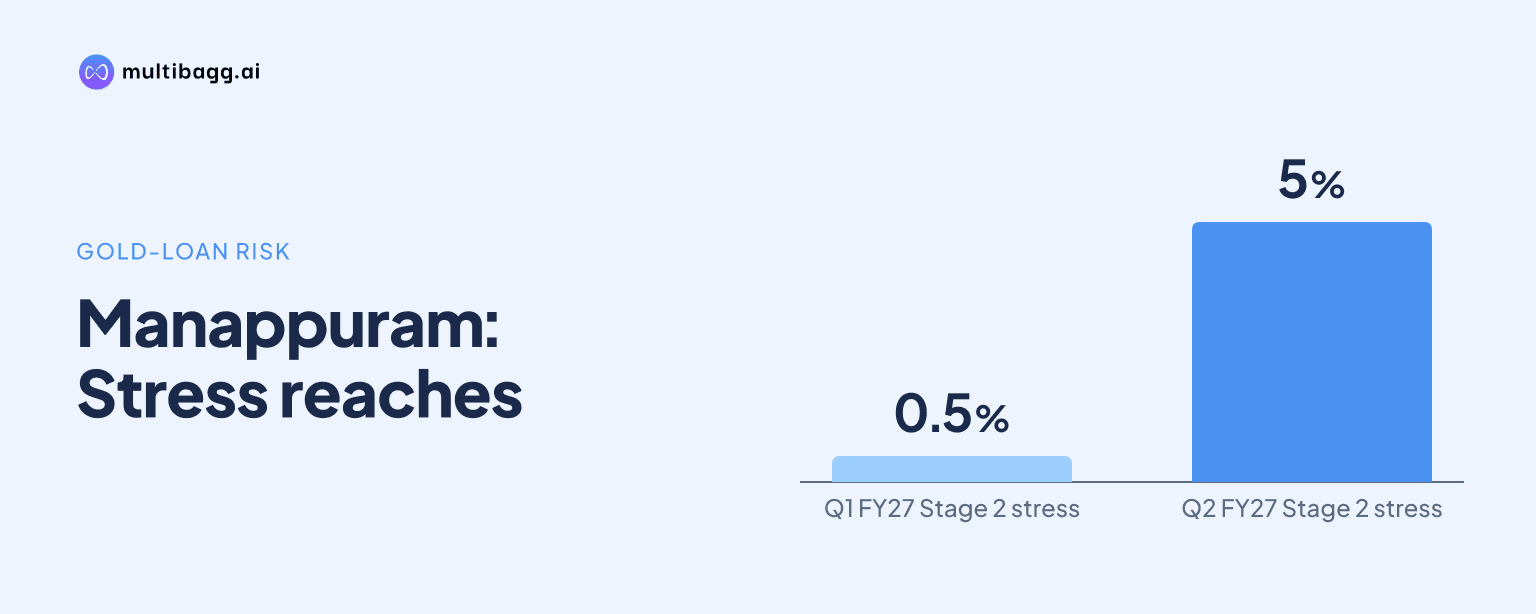
Manappuram Finance reported Stage 2 loans of about 5% of gold assets under management (AUM) in the quarter ended September 30, 2026, up from close to 50 basis points in Q1 FY27, as borrowers adapted to new shorter-tenure and equated monthly instalment products; management said early collections showed some accounts regularising.
Know Manappuram Finance inside out
Results, valuation, peers and who's buying, in one view.
Why did Manappuram's gold-loan Stage 2 stress rise?
Manappuram said the increase was largely behavioural and followed an April regulatory change and the launch of shorter-tenure and equated monthly instalment (EMI)-based products. Customers were more familiar with the traditional one-year consumption gold loan, generally structured as a bullet loan, rather than products requiring repayment during shorter contractual periods.
Management said the newer formats were still a smaller component of the overall portfolio. More than 90% of the gold-loan book remained in bullet schemes, while monthly or quarterly payment products represented about 8% to 10% of incremental disbursements. Income-generating gold loans were also a very small part of the gold-loan base, according to management.
The shift changes customer repayment behaviour rather than the predominant structure of the portfolio. Management said that, even where regular interest payment is not contractually scheduled on longer-tenure loans, about 60% to 65% of customers historically paid interest promptly. It said it had not seen a change in that observed behaviour for the traditional book.
How much did Manappuram's Stage 2 ratio change?
Manappuram said Stage 2 loans were about 5% of gold AUM in the September 2026 quarter, compared with close to 50 basis points, or 0.5%, in Q1 FY27. The disclosed movement is therefore about 4.5 percentage points between the two reported periods, although management initially described the September ratio as being in the low- to mid-single digits.
Management separately put Stage 3 in the gold-loan book at about 1% and gold GNPA at about 1.04% in the quarter. These measures were reported alongside the 5% Stage 2 figure, rather than as substitutes for it. Overall GNPA was 1.79%, which was 0.75 percentage points above the reported gold GNPA ratio.
The company also cited an average loan-to-value (LTV) ratio of around 65% for its gold-loan book. Management did not disclose the proportion of the portfolio above 80% LTV when asked during the call, saying it would return with that figure.
Are stressed Manappuram gold-loan customers regularising?
Manappuram said early collection trends were encouraging, with a large number of customers in the affected cohorts returning to pay either fully or partly and thereby regularising outstanding amounts. Management said it was increasing customer contact and explaining the differences between traditional bullet loans and the newer EMI and shorter-tenure products.
Management said notices are sent to customers, who are contacted and asked to meet interest obligations and restore LTV to the current level. It said this process had limited the need to take accounts down the auction route, while describing the default option as very low. The company did not quantify the number or value of Stage 2 accounts that had regularised.
Management did not say that the ratio had already returned to a normal level. It said collections after the September level had been “a fair bit”, but Stage 2 continues to receive inflows on a rolling basis. Management said the eventual normal trend was difficult to predict at this stage, despite earlier indicating that the effect could normalise in the next couple of quarters.
Got a follow-up? Ask IRIS
What is Manappuram changing in its short-tenure gold loans?
Manappuram said it is moving gradually from three- and six-month products towards one-year products for customers without clarity on short-term redemption. Short-term loans will remain available for customers whose funding requirement is clearly short term, but management said it does not induce customers to take such products.
The implementation is phased because the company is training employees and educating customers about repayment terms. Management said the share of monthly or quarterly payment schemes was around 8% to 10% even in incremental disbursements, while the majority of the book continued to be bullet loans. This means the product adjustment is occurring within a portfolio still dominated by one-year bullet structures.
Management said combined gross yield across EMI and bullet products was expected to remain in a range of 17.5% to 18.5%. Separately, it said it expected gold-loan yield to be around 17% in three years, although it said borrowing costs, policy and other external factors could change that outcome.
What do auctions and provisions show about Manappuram's response?
Manappuram reported an auction amount of nearly Rs 100 crore in the September 2026 quarter and Rs 115 crore in the first half. Management did not attribute those auctions specifically to shorter-tenure or EMI products, but said customer repayments in the affected Stage 2 cohort reduced the need for accounts to proceed to auction.
Standalone provisioning was Rs 220 crore in the quarter, and management said it was largely driven by gold loans and included prudent management overlays. It said 70 to 80 basis points of the reported 1.79% cost represented overlays, while Rs 14 crore of loss on an asset reconstruction company sale was reclassified to provisions.
Management did not quantify the gold-versus-non-gold split within the Rs 220 crore provision, the quarterly overlay amount, or the cumulative overlay carried on the balance sheet. It said overlays are assessed every quarter and were not solely an FY27 measure.
Conclusion
Manappuram's reported increase from close to 0.5% Stage 2 gold loans in Q1 FY27 to about 5% in the September 2026 quarter marks a material rise in early-stage stress after the introduction of shorter-tenure and EMI products. The portfolio nevertheless remained more than 90% bullet-based, while management cited a 65% average LTV, 1.04% gold GNPA and early regularisation collections.
The next disclosed test is whether collection efforts and customer education reduce Stage 2 balances over the next couple of quarters. Management's plan is to shift borrowers without clear short-term repayment certainty towards one-year products, retain short-tenure loans for suitable customers, and expand the newer payment formats gradually rather than rapidly.