










Mangalam Organics FY26 cash trailed profit after working capital
Key highlights
- Mangalam Organics reported Rs 0.91 crore of net operating cash in FY26 versus Rs 25.38 crore of profit for the year.
- FY26 working-capital changes absorbed Rs 85.85 crore, compared with an Rs 66.67 crore absorption in FY25.
- Inventories rose Rs 87 crore to Rs 300 crore at March 2026, while trade receivables fell Rs 10 crore to Rs 59 crore.
- Total reported borrowings increased Rs 87 crore to Rs 356 crore at March 2026.
powered by IRIS
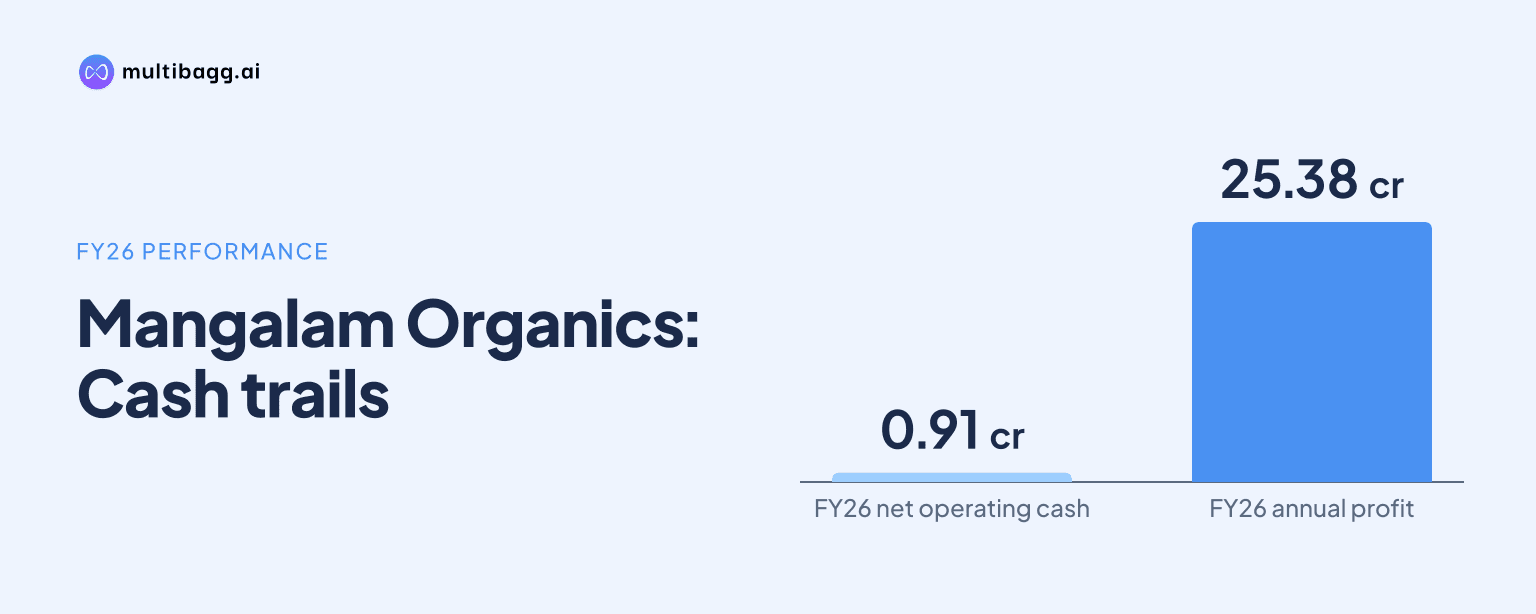
Mangalam Organics Limited generated Rs 0.91 crore of net cash from operating activities in FY26 despite reporting Rs 25.38 crore of profit for the year, because changes in working capital absorbed Rs 85.85 crore. The outflow largely offset Rs 89.10 crore of operating profit before working-capital changes and followed Rs 2.34 crore of net direct-tax payments.
Know Mangalam Organics inside out
Results, valuation, peers and who's buying, in one view.
Why did Mangalam Organics generate only Rs 0.91 crore of operating cash in FY26?
Mangalam Organics generated Rs 0.91 crore of operating cash because an Rs 85.85 crore working-capital outflow reduced Rs 89.10 crore of operating profit before working-capital changes to Rs 3.25 crore of cash generated from operations. Net direct taxes paid of Rs 2.34 crore then reduced this amount to the FY26 net operating cash inflow.
Profit for the year rose to Rs 25.38 crore in FY26 from Rs 12.50 crore in FY25, while net cash from operating activities improved from an outflow of Rs 7.84 crore to an inflow of Rs 0.91 crore. The FY26 difference between profit and net operating cash was Rs 24.47 crore, showing that higher reported earnings did not translate into a comparable cash inflow during the year.
Working capital contributed Rs 29.78 crore of cash in FY24, but absorbed Rs 66.67 crore in FY25 and Rs 85.85 crore in FY26. Although operating profit before working-capital changes increased by Rs 30.21 crore year on year to Rs 89.10 crore, the additional Rs 19.18 crore of working-capital absorption left only Rs 3.25 crore of cash generated from operations.
What balance-sheet movements accompanied Mangalam Organics’ working-capital outflow?
Mangalam Organics reported inventories of Rs 300 crore at March 2026, up Rs 87 crore from Rs 213 crore at March 2025, alongside the Rs 85.85 crore aggregate working-capital cash outflow. Trade receivables declined by Rs 10 crore to Rs 59 crore, while trade payables declined by Rs 4 crore to Rs 47 crore.
The inventory increase was the largest movement among the listed working-capital balances. Higher inventory and lower trade payables are cash uses in directional terms, while lower receivables release cash; however, the audited presentation does not provide a line-by-line cash-flow reconciliation assigning exact portions of the Rs 85.85 crore movement to inventory, receivables or payables.
The presentation lists total current assets of Rs 102 crore for March 2026 despite separately listing inventories of Rs 300 crore, trade receivables of Rs 59 crore and other current-asset balances. The displayed figures therefore do not reconcile within the slide, so they do not support a precise calculation of current assets, net working capital or liquidity ratios from this presentation alone.
Got a follow-up? Ask IRIS
How were Mangalam Organics’ investment spending and financing funded in FY26?
Mangalam Organics used Rs 60.05 crore in net investing cash flows during FY26 and generated Rs 59.78 crore from financing activities. With net operating cash of only Rs 0.91 crore, the disclosed cash-flow pattern shows financing inflows broadly offsetting the investing outflow rather than operating cash covering that amount.
Reported borrowings rose by Rs 87 crore to Rs 356 crore at March 2026, comprising current borrowings of Rs 301 crore and non-current borrowings of Rs 55 crore. Property, plant and equipment increased to Rs 328 crore from Rs 269 crore, while capital work-in-progress fell to nil from Rs 26 crore, alongside the Rs 60.05 crore investing outflow.
Financing inflows declined from Rs 73.63 crore in FY25 to Rs 59.78 crore in FY26, while the investing outflow narrowed from Rs 67.05 crore to Rs 60.05 crore. Net cash and cash equivalents increased by Rs 0.65 crore in FY26 after falling by Rs 1.27 crore in FY25; the balance sheet rounds cash and cash equivalents to Rs 1 crore in both March 2025 and March 2026.
Did Mangalam Organics’ FY26 earnings improve despite the cash conversion gap?
Mangalam Organics’ reported earnings improved in FY26: revenue rose 17.46% to Rs 622.57 crore, earnings before interest, tax, depreciation and amortisation (EBITDA) rose 49.91% to Rs 87.82 crore, and profit for the year increased 103.04% to Rs 25.38 crore. EBITDA margin increased to 14.11% from 11.05%, while profit after tax margin rose to 4.08% from 2.36%.
Profit before tax before exceptional items was Rs 36.80 crore in FY26, compared with Rs 16.62 crore in FY25, before an Rs 3.50 crore exceptional loss. Finance costs increased to Rs 28.19 crore from Rs 21.48 crore, a change that occurred alongside the Rs 87 crore increase in reported borrowings at March 2026.
FY26 also contrasted with FY24, when EBITDA was Rs 38.67 crore but net operating cash was Rs 72.72 crore because working capital contributed Rs 29.78 crore. By FY26, EBITDA had risen to Rs 87.82 crore, but the Rs 85.85 crore working-capital absorption reduced net operating cash to Rs 0.91 crore.
Conclusion
Mangalam Organics’ FY26 disclosures show a divergence between income-statement profitability and cash generation. Revenue, EBITDA and profit all increased from FY25, but the Rs 85.85 crore working-capital outflow, alongside Rs 2.34 crore of direct taxes paid, left net operating cash at Rs 0.91 crore. The Rs 87 crore rise in inventories and Rs 87 crore increase in reported borrowings were material accompanying balance-sheet movements.
The next reports will show whether inventory, borrowings and operating cash move differently after March 2026. Management said it would continue focusing on operational efficiencies and strengthening margins, but the presentation gives no target or timetable for reducing working-capital absorption; inventories were Rs 300 crore and total borrowings were Rs 356 crore at March 2026.