










Mangalam Organics Limited: terpenes provide 96% revenue
Key highlights
- Mangalam reports 96% of its disclosed revenue mix from B2B terpene operations and 4% from B2B synthetic resins.
- The 96% and 4% B2B revenue shares total 100%, while no separate B2C retail revenue share is disclosed.
- Mangalam increased stated camphor production capacity to 12,000 MT in 2025–26 from approximately 10,000 MT in 2021.
- Mangalam completed a 2,500 MT-per-year Bhimseni or isoborneol flakes expansion in 2025–26.
powered by IRIS
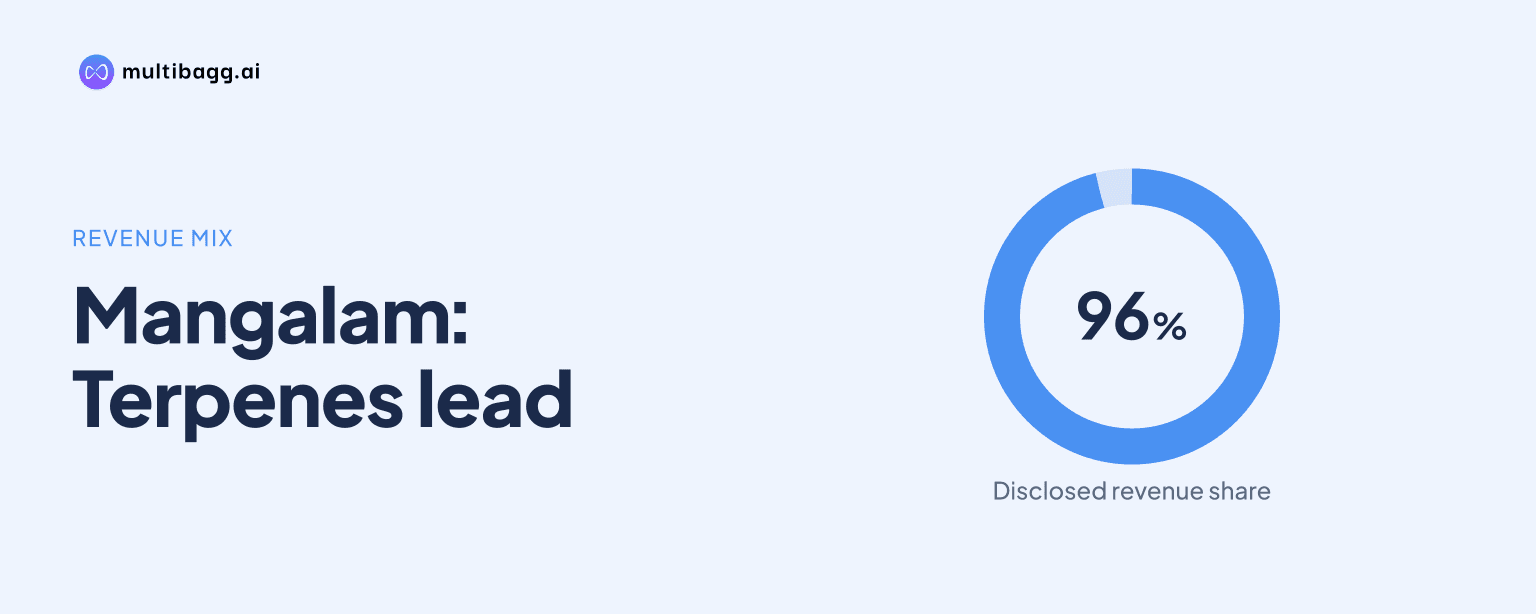
Mangalam Organics Limited reports that business-to-business (B2B) terpene operations accounted for 96% of the revenue break-up shown in its September 2026 investor presentation, compared with 4% for B2B synthetic resins. The two stated B2B shares total 100%, while the presentation separately describes retail brands without assigning them a revenue percentage.
Know Mangalam Organics inside out
Results, valuation, peers and who's buying, in one view.
What share of Mangalam revenue comes from terpene operations?
Mangalam states that B2B terpene operations represent 96% of revenue, while B2B synthetic resin operations represent 4%. This makes terpenes the main reported operating category in the September 2026 presentation, with a 92-percentage-point lead over synthetic resins. The presentation does not attach a revenue value, financial period, volume or margin to either percentage.
The 96% terpene share is 24 times the 4% synthetic-resin share. This comparison applies only to the two B2B categories in the revenue chart, not to individual products such as camphor, dipentene or terpene phenolic resin. Mangalam does not disclose a previous revenue mix, so the presentation does not establish whether either segment's share changed over time.
Which products are part of Mangalam's terpene business?
Mangalam lists camphor, dipentene, sodium acetate, isobornyl acetate and isoborneol in its B2B terpene business. Camphor is linked to religious use, healthcare and hygiene products; dipentene is linked to paints, cleaning and degreasing agents; and sodium acetate is linked to textiles, dyes and leather tanning. The slide does not provide product-level sales or customer names.
Isobornyl acetate and isoborneol are also included in the terpene portfolio, although the presentation gives no stated applications or revenue shares for either product. Mangalam says it completed a 2,500 metric tonne per annum Bhimseni or isoborneol flakes expansion in 2025–26. That project provides capacity context for isoborneol, but the source does not disclose production, utilisation or sales from the expanded facility.
How does Mangalam's synthetic resin business compare with terpenes?
Mangalam's synthetic resin business accounts for 4% of reported revenue, compared with 96% for terpenes. The segment therefore remains the smaller of the two B2B revenue categories by 92 percentage points. The presentation identifies the split but supplies no prior-period data to show whether the synthetic resin share rose or declined.
The synthetic resin portfolio comprises terpene phenolic resin, alkyl phenolic resin and resin esters. Terpene phenolic resin is listed for adhesives, tyres, rubber and chewing gum, while alkyl phenolic resin is listed for printing inks. This places adhesive-related applications in the 4% synthetic-resin segment, whereas paint, cleaning and degreasing uses are listed under dipentene in the 96% terpene segment.
Got a follow-up? Ask IRIS
What does Mangalam disclose about CamPure and Mangalam retail brands?
Mangalam identifies CamPure and Mangalam as business-to-consumer (B2C) retail operations, but does not disclose a separate retail revenue share. CamPure is described as a camphor-based homecare and personal-care range, while Mangalam includes camphor tablets for religious use and private-labelling initiatives. The two B2B revenue shares already total 100% in the chart.
The Mangalam range includes camphor tablets, camphor brass cleaner, Bhim Seni camphor puja oil and Bhim Seni camphor. CamPure's displayed products include INSTA, disinfectant, Classic Cone, Spray Matic and Blissful Lavender car freshener. The product labels show duration claims of up to 25–30, 45–60, 2,800 and 30–45 respectively, but the slide does not state the unit for those claims.
What capacity changes support Mangalam's terpene portfolio?
Mangalam says camphor production capacity increased to 12,000 metric tonnes (MT) in 2025–26, from approximately 10,000 MT after a 2021 expansion. The presentation therefore shows a higher stated camphor capacity at the 2025–26 point than in 2021. It does not provide capacity utilisation, output, demand estimates or the financial effect of the increase.
The company also states that the 2,500 MT per annum Bhimseni or isoborneol flakes expansion was completed in 2025–26. Its operating history dates Rosin and Turpentine manufacturing to 1949, a Khopoli Rosin and Turpentine facility to 1988, and a camphor manufacturing facility to 1994. Synthetic resins began in 2007, later than the manufacturing activities associated with the terpene portfolio.
Conclusion
Mangalam's September 2026 presentation depicts a revenue mix led by B2B terpenes at 96%, with B2B synthetic resins at 4%. The terpene category spans products serving religious, healthcare, hygiene, paint, cleaning, textile and leather-related applications, while synthetic resins include products for adhesives, rubber, tyres, chewing gum and printing inks. CamPure and Mangalam retail ranges are presented as B2C operations but without revenue allocation.
The next disclosed operating matters to watch are the 12,000 MT camphor capacity level and the completed 2,500 MT-per-year Bhimseni or isoborneol flakes expansion in 2025–26. Mangalam has not disclosed utilisation, production, revenue or margin targets for either capacity addition, leaving later disclosures on their sales contribution relevant to assessing the terpene-led business mix.