










Marksans revenue rose 3.8 times as acquisitions expanded
Key highlights
- Marksans reported FY26 operating revenue of Rs 2,951 crore, about 3.8 times the Rs 767 crore reported in FY17.
- Marksans' FY26 OTC revenue was Rs 2,361 crore, compared with Rs 445 crore in FY17.
- Marksans increased manufacturing capacity from 6 billion units annually in 2017 to 26 billion units annually in FY26.
- Marksans acquired QlinIQ in the Netherlands on June 1, 2026 and ABCnow in Germany on July 8, 2026.
powered by IRIS
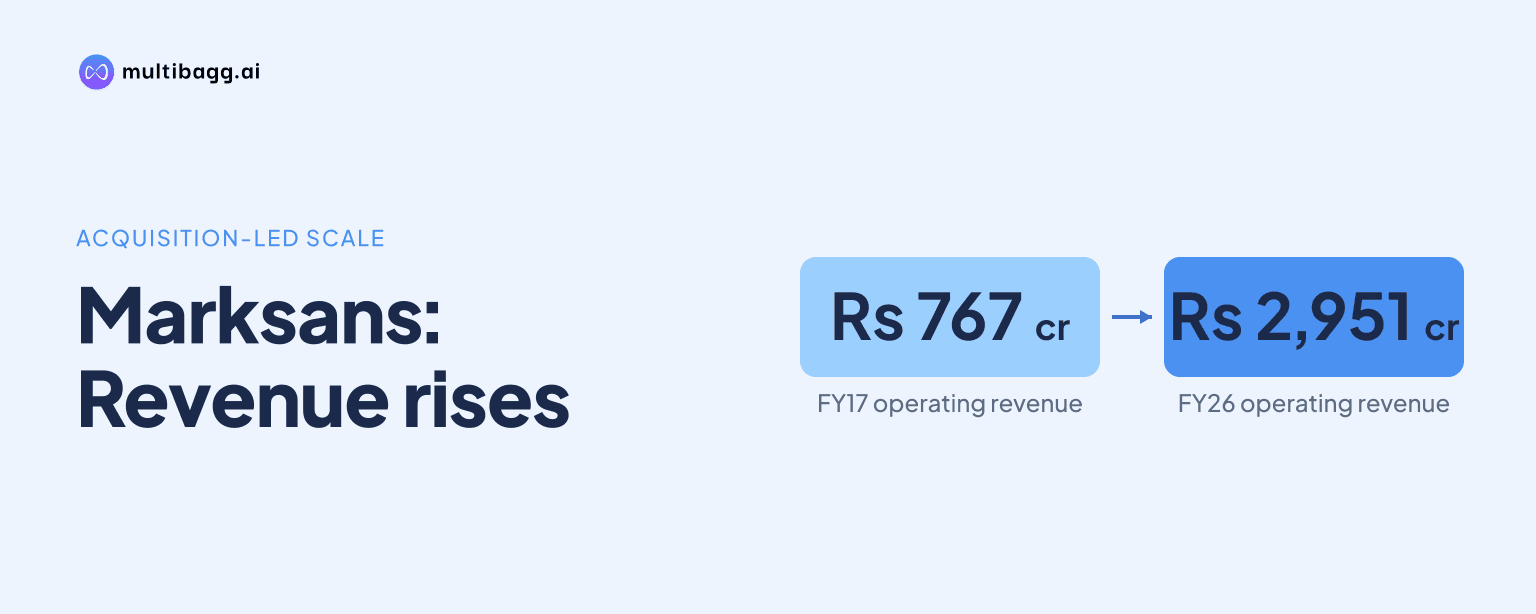
Marksans Pharma Ltd. increased FY26 operating revenue to Rs 2,951 crore, about 3.8 times its Rs 767 crore FY17 level, while acquisitions built commercial front ends from Australia to Germany. The company also reported Rs 2,361 crore of over-the-counter, or OTC, revenue in FY26 and 26 billion units of annual manufacturing capacity.
Know Marksans Pharma inside out
Results, valuation, peers and who's buying, in one view.
How has Marksans used acquisitions to build market access?
Marksans has used acquisitions to establish front-end market access in Australia, the United Kingdom, the United States, the Middle East and Africa, the Netherlands and Germany. Its first listed deal was Nova Pharmaceuticals Australasia Pty Ltd, acquired on March 24, 2006 to leverage research capabilities and establish an Australia and New Zealand front end; Marksans reports sales growth of about 74 times from acquisition.
The company acquired Bell, Sons & Co. (Druggists) Ltd on December 31, 2007 to strengthen its UK presence and enter OTC, and acquired Relonchem Ltd on August 27, 2008 to establish a UK front end. The presentation reports sales growth of about seven times for Bell's Healthcare and about 15 times for Relon Chem from acquisition. Time-Cap Laboratories Inc., acquired in the US on June 30, 2015, established a US front end and recorded about four-times sales growth from acquisition.
Access Healthcare Dubai, acquired on April 25, 2022, was intended to create a front-end presence in the Middle East and Africa. Marksans then acquired a Goa manufacturing facility from Teva Pharma India on April 19, 2023, with the stated purpose of expanding Indian manufacturing capacity. In 2023, the company also raised Rs 372.40 crore in equity through conversion of warrants issued to OrbiMed and promoters.
In 2026, Marksans entered Germany, Canada and Ireland, acquired QlinIQ B.V. in the Netherlands on June 1, and acquired ABCnow GmbH in Germany on July 8. QlinIQ was acquired to establish a European Union front end, while ABCnow was intended to establish a German front end. The presentation provides no sales-growth measure for the 2022, 2023 or 2026 transactions, unlike the earlier Australia, UK and US deals.
What changed in Marksans revenue, OTC sales and margins since FY17?
Marksans increased operating revenue to Rs 2,951 crore in FY26 from Rs 767 crore in FY17, a rise of about 3.8 times and a stated compound annual growth rate, or CAGR, of 16.1%. OTC revenue grew faster, reaching Rs 2,361 crore in FY26 from Rs 445 crore in FY17, or about 5.3 times, with a stated 20.4% CAGR.
Earnings before interest, tax, depreciation and amortisation, or EBITDA, rose to Rs 601 crore in FY26 from Rs 45 crore in FY17. EBITDA margin increased to 20.4% from 5.8%, although it was below the 24.7% reported in FY21. In H1FY27, EBITDA was Rs 427 crore and the margin was 24.0%, compared with Rs 245 crore and 18.2% in H1FY26.
OTC revenue increased from Rs 2,066 crore in FY25 to Rs 2,361 crore in FY26, after Marksans said the segment crossed Rs 2,000 crore in 2025. The company identifies store-brand OTC as a strategic focus and reported more than 2,000 stock-keeping units, or SKUs, in FY26. The presentation does not state the FY17 SKU count, so the scale of SKU growth cannot be measured from the disclosed data.
Got a follow-up? Ask IRIS
How did Marksans expand capacity and product development?
Marksans increased manufacturing capacity from 6 billion units a year in 2017 to 26 billion units a year in FY26. The FY26 figure includes the acquired Goa facility, which has scalable capacity of up to 8 billion units annually. Management plans to expand Indian capacity to 16 billion units a year for tablets, hard capsules, ointments, liquids and creams.
The existing Goa unit has capacity for 2.4 billion softgel and hard-gelatin capsules and 6 billion solid tablets annually. The Farmingdale facility in the US can produce 6 billion tablets and hard capsules annually, while the Southport facility in the UK can produce 2 billion bottles, 1 billion tubes and 1 billion sachets. Southport supplies the UK, West Africa and the Middle East.
Research and development, or R&D, spending rose to Rs 89 crore in FY26 from Rs 5 crore in FY17, increasing to 3.0% of sales from 0.6%. H1FY27 R&D spending was Rs 47 crore, or 2.6% of sales. Marksans reports four R&D centres, more than 200 products in its pipeline, more than 350 approved abbreviated new drug applications or marketing authorisations, and more than 30 filings awaiting approval.
Management plans to add 20 to 25 products annually, focusing on softgels, extended-release products, liquids, OTC products and ointments. It also says it will follow a calibrated inorganic-growth approach, pursuing front-end marketing and distribution companies in growing markets and Europe. These plans link future product additions and capacity expansion to the acquisition strategy disclosed through July 2026.
What do Marksans assets, debt and returns show after expansion?
Marksans reported total assets of Rs 3,861 crore in FY26, up from Rs 752 crore in FY17, while net worth increased to Rs 3,053 crore from Rs 440 crore. By H1FY27, total assets were Rs 4,360 crore and net worth was Rs 3,367 crore. This balance-sheet expansion occurred across the period that included the Rs 372.40 crore warrant conversion in 2023.
Net debt to EBITDA moved from 1.6 times in FY17 to negative 1.6 times in FY26, and stood at negative 1.3 times in both H1FY26 and H1FY27. Return on capital employed, or ROCE, increased to 20.0% in FY26 from 4.8% in FY17, while return on equity, or ROE, increased to 15.2% from 2.5%.
The return measures did not rise in a straight line. ROCE reached 35.8% in FY21 before declining to 21.4% in FY22 and 20.0% in FY26; ROE peaked at 30.7% in FY21 before reaching 15.2% in FY26. H1FY27 ROCE was 24.7% and ROE was 18.6% on Marksans' trailing-12-month methodology.
Marksans defines ROCE as earnings before interest and tax divided by capital employed, and defines ROE as net profit after tax divided by average shareholder value. Its capital-employed definition includes tangible net worth, total debt and deferred tax liabilities. The higher H1FY27 ratios therefore need to be read as trailing-12-month figures rather than standalone six-month results.
Conclusion
Marksans' disclosed record shows acquisitions adding commercial front ends across several markets while operating scale expanded substantially. From FY17 to FY26, operating revenue rose from Rs 767 crore to Rs 2,951 crore, OTC revenue rose from Rs 445 crore to Rs 2,361 crore, EBITDA rose from Rs 45 crore to Rs 601 crore, and manufacturing capacity increased from 6 billion to 26 billion units annually.
The next items to watch are management's plan to expand Indian capacity to 16 billion units annually, add 20 to 25 products each year and pursue calibrated acquisitions of marketing and distribution businesses. The presentation has not yet disclosed sales-growth data for Access Healthcare, the acquired Goa facility, QlinIQ or ABCnow, leaving the financial contribution of those more recent transactions unresolved.