










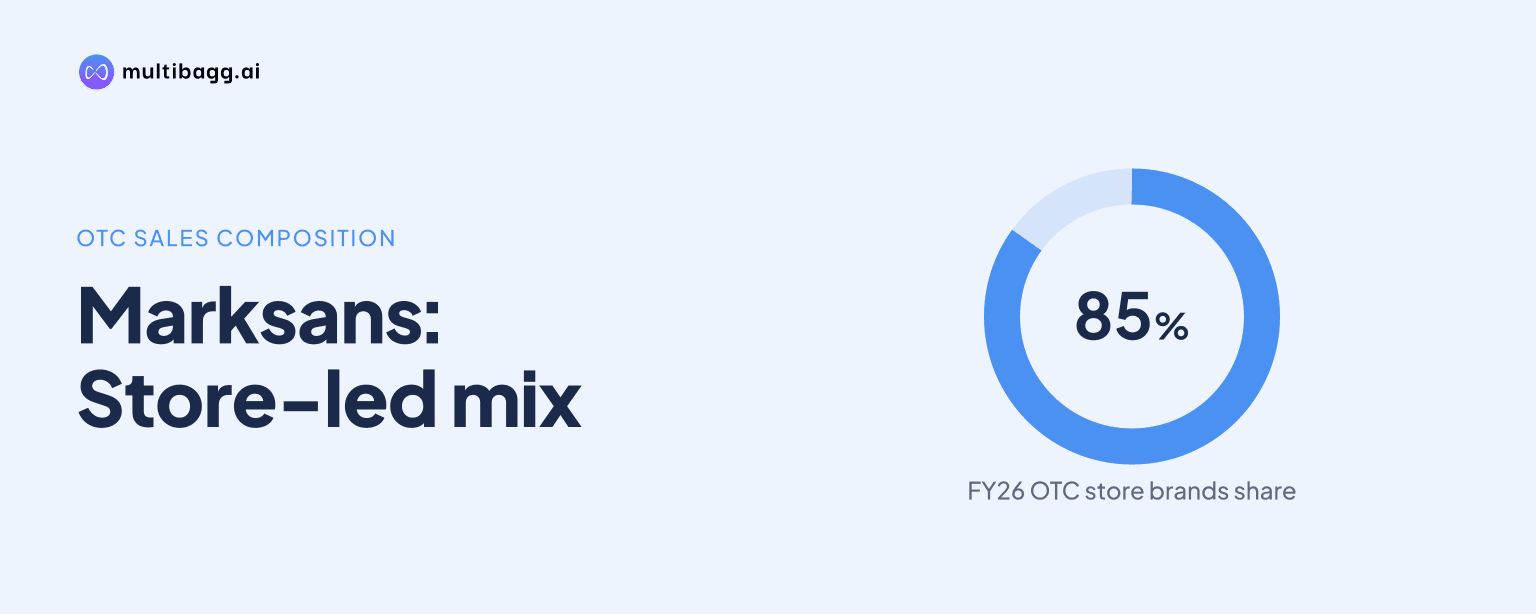
Marksans store brands made up 85% of FY26 OTC revenue
Key highlights
- Marksans said store brands represented approximately 85% of FY26 OTC revenue, versus 15% for own labels.
- OTC contributed 80.0% of Marksans’ FY26 revenue and recorded a 20.4% CAGR from FY17 to FY26.
- Marksans reported 26 billion units of annual manufacturing capacity, compared with 6 billion units in 2017.
- R&D spending rose to Rs 89 crore, or 3.0% of sales, in FY26 from Rs 58 crore in FY25.
powered by IRIS
Marksans Pharma Limited said approximately 85% of its FY26 over-the-counter (OTC) revenue came from store brands, making retailer and customer private-label manufacturing the core of an OTC segment that represented 80.0% of FY26 revenue; it also reported 26 billion units of annual manufacturing capacity and more than 200 pipeline products.
Know Marksans Pharma inside out
Results, valuation, peers and who's buying, in one view.
How is Marksans’ OTC revenue structured?
Marksans’ FY26 OTC revenue was approximately 85% store brands and 15% own labels. The company defines store brands as private-label manufacturing for retailers and customers, while its own-label business covers products sold under its own label. Marksans notes that the FY26 revenue split is an approximate range rather than a precise allocation.
OTC represented 80.0% of Marksans’ FY26 revenue by business segment, compared with 20.0% from prescription, or Rx, products. This means the store-brand model sits within the company’s larger revenue segment: most FY26 revenue was OTC, and most of that OTC revenue was generated by private-label supply rather than own-label products.
Marksans reported an OTC revenue compound annual growth rate (CAGR) of 20.4% from FY17 to FY26. It also said OTC revenue reached Rs 2,361 crore in FY26, about 5.3 times its 2017 level, while operating revenue reached Rs 2,951 crore, about 3.8 times its 2017 level. The comparison shows that OTC revenue grew by a higher stated multiple than operating revenue over the period.
What manufacturing capacity supports Marksans’ OTC business?
Marksans reported total manufacturing capacity of 26 billion units a year in FY26, up from 6 billion units a year in 2017. Its manufacturing network spans Farmingdale in the United States, Southport in the United Kingdom and two facilities in Goa, India, covering tablets, capsules, liquids, ointments, tubes and sachets.
The Farmingdale facility has capacity for 6 billion tablets and hard capsules a year and has added incremental packaging lines. The 7,000-square-metre United States site makes hard gels, tablets and capsules, holds United States Food and Drug Administration accreditation and supports Marksans’ “Made in the USA” product offering.
In the United Kingdom, Marksans’ Southport site can make 2 billion bottles, 1 billion tubes and 1 billion sachets a year. The 7,300-square-metre facility produces non-sterile liquids, ointments and powder sachets for the United Kingdom, West Africa and the Middle East, and it holds Medicines and Healthcare products Regulatory Agency accreditation.
Marksans’ existing Goa Unit 1 has annual capacity for 2.4 billion softgel and hard-gelatin capsules and 6 billion solid tablets. The company said the acquired Goa Unit 2 has scalable capacity of 8 billion units a year and is planned for tablets, ointments, liquids and creams. Marksans also disclosed a plan to double its existing Indian capacity from 8 billion units annually, positioning the acquired site as a capacity-expansion mechanism.
Got a follow-up? Ask IRIS
How is Marksans building its product pipeline?
Marksans raised research and development (R&D) spending to Rs 89 crore in FY26, equal to 3.0% of sales, from Rs 58 crore and 2.2% of sales in FY25. This followed R&D spending of Rs 35 crore, or 1.6% of sales, in FY24, so both the rupee expenditure and the share of sales increased in FY26.
Marksans spent Rs 47 crore on R&D in H1FY27, equivalent to 2.6% of sales in that partial period. H1FY27 does not establish a full-year spending trend against FY26 because it covers only six months, but the disclosed expenditure shows R&D remained a spending area following the FY26 increase.
Marksans operates four R&D centres in Farmingdale, Southport, Goa and Navi Mumbai, with more than 50 scientists. It listed more than 200 products in its pipeline, more than 350 approved Abbreviated New Drug Applications (ANDAs) and Marketing Authorisations (MAs), and more than 30 ANDAs and MAs filed and awaiting approval. Management plans to add 20 to 25 products annually, focusing on softgels, extended-release delivery systems, liquids, OTC products and ointments.
Which products and market trends frame Marksans’ OTC strategy?
Marksans’ FY26 therapeutic portfolio included pain management, cough and cold, gastrointestinal, anti-allergic, vitamin and mineral supplements and anti-hair-fall products. Pain management was the largest reported therapeutic category, followed by cough and cold and gastrointestinal products, linking the company’s formulations and delivery formats to established consumer-health categories.
The FY26 mix also included cardiovascular-system, central-nervous-system, anti-diabetic, anti-infective and anti-cancer medicines. These categories operate alongside the 80.0% OTC and 20.0% Rx revenue split, indicating that the company’s development and manufacturing platform serves prescription-oriented products as well as consumer-health products.
Marksans cited IQVIA’s projection that the global OTC market would reach $215 billion in calendar 2026, following $204 billion projected for 2025. It identified prescription-to-OTC switches as a key industry growth driver. The $215 billion figure is an external market projection cited by Marksans, rather than a company revenue target.
Conclusion
Marksans’ disclosures describe an OTC model led by retailer and customer private-label supply, backed by 26 billion units of annual capacity and a rising R&D budget. The approximate 85% store-brand share of FY26 OTC revenue, combined with OTC’s 80.0% share of total segment revenue, places private-label manufacturing at the centre of its consumer-healthcare business.
The next items to watch are management’s plan to add 20 to 25 products each year, development of the acquired Goa site toward its scalable 8-billion-unit capacity and the outcome of more than 30 ANDA and MA filings awaiting approval. The presentation also identifies product filings and initial approvals in Canada, with commercial revenue expected in coming quarters.