










MAS Financial crosses Rs 17,042 crore AUM without new capital
Key highlights
- MAS Financial's consolidated AUM reached Rs 17,042 crore in Q2 FY27, up 23.31% year on year.
- MAS Financial reported consolidated Q2 FY27 PAT of Rs 115 crore, about 26% above the corresponding quarter.
- MAS Financial's capital adequacy ratio was 22.12% as of September 30, 2026, and management does not expect a near-term capital raise.
- MAS Rural Housing crossed Rs 1,000 crore in AUM and reported Q2 FY27 PAT growth of 54.71% to Rs 4.62 crore.
powered by IRIS
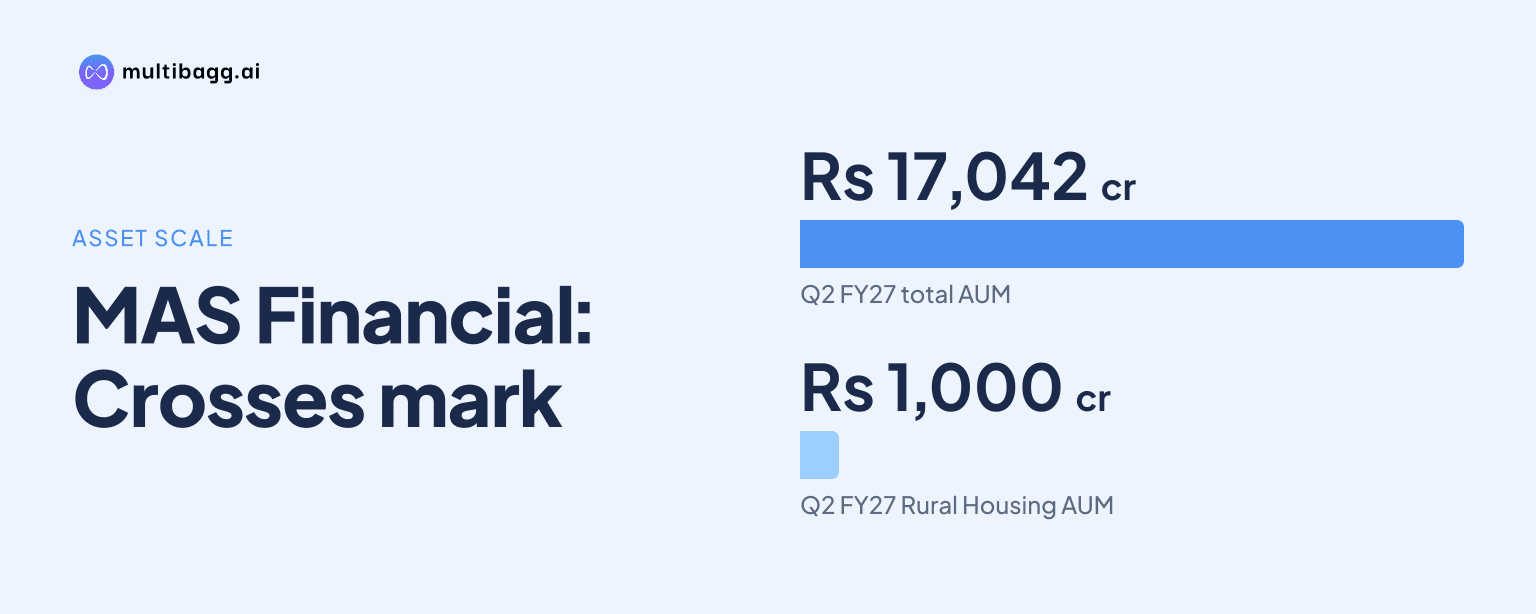
MAS Financial Services Limited crossed Rs 17,042 crore in consolidated assets under management in Q2 FY27, up 23.31% year on year, while management said a 22.12% capital adequacy ratio means it does not expect to raise capital in the near future. Consolidated profit after tax rose about 26% to Rs 115 crore.
Know MAS Financial Services inside out
Results, valuation, peers and who's buying, in one view.
Why is MAS Financial not planning to raise capital soon?
MAS Financial said it does not expect a near-term capital raise because its capital adequacy ratio was 22.12% as of September 30, 2026, including Tier 1 capital of 20.82%. Chairman and Managing Director Kamlesh Gandhi said MAS Financial last raised capital when its assets under management, or AUM, were Rs 10,000 crore, compared with consolidated AUM of Rs 17,042 crore in Q2 FY27. Its debt-to-equity ratio was 3.50 times.
Management described its model as self-propelling, with existing capital and internal profit generation expected to support expansion. This is management's assessment, rather than a formal capital target. MAS Financial has said it aims for AUM growth of 20% to 25%, depending on market opportunities and risk considerations, and management said it could be within striking distance of Rs 20,000 crore in AUM by FY27-end.
How did MAS Financial's AUM and profit change in Q2 FY27?
MAS Financial's consolidated AUM increased 23.31% year on year to Rs 17,042 crore in Q2 FY27, after it crossed Rs 16,000 crore in the preceding quarter. Consolidated profit after tax, or PAT, rose about 26% from the corresponding quarter to Rs 115 crore. First-half consolidated PAT increased 26.54% to Rs 225 crore, showing profit growth ahead of the reported 23.31% AUM growth.
On a standalone basis, MAS Financial's portfolio rose 23.17% to Rs 16,011.38 crore in Q2 FY27 from Rs 12,999.44 crore in Q2 FY26. Total income grew 21.94% to Rs 560.29 crore, while profit before tax increased 22.58% to Rs 147.38 crore and PAT rose 22.69% to Rs 110.05 crore. For H1 FY27, standalone PAT grew 23.65% to Rs 214.65 crore from Rs 173.60 crore a year earlier.
MAS Rural Housing and Mortgage Finance Limited crossed Rs 1,000 crore in AUM during Q2 FY27. MAS Rural Housing's portfolio rose 25.53% to Rs 1,031.47 crore from Rs 821.70 crore a year earlier, faster than the 23.17% growth in MAS Financial's standalone portfolio. Its quarterly PAT increased 54.71% to Rs 4.62 crore from Rs 2.99 crore, although it remained a smaller contributor than the standalone business.
What products and distribution channels are driving MAS Financial's growth?
MAS Financial said micro-enterprise loans remain its flagship business, while its small and medium enterprise loans extend up to Rs 5 crore and are collateral-backed. Its portfolio also includes two-wheelers, commercial vehicles, salaried personal loans and housing finance. Salaried personal loans accounted for about 9% of total assets, below management's stated ceiling of 10%, while MAS Rural Housing's AUM exceeded Rs 1,000 crore.
MAS Financial's direct distribution accounted for about 68% of assets and distribution through non-banking financial companies, or NBFCs, made up about 32%. Management said it is expanding the reach of existing branches rather than adding branches rapidly, seeking to avoid substantial upfront expansion costs. This model accompanied AUM growth of close to 23.5% in the first half.
MAS Financial reported decent two-wheeler growth but remains cautious on commercial-vehicle growth. Management said it is building its own commercial-vehicle distribution and manpower across its operating locations, and expects this business to pick up over the next two to three quarters. It is also using a loan-origination system with a business rules engine, which management said helps field officers and reduces origination and operating costs.
Got a follow-up? Ask IRIS
How are MAS Financial's asset quality, funding and rate risks changing?
MAS Financial's standalone gross Stage 3 assets were 2.63% in Q2 FY27, compared with 2.58% in the June quarter, while net Stage 3 assets were unchanged at 1.70%. The company held a Rs 17 crore management overlay that was not netted from net Stage 3 assets. Management attributed the movement in gross Stage 3 assets partly to seasoning in retail portfolios, especially wheels, and continuing stress in micro, small and medium enterprises over the past one to one-and-a-half years.
MAS Rural Housing reported gross Stage 3 assets of 0.99% in Q2 FY27, compared with 0.98% in the June quarter, while net Stage 3 assets increased to 0.70% from 0.68%. MAS Rural Housing carried a separate Rs 3.69 crore management overlay outside its net Stage 3 calculation. The subsidiary's gross and net Stage 3 ratios remained below MAS Financial's standalone ratios of 2.63% and 1.70%, respectively.
MAS Financial's average borrowing cost was 9.19% in Q2 FY27, down 43 basis points from the corresponding period a year earlier and 6 basis points from 9.25% in the previous quarter. Management said about 20% of borrowings were fixed rate and about 50% were linked to the marginal cost of funds based lending rate, or MCLR, mainly with one-year resets. It said the remaining repo-linked borrowing generally resets every three months.
Management expects a 20 to 25 basis-point increase in borrowing costs if the Reserve Bank of India's 25 basis-point repo-rate increase is followed by a further 25 basis-point increase during the year. It said around 65% to 70% of assets are fixed-rate, but shorter loan tenures allow repricing on new disbursements. Management said these levers, including renegotiating bank spreads and repricing floating-rate assets, should help limit the effect on return on assets.
MAS Financial maintained average balance-sheet liquidity of about Rs 1,000 crore during the quarter and had borrowing sanctions exceeding Rs 2,500 crore as of September 30, 2026. It executed direct-assignment transactions of about Rs 850 crore during Q2 FY27 and had about Rs 850 crore of further sanctions expected to be used in the current quarter. Off-book assets were 17% of the portfolio, below management's strategic objective of 20% to 25%.
Conclusion
MAS Financial paired 23.31% consolidated AUM growth with about 26% quarterly PAT growth in Q2 FY27, while management cited the 22.12% capital adequacy ratio in saying fresh capital is not expected soon. The standalone business produced Rs 110.05 crore in quarterly PAT, while MAS Rural Housing recorded faster 54.71% PAT growth to Rs 4.62 crore from a smaller base.
The next points to watch are management's 20% to 25% AUM-growth range and its expectation of nearing Rs 20,000 crore by FY27-end. Management also expects its commercial-vehicle distribution buildout to gain pace over the next two to three quarters, while MAS Rural Housing plans to begin generating numbers from Tamil Nadu and Karnataka from Q4 onward.