










MAS Financial targets 300 branches through centre expansion
Key highlights
- MAS plans to increase its branch network from 210 to about 300 over the next 2 years.
- MAS added almost 1,000 centres in the last 4 to 5 quarters.
- An analyst said 68% of MAS's book now comes from own branches, versus less than 50% 4 to 5 years ago.
- MAS is hiring senior staff to support growth from around Rs 17,000 crore to Rs 18,000 crore toward Rs 30,000 crore to Rs 35,000 crore of assets.
powered by IRIS
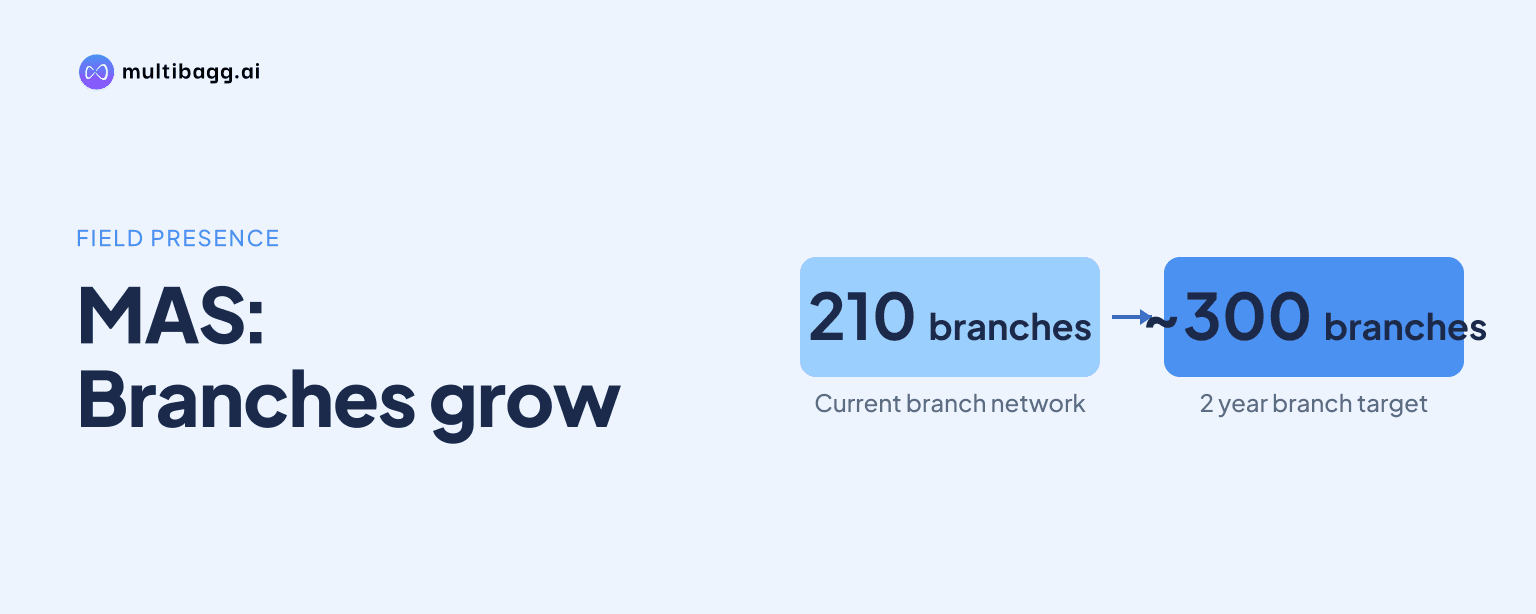
MAS Financial plans to increase its branch network from 210 to about 300 over the next two years, while adding almost 1,000 centres in the last four to five quarters. The plan relies on extending reach from existing outlets and hiring senior personnel as MAS works toward a medium-term asset base of Rs 30,000 crore to Rs 35,000 crore.
Know MAS Financial Services inside out
Results, valuation, peers and who's buying, in one view.
How will MAS expand its distribution network?
MAS will expand its distribution primarily through additional centres served by existing branches, while increasing its branch count from 210 to about 300 over the next two years. Management said a branch typically operates within a 40-kilometre to 60-kilometre range, depending on local demography, making centre additions a more relevant measure of ground coverage than branch openings alone.
The strategy has produced almost 1,000 additional centres during the last four to five quarters, despite branch additions remaining slow in recent quarters. Management said the medium- to long-term branch target remains unchanged and includes expansion in northern and southern India, though it did not provide state-level branch or centre targets.
An analyst on the call said 68% of the book now comes from MAS's own branches, compared with less than 50% four to five years ago. Management did not give branch-level profitability data, but said it has increased retail business without a substantial rise in operating costs that could affect return on assets, or ROA.
Why is MAS adding centres instead of branches?
MAS says adding centres can extend local coverage while containing infrastructure and operating costs. Management is also working on digital transformation, improved demographic assessment and better branch placement to reduce the cost of serving retail borrowers as distribution expands.
Each branch's 40-kilometre to 60-kilometre catchment gives MAS the ability to add local centres before creating a new branch. Management linked this approach to its objective of creating quality retail assets and said it sees continuing scope to improve digital processes, geographic deployment and its understanding of borrower demographics.
The company measures the outcome against an ROA objective of 2.75% to 3%. Management said product mix can change disbursement growth, yields and quarterly ratios, but it intends to manage activities so that risk-adjusted returns remain within that ROA range.
Where will MAS add business and branches?
MAS expects newer geographies to contribute a higher percentage of incremental business, while established markets should remain the larger source of absolute additions for the next few quarters. Management said there is still potential to grow across products in existing geographies, even as northern and southern expansion proceeds.
Management illustrated the percentage effect with an example of southern business growing from Rs 100 crore to Rs 150 crore, which would represent 50% growth from a smaller base. That means percentage growth in new regions may exceed that in older markets without displacing established geographies as the main contributor to absolute business growth.
MAS's housing finance arm is continuing its plan for Tamil Nadu and Karnataka, with no change because of the macro environment. Management said it will enter with suitable teams, develop an understanding of local geography and demography, and scale gradually; numbers from those states are expected from Q4, with a foothold anticipated in the following financial year.
Got a follow-up? Ask IRIS
Which senior roles is MAS hiring for scale?
MAS is hiring experienced personnel in sales, business development, underwriting, credit, operations and technology as it prepares to grow from around Rs 17,000 crore to Rs 18,000 crore toward Rs 30,000 crore to Rs 35,000 crore of assets. Management said it is seeking senior hires from peers and the market who have operated businesses at comparable scale.
The hiring does not signal a new product line. Management said the focus remains on existing lending segments, including SME and Wheels, and that senior recruits may lead sub-products within those segments rather than a new category.
MAS has also created talent hubs in Mumbai and Delhi, allowing some senior recruits to work outside its Ahmedabad head office. Management said the hubs should widen the pool of available leadership as it builds teams and systems for expansion across sales, credit delivery, operations and technology.
In Wheels, management said the company is developing teams, processes and technology to reduce customer friction and improve turnaround time, or TAT, while retaining credit discipline. It expects Wheels to become a meaningful contributor over time, but said the segment will take time to reach the volumes it seeks.
What could slow MAS's expansion?
MAS may take a more cautious approach to growth if it detects early repayment bounces, early delinquencies, material deterioration in a segment, or macro disruption affecting logistics or energy. Management said it was not seeing such conditions at the time of the call, but would tighten policy parameters if these early-warning indicators emerged.
Credit demand remains strong, according to management, although forward-looking borrower assessment and caution in vulnerable income segments could lower sanction rates. Management said stronger demand could offset lower approval rates, but also stated that MAS is prepared to reduce growth if it does not find sufficient suitable lending opportunities.
Asset-quality monitoring is part of that discipline. Management said gross non-performing assets should remain between 2.5% and 2.75%, while net non-performing assets should stay below 2%; it attributed the recent rise in overdue buckets broadly to Wheels, alongside retail portfolio seasoning and SME stress over the previous one to one-and-a-half years.
MAS also said assignment funding may fluctuate quarter to quarter with available opportunities, but should strategically hover between 20% and 22%. Management said its capital position allows it to choose borrowing sources selectively rather than expand independently of underwriting standards, operating capacity or balance-sheet considerations.
Conclusion
MAS's plan combines a rise from 210 to about 300 branches with a centre-led model that has already added almost 1,000 centres in four to five quarters. The approach seeks to widen reach while containing fixed infrastructure costs, supported by senior hiring across sales, credit, operations and technology as the company targets Rs 30,000 crore to Rs 35,000 crore of assets.
The next indicators are progress toward 300 branches within two years, contributions from northern and southern markets, and the housing finance rollout in Tamil Nadu and Karnataka from Q4. Management has also identified early bounces, delinquencies and logistics or energy disruptions as conditions that could lead it to tighten lending parameters and moderate growth.