










MAS Financial expects Stage 3 assets within 2.5%-2.75%
Key highlights
- MAS Financial reported gross Stage 3 assets of 2.63%, versus 2.58% in the June quarter.
- Management expects MAS Financial's gross Stage 3 assets to remain between 2.5% and 2.75%.
- Net Stage 3 assets were unchanged at 1.70%, before a Rs 17 crore management overlay.
- MAS Financial's rural housing subsidiary reported 0.99% gross Stage 3 assets on a Rs 1,031.47 crore portfolio.
powered by IRIS
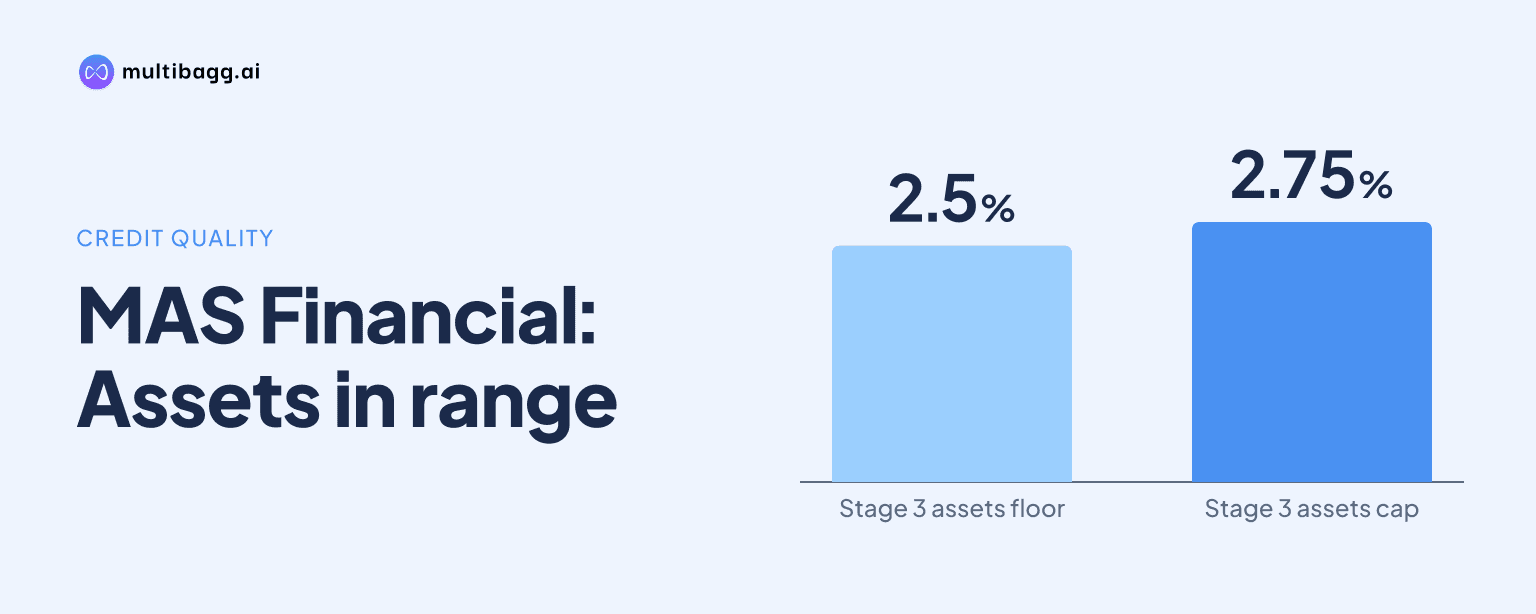
MAS Financial expects gross Stage 3 assets to remain between 2.5% and 2.75%, after the ratio increased to 2.63% from 2.58% in the June quarter. Management attributed the recent increase in overdue buckets mainly to wheels finance and retail-book seasoning, while retaining its 2.75% to 3% return-on-assets target.
Know MAS Financial Services inside out
Results, valuation, peers and who's buying, in one view.
Why did MAS Financial's Stage 3 ratio rise?
MAS Financial said the rise reflected the seasoning of its retail portfolio, particularly the wheels business, rather than a single identified deterioration across all lending products. Gross Stage 3 assets increased by 5 basis points to 2.63% from 2.58% in the June quarter, while net Stage 3 assets remained unchanged at 1.70%. A basis point is one-hundredth of a percentage point.
Management also cited continuing stress in micro, small and medium enterprises, or MSMEs, over the last 1 to 1.5 years, although it said this had stabilised somewhat in the past year or one to two quarters. It said the retail portfolio had changed from a 40/60 mix to 30/68, without defining those measures in the call, and described wheels as a higher-yield, higher-credit-loss product.
The increase was also visible in earlier delinquency buckets. Asked about movements in loans overdue by 61 to 90 days and 91 to 120 days, management said the change was broad-based but led by wheels finance. MAS Financial did not disclose the value or percentage of those buckets, but the analyst also referred to higher provisions during the quarter.
MAS Financial said the Rs 17 crore management overlay was not netted off from reported net Stage 3 assets. That treatment means the 1.70% net Stage 3 ratio was stated before reflecting the separate overlay, according to management's explanation on the call.
What is MAS Financial's Stage 3 asset outlook?
MAS Financial expects gross Stage 3 assets to stay between 2.5% and 2.75% and net non-performing assets to remain below 2%. Management said the reported 2.63% gross Stage 3 ratio was inside that range and could decline in coming quarters if conditions are favourable.
Management cautioned that small quarter-to-quarter moves should not alone define the direction of asset quality. It said a change from 2.58% to 2.62% should not necessarily be treated as deterioration, just as a move from 2.62% to 2.55% should not automatically be read as improvement, given MAS Financial's multiple products and borrower groups with vulnerable incomes.
The company said it measures performance through risk-adjusted returns and plans its activities to retain return on assets, or ROA, in the 2.75% to 3% range. Management's stated mechanism is that yields on products carrying greater credit risk should compensate for credit losses and operating costs, rather than an expectation that every product will have the same delinquency profile.
Which MAS Financial portfolios have lower or higher delinquencies?
MAS Financial identified wheels finance as the main contributor to recent overdue-bucket pressure, while its rural housing subsidiary reported considerably lower Stage 3 ratios. The standalone portfolio had gross and net Stage 3 assets of 2.63% and 1.70%, respectively, compared with 0.99% and 0.70% for the rural housing business.
MAS Financial's rural housing portfolio grew 25.53% to Rs 1,031.47 crore from Rs 821.70 crore. Its gross Stage 3 ratio rose by 1 basis point from 0.98% in the June quarter, while net Stage 3 assets rose by 2 basis points from 0.68%; it also carried a Rs 3.69 crore management overlay not netted from net Stage 3 assets.
Management said wheels requires the right teams, processes and technology because it serves individual borrowers and needs both low customer friction and disciplined credit assessment. It did not disclose a separate wheels Stage 3 ratio, a target date for resolving the overdue pressure, or the portfolio's value during the call.
Got a follow-up? Ask IRIS
How does MAS Financial plan to manage wheels risk?
MAS Financial said it will develop the teams, processes and technology needed to expand wheels finance without pursuing volumes at any cost. Management said the immediate task is to balance customer service and turnaround time, or TAT, with portfolio quality and loan volumes.
Management remained optimistic about wheels over the long term but said it would take time for the business to produce the scale it seeks. The stated approach is to assess risk in a comprehensive manner, ensure teams follow processes and avoid compromising credit standards merely to increase disbursements.
MAS Financial also said its SME book was maturing after growth over the previous six to eight quarters. It said the increase in SME gross non-performing assets was within the parameters designed for that product, while acknowledging that a maturing book can develop some stress.
For new SME lending, management said it had become somewhat more cautious on import-export businesses, logistics and transportation, and certain metal-linked businesses. The adjustments were described as incremental, based on borrower and geographic data, rather than a broad restriction on those industries or regions.
Can MAS Financial sustain its ROA target as funding costs rise?
MAS Financial said it plans to maintain ROA at 2.75% to 3% even though management expects the cost of borrowing to increase by 20 to 25 basis points under its assumption of a total 50-basis-point repo-rate increase during the year. Average borrowing cost was 9.19% in the reported quarter, down 43 basis points from the corresponding period a year earlier and 6 basis points from 9.25% in the preceding quarter.
Management said about 20% of borrowings were fixed rate and about 50% were linked to the marginal cost of funds-based lending rate, or MCLR. Most MCLR-linked borrowing resets annually, with some resetting after six months, while repo-linked borrowings reset every three months.
On the lending side, MAS Financial said about 65% to 70% of assets were fixed rate, but shorter loan tenures provide opportunities to reprice new disbursements. Management cited potential negotiations on bank spreads, repricing of about 30% of floating-rate assets and marginally higher pricing on shorter-tenure new loans as levers to limit the funding-cost effect.
Average loan yield was 16.08% in the reported quarter, compared with 16.17% in the June quarter, a decline of about 9 basis points. Management attributed that movement to product configuration and said it would reconcile separately with the analyst who had calculated a larger decline.
Is drought affecting MAS Financial's borrowers?
MAS Financial said it was not seeing stress among its SME borrowers and did not foresee a substantial asset-quality impact from drought-hit areas. About 10% of its portfolio was located in states declared drought-affected, but borrowers dependent solely on agricultural income represented less than 1% of the portfolio.
Management said MAS Financial does not undertake direct agriculture lending and that its borrowers have allied income sources. It also said borrower financials are reviewed periodically and SME demand remained continuous, while noting that drought outcomes can differ across non-bank lenders depending on asset mix, income profiles and underwriting.
MAS Financial retained its 20% to 25% growth objective, but management said it could accept a lower sanction rate if forward-looking borrower assessments warrant more caution. It also said the company is prepared to reduce growth if it cannot identify sufficient suitable lending opportunities, despite current credit demand.
Conclusion
MAS Financial's 2.63% gross Stage 3 ratio remains within management's 2.5% to 2.75% range, but the call identified wheels-led overdue pressure, retail-book seasoning and some MSME stress as relevant risks. Net Stage 3 assets remained at 1.70%, while the rural housing subsidiary's 0.99% gross Stage 3 ratio was lower than the standalone portfolio's 2.63%.
The next disclosures to watch are whether wheels collections and overdue buckets stabilise, whether SME underwriting adjustments affect sanctions, and whether borrowing costs move toward management's indicated 9.4% to 9.5% range. Management also said its housing expansion in Tamil Nadu and Karnataka should begin contributing numbers from the fourth quarter.