










Max India narrows Q2 EBITDA loss as income rises 90%
Key highlights
- Max India reported Q2FY27 total income of Rs 95.5 crore, up 90.4% year on year.
- Max India’s Q2FY27 EBITDA loss narrowed to Rs 11.4 crore from Rs 25.3 crore a year earlier.
- Max India reported H1FY27 total income of Rs 164.1 crore and a loss after tax of Rs 58.5 crore.
- Max India reported equity of Rs 394.66 crore and cash and cash equivalents of Rs 52 crore at September 30, 2026.
powered by IRIS
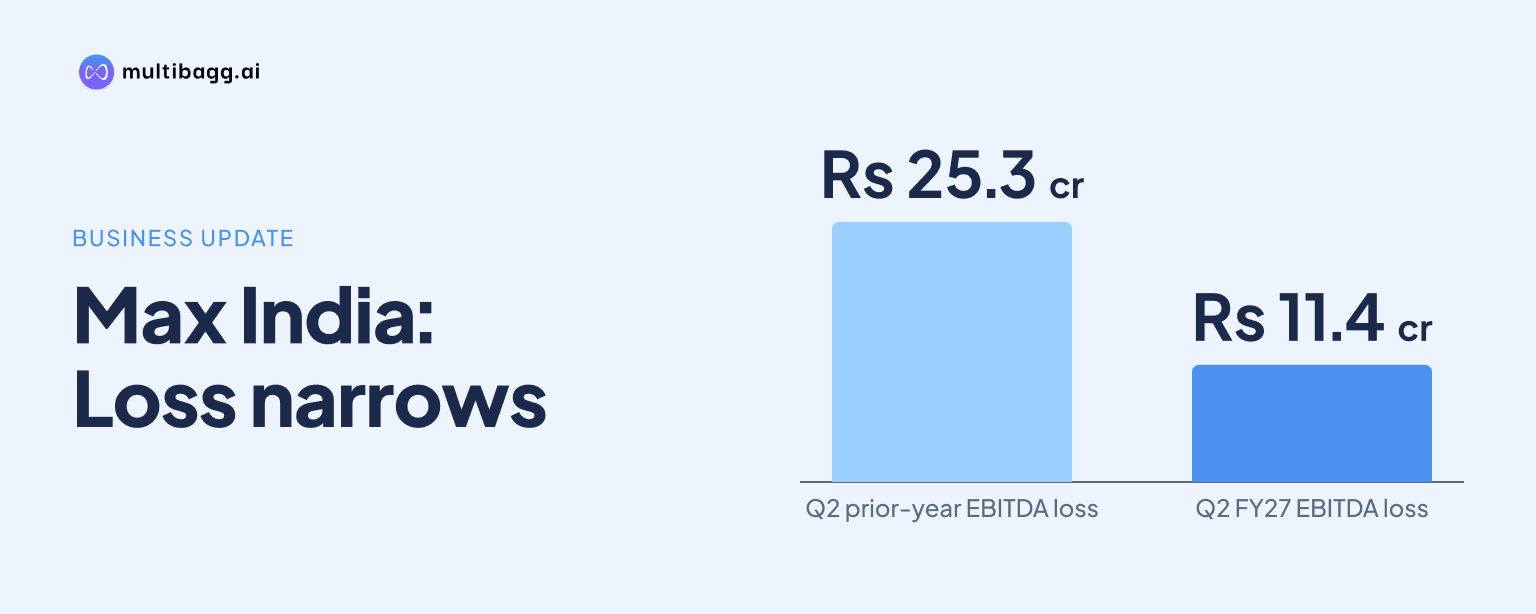
Max India Limited reported a Q2FY27 EBITDA loss of Rs 11.4 crore, 55% lower year on year, as consolidated total income rose 90.4% to Rs 95.5 crore from Rs 50.2 crore. The company remained loss-making, but loss after tax narrowed to Rs 22.3 crore from Rs 34.1 crore in Q2FY26.
Know Max India inside out
Results, valuation, peers and who's buying, in one view.
Why did Max India’s total income rise in Q2FY27?
Max India reported consolidated total income of Rs 95.5 crore in Q2FY27, compared with Rs 68.6 crore in Q1FY27 and Rs 50.2 crore in Q2FY26. This represented growth of 39.2% quarter on quarter and 90.4% year on year. While the presentation headline refers to revenue, the detailed consolidated financial table labels the measure as total income and notes that consolidated revenue excludes secondary revenue from Assisted Care Services.
AGEasy disclosed product and demand metrics, although the presentation does not provide a segment-level reconciliation between these measures and consolidated total income. Its 10 highest-revenue products generated Rs 23.8 crore in Q2FY27 through marketplace and direct-to-consumer channels, accounting for 88% of online revenue. Gun massagers generated Rs 7.6 crore, digital blood pressure monitors contributed Rs 5.9 crore, and incontinence protectors generated Rs 3.3 crore.
AGEasy’s campaigns and website measures showed increased audience activity from April to September. The business reported campaign reach of more than 25 million in Q2, while monthly brand searches increased from 20.8 thousand in April to 30.5 thousand in August. Monthly direct web traffic rose from 30 thousand in April to 62 thousand in August, before measuring 60 thousand in September; these are demand indicators rather than consolidated revenue figures.
How did Max India reduce its Q2FY27 EBITDA loss?
Max India reduced its EBITDA, or earnings before interest, tax, depreciation and amortisation, loss to Rs 11.4 crore in Q2FY27 from Rs 25.3 crore in Q2FY26 and Rs 24.9 crore in Q1FY27. Management described this as a 55% year-on-year reduction and a 54% sequential reduction, and said the result demonstrated a path to profitability. Total income increased by Rs 45.3 crore year on year, while total expenses increased by Rs 31.5 crore.
The difference between total income and total expenses narrowed to Rs 11.4 crore in Q2FY27 from Rs 25.3 crore a year earlier, in line with the reported EBITDA loss. On a sequential basis, total income rose by Rs 26.9 crore from Q1FY27, compared with a Rs 13.3 crore rise in expenses. The presentation does not disclose operating-cost categories by business vertical or identify individual cost-reduction measures.
Depreciation was Rs 7.4 crore in Q2FY27, unchanged from Q1FY27 and above Rs 5.9 crore in Q2FY26. Finance cost increased to Rs 3.0 crore from Rs 2.7 crore in the preceding quarter but was below Rs 4.1 crore a year earlier. Loss before tax and exceptional items consequently narrowed to Rs 21.7 crore, compared with losses of Rs 35.6 crore in Q1FY27 and Rs 36.0 crore in Q2FY26.
Got a follow-up? Ask IRIS
What does Max India’s first-half performance show?
Max India reported H1FY27 total income of Rs 164.1 crore, up 79.3% from Rs 91.5 crore in H1FY26, while its EBITDA loss narrowed to Rs 36.4 crore from Rs 48.4 crore. Total expenses increased to Rs 200.5 crore from Rs 139.9 crore over the same period. The H1FY27 result includes the Rs 95.5 crore of total income recorded in Q2FY27.
The H1FY27 loss after tax was Rs 58.5 crore, compared with Rs 59.7 crore in H1FY26, showing a smaller improvement than the EBITDA comparison. Depreciation rose to Rs 14.8 crore from Rs 11.7 crore, while finance cost declined to Rs 5.7 crore from Rs 7.6 crore. The prior-year half included an exceptional item of Rs 7.85 crore, compared with a negative exceptional item of Rs 5 lakh in H1FY27.
Loss before tax was Rs 57.2 crore in H1FY27, compared with Rs 60.7 crore in H1FY26. Tax was Rs 1.3 crore in H1FY27, while the previous first half recorded negative tax of Rs 1 lakh. Earnings per share were negative Rs 10.8 in H1FY27, compared with negative Rs 12.0 in H1FY26.
What was Max India’s financial position at September 30, 2026?
Max India reported consolidated equity, described in the presentation as net worth, of Rs 394.66 crore at September 30, 2026, compared with Rs 408.30 crore at March 31, 2026. Total assets increased to Rs 685.99 crore from Rs 670.03 crore during the six-month period. Current assets rose by Rs 18.57 crore to Rs 399.91 crore, while non-current assets declined by Rs 2.61 crore to Rs 286.08 crore.
Current liabilities increased to Rs 193.26 crore at September 30, 2026 from Rs 162.49 crore at March 31, 2026. Non-current liabilities were Rs 98.07 crore, slightly below Rs 99.24 crore six months earlier. The balance sheet recorded no assets classified as held for sale at either reporting date.
The presentation separately identified Rs 52 crore of cash and cash equivalents as other monetisable assets. It listed invested capital of about Rs 472 crore in Antara Senior Living residences and about Rs 542 crore in Care Homes and AGEasy. The residences business was shown with a surplus of about Rs 67 crore, including Rs 176 crore invested in Noida Sector 150, Rs 33 crore in Gurugram and Rs 7 crore in Noida Sector 105.
Conclusion
Max India’s Q2FY27 disclosures show that total income rose faster than total expenses, narrowing the EBITDA loss to Rs 11.4 crore from Rs 25.3 crore a year earlier. The first-half figures show the same direction, with total income increasing 79.3% to Rs 164.1 crore, although the company still reported an H1FY27 loss after tax of Rs 58.5 crore.
The next reported measure to watch is whether management’s stated focus on profitability across all business verticals leads to further loss reduction. The presentation provides no numerical profitability target or timetable, while reporting Rs 52 crore of cash and cash equivalents and current liabilities of Rs 193.26 crore as of September 30, 2026.