










Mayur expects Rs 300 crore export OEM revenue this year
Key highlights
- Mayur expects export OEM revenue of around Rs 300 crore this year.
- Management corrected the prior-year consolidated automotive-export figure to nearly Rs 280 crore.
- Ford and Chrysler requirements expanded from 2 models to 5 models in management’s illustration.
- Freight costs had fallen 20% to 25% from their peak, according to management.
powered by IRIS
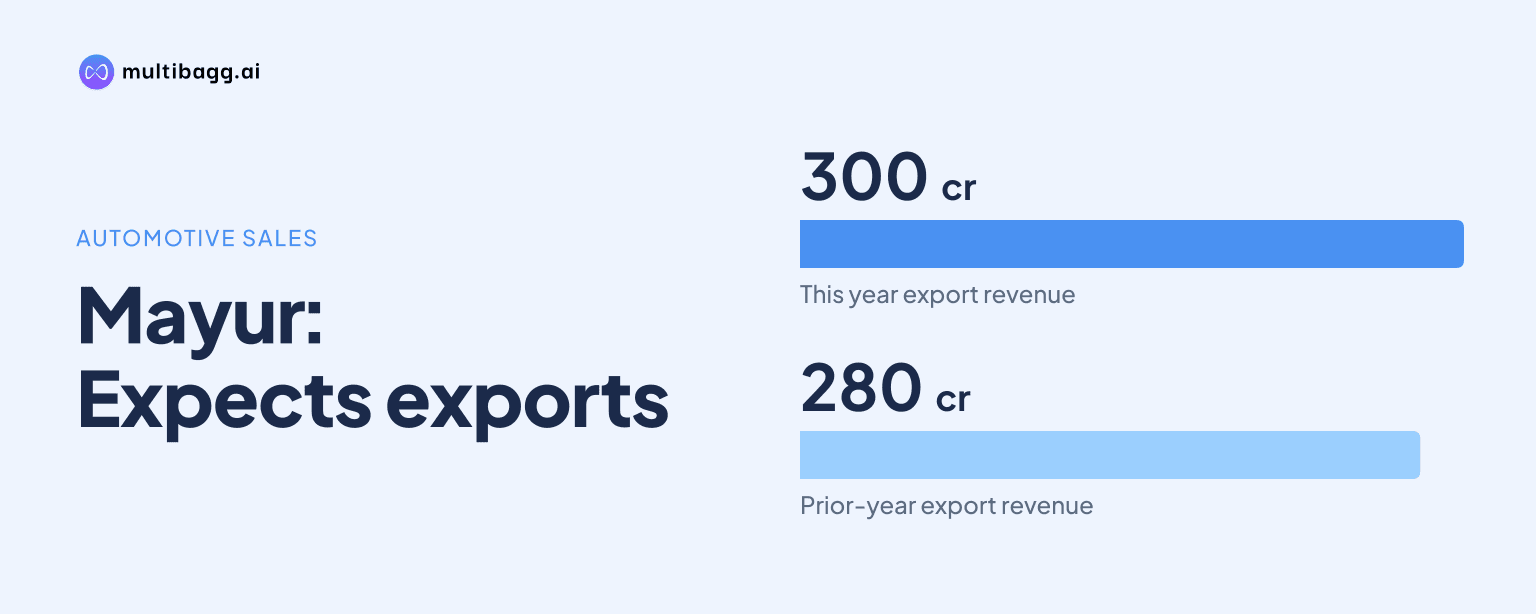
Mayur Uniquoters Limited expects export original equipment manufacturer (OEM) revenue of around Rs 300 crore this year, compared with nearly Rs 280 crore of consolidated automotive exports in the prior year after management corrected its earlier figure. Higher requirements across Ford and Chrysler models and South African customer volumes underpin management’s expectation.
Know Mayur Uniquoters inside out
Results, valuation, peers and who's buying, in one view.
What is Mayur's export OEM revenue target this year?
Mayur expects export OEM revenue of around Rs 300 crore this year, according to management’s answer during the Q2 conference call. Management initially said export OEM revenue had been around Rs 200 crore in the prior year and could reach Rs 250 crore to Rs 300 crore this year. That historical comparison changed after an analyst questioned it against quarterly disclosures.
Mayur ultimately confirmed that the prior-year consolidated automotive-export figure was nearly Rs 280 crore, rather than Rs 200 crore or Rs 260 crore. The stated Rs 300 crore expectation is therefore about Rs 20 crore above the corrected comparison point. Management did not provide a reconciliation for the three historical figures during the call.
Why does Mayur expect automotive export revenue to increase?
Mayur expects automotive export revenue to increase mainly because existing U.S. customers have expanded their model requirements, not because of newly disclosed customer wins. Management identified Ford and Chrysler as its major U.S. customers and said both had increased requirements for other models. It illustrated the expansion as moving from supply for 2 models to orders covering 5 models.
Mayur also cited its South African business with BMW and Mercedes-Benz. Management said these customers were taking material according to their requirements and had reached almost their full projected volumes. It expected that business to continue with a little further increase, supporting the Rs 300 crore export OEM expectation.
The current-year increase reflects orders received in the prior year that are beginning on planned vehicle models, according to management. When asked whether new model orders had been won in the current financial year, management said the orders were the same ones received last year. The growth trend, it said, was becoming visible quarter to quarter and year to year as those programmes started.
Is Mayur adding new export automotive customers?
Mayur is pursuing Volkswagen in addition to Ford, Chrysler, BMW and Mercedes-Benz, but management neither confirmed an order nor gave a timetable. It said discussions with Volkswagen were under way and described automotive customer qualification as a process involving testing, sampling and progress toward a purchase order or agreement.
Management said the process from discussions to an automotive purchase order or agreement can take 2 to 3 years. Volkswagen is therefore a prospective customer opportunity rather than a disclosed contributor to this year’s Rs 300 crore expectation. Mayur said it was trying to add customers in both the U.S. and European markets.
Mayur also explained why consolidated automotive-export revenue can exceed standalone disclosures. Products dispatched through the U.S. warehouse add to consolidated revenue, and management said the major part of the consolidated-versus-standalone difference was automotive. In an illustrative 10% margin example, it said 8% could remain in India and 2% with the U.S. subsidiary for local warehouse expenses.
Got a follow-up? Ask IRIS
How do Mayur's export margins compare with other business lines?
Mayur said export automotive carries a higher margin percentage and has been a major contributor to overall margin improvement. Management directly linked the improvement to growth in export automotive, including higher orders from Ford and Chrysler. It did not disclose an export OEM margin percentage, so the call does not support a calculation of segment profitability.
Mayur said export general business has lower margins than export OEM but higher margins than domestic business. Management attributed export general growth to repeat orders from existing customers, efforts to add customers worldwide and a retail company started in Europe. It expected export general business to continue improving in double digits.
Mayur said it was focusing more on automotive exports and automotive business. By contrast, its polyurethane, or PU, business was operating at 25% capacity utilisation and was not generating profit, according to management. Management said the PU business required 40% capacity utilisation to break even.
What could affect Mayur's export outlook and capacity plans?
Mayur said market conditions could not be projected with certainty when asked about the second half and the following year. Management nevertheless said it hoped current margins would be sustained and that performance could improve in coming quarters. Its comments were expectations rather than a numerical revenue or margin guidance range.
Freight costs are one disclosed variable for export economics. Management said freight had reached a peak comparable with COVID-period levels but had fallen 20% to 25% from that peak. It said it would discuss passing on costs to customers only if an increase became stable and permanent, rather than responding to a short-term movement.
Mayur expects machinery and equipment for an additional line by late November and December, with installation targeted for the March quarter and start-up hoped for in Q1. Management also said a new plant in southern India and a possible Mexico facility remained in the pipeline but had not been concluded. These plans were not presented as capacity additions supporting the current Rs 300 crore target.
Conclusion
Mayur’s stated export OEM outlook of around Rs 300 crore rests on expanded model coverage at Ford and Chrysler and South African volumes that management said were close to projections. The central qualification is the comparison base: management concluded the call by confirming nearly Rs 280 crore of consolidated automotive exports in the prior year, after first citing Rs 200 crore and then Rs 260 crore.
The next items to watch are whether the additional line begins in Q1 as management hopes, whether Ford and Chrysler requirements continue across the broader model set, and whether Volkswagen discussions advance through the 2-to-3-year testing and sampling process management described. Freight costs, already down 20% to 25% from their peak, remain another disclosed matter for export economics.