










Mayur warehouse clearance lifted Q2 consolidated revenue
Key highlights
- Mayur reported Q2 FY27 consolidated revenue of Rs 282.95 crore, up 18% year on year.
- Standalone Q2 FY27 revenue rose 6% to Rs 252.99 crore as Mayur reduced dispatches from India.
- Q2 FY27 standalone export OEM revenue was Rs 57.46 crore, within total export revenue of Rs 90.46 crore.
- Management expects FY27 export OEM revenue of about Rs 250 crore to Rs 300 crore.
powered by IRIS
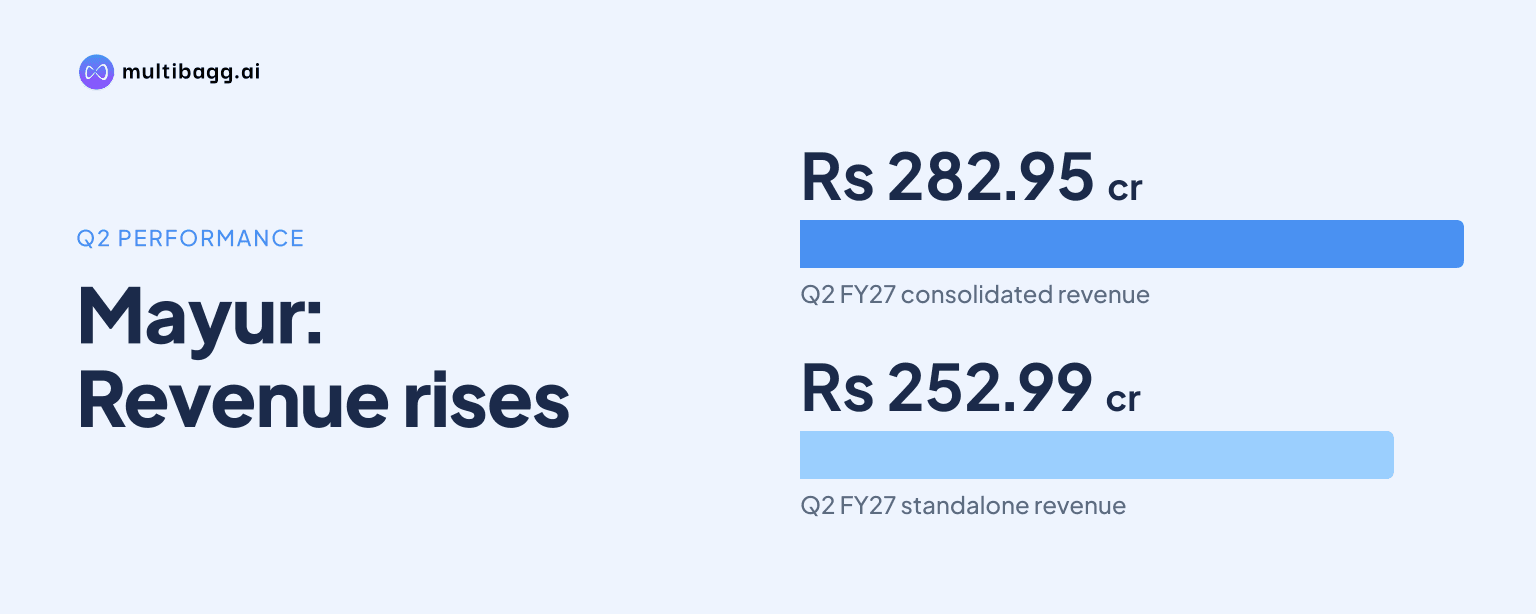
Mayur Uniquoters Limited reported consolidated revenue of Rs 282.95 crore in Q2 FY27, up 18% year on year, after reducing fresh dispatches from India and selling inventory through its U.S. warehouse. Standalone revenue increased 6% to Rs 252.99 crore, showing that the quarter’s faster consolidated growth was driven by sales-channel timing.
Know Mayur Uniquoters inside out
Results, valuation, peers and who's buying, in one view.
Why did Mayur’s consolidated revenue grow faster than standalone revenue?
Mayur’s consolidated revenue grew faster because it sold more material from its U.S. warehouse while deliberately cutting dispatches from India in Q2 FY27. Consolidated revenue was Rs 282.95 crore, compared with standalone revenue of Rs 252.99 crore, a difference of Rs 29.96 crore.
Management said the company had asked the U.S. warehouse to clear its stock rather than receive the usual level of fresh material from India. Warehouse sales are included in consolidated revenue, while lower dispatches from India limited standalone growth to 6% year on year, against 18% for consolidated revenue.
The channel shift also affected the reported profit comparison. Consolidated profit before tax was Rs 79.31 crore, up 43% year on year, while standalone profit before tax was Rs 70.46 crore, up 9%. Management said consolidated margins can rise when final sales occur through the overseas subsidiary because the subsidiary’s margin is added to the group result.
Management described its transfer-pricing approach as retaining in the U.S. subsidiary the margin required for local warehouse expenses and billing the remaining margin from India. It used an illustration in which 8% of a 10% margin could remain in India and 2% with the U.S. subsidiary. The location of the final sale can therefore change the split between standalone and consolidated results.
Why did Mayur reduce U.S. dispatches from India?
Mayur reduced U.S. dispatches because the U.S. automotive market had not responded well for the previous two quarters, according to management. Customers were buying fewer new cars than expected, prompting automotive companies to revise their projections and Mayur to adjust its supply schedule.
Management said export volume did not record positive year-on-year growth because of U.S. conditions. It distinguished this from its South African business, which it said was doing well with Mercedes-Benz and BMW, while Chrysler and Ford remained the major U.S. customers.
Standalone export original equipment manufacturer, or OEM, revenue was Rs 57.46 crore in Q2 FY27, within total export revenue of Rs 90.46 crore. An analyst said export OEM revenue had previously been running at Rs 75 crore to Rs 80 crore a quarter; management said it expected improvement from current levels, supported by orders already in hand from U.S. automotive companies.
The U.S. orders cited were for existing customers and expanded model allocations rather than new OEM order wins during the quarter. Management gave an example of supply moving from two models to five models for Ford and Chrysler. It is also discussing opportunities with Volkswagen, though management said automotive testing, sampling and conversion into purchase orders can take two to three years.
Got a follow-up? Ask IRIS
What was Mayur’s Q2 FY27 sales mix?
Mayur’s standalone sales mix was led by domestic revenue of Rs 162.53 crore in Q2 FY27, while export revenue was Rs 90.46 crore. Total standalone revenue was Rs 252.99 crore and quarterly volume was 77.51 lakh metres.
Mayur recorded polyurethane, or PU, revenue of Rs 6.28 crore during the quarter. Management said footwear increased in both value and volume, but the company remained more focused on automotive sales and supplied footwear to selected customers where pricing and margins met its requirements.
PU was operating at 25% capacity utilisation and was not generating a profit, according to management. It said PU would need 40% utilisation to break even and that it had supplied samples to large shoe customers while awaiting purchase-order decisions.
What does Mayur expect for export OEM sales and margins?
Mayur expects FY27 export OEM revenue of about Rs 250 crore to Rs 300 crore, compared with around Rs 200 crore in the preceding year, according to management. Management also said export OEM could improve by 10% to 15% beyond that period, while cautioning that market conditions cannot be projected with certainty.
Management indicated a gross-margin range of around 55% to 56%, after an analyst cited gross margin of 52% in Q1 FY27 and about 57% in Q2 FY27. It attributed the quarterly variation to raw-material and crude-oil prices rather than a change to a fixed margin target.
Employee cost appeared lower sequentially because an additional provision related to changes in labour codes, booked in Q1 FY27, was reversed in Q2 FY27. Management said the underlying employee-cost level was about 12.5%, or Rs 12.5 crore a quarter.
What should Mayur shareholders watch after the warehouse clearance?
The main item to watch is whether improving U.S. automotive conditions translate into renewed dispatches from India in subsequent quarters. Management said the U.S. market was gradually improving and that the effect should be reflected in coming quarters, but Q2 FY27 sales were supported by warehouse inventory clearance rather than higher fresh Indian shipments.
The relationship between standalone and consolidated revenue is also relevant after the Rs 29.96 crore gap in Q2 FY27. Management said standalone growth can exceed consolidated growth when Indian dispatches are higher, while consolidated growth can be higher when more sales are completed through the warehouse.
Conclusion
Mayur’s Q2 FY27 result shows that the 18% increase in consolidated revenue to Rs 282.95 crore was materially influenced by U.S. warehouse sales, while fresh dispatches from India were reduced amid a two-quarter U.S. auto-demand slowdown. The resulting 6% increase in standalone revenue to Rs 252.99 crore reflects the different timing of shipment and final-sale recognition.
Next, management’s stated expectation of Rs 250 crore to Rs 300 crore in FY27 export OEM revenue depends in part on U.S. demand and warehouse replenishment. Management also expects machinery for an additional line in late November and December, plans installation in the March quarter, and hopes to begin operations in Q1.