










MBAPL targets 15.60 lakh MT fertiliser capacity by FY28
Key highlights
- MBAPL plans to raise fertiliser capacity from 9 lakh MT in FY26 to 15.60 lakh MT in FY28.
- MBAPL’s FY28 schedule includes 5.70 lakh MT of SSP and 9.90 lakh MT of NPK/DAP capacity.
- MBAPL links Dhule to about 10 lakh MT of capacity and a Rs 3,500 crore opportunity at optimal utilisation.
- Intermediate capacity is scheduled to increase from 7.86 lakh MT in FY26 to 11.49 lakh MT in FY28.
powered by IRIS
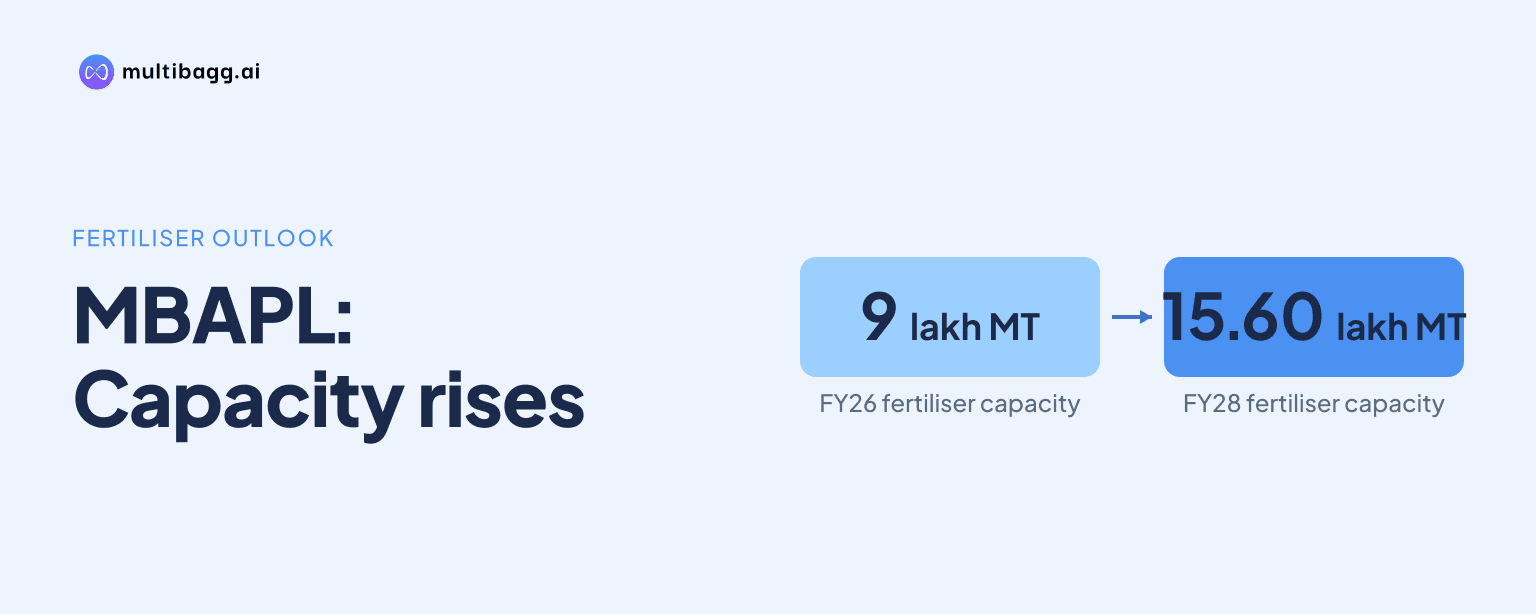
Madhya Bharat Agro Products Ltd (MBAPL) plans to raise fertiliser capacity from 9 lakh metric tonnes (MT) in FY26 to 15.60 lakh MT in FY28, an increase of 6.60 lakh MT. Its schedule combines single super phosphate (SSP) expansion with nitrogen, phosphorus and potassium (NPK) and di-ammonium phosphate (DAP) additions, while Dhule is linked to a Rs 3,500 crore opportunity at optimal utilisation.
Know Madhya Bharat Agro Products inside out
Results, valuation, peers and who's buying, in one view.
How will MBAPL reach 15.60 lakh MT by FY28?
MBAPL’s capacity schedule reaches 15.60 lakh MT in FY28, from 9 lakh MT in FY26 and 12.30 lakh MT in FY27. The stated plan therefore adds 3.30 lakh MT in FY27 and another 3.30 lakh MT in FY28. These are installed-capacity targets, not a forecast of production, sales or utilisation.
MBAPL’s FY26 table shows 2.40 lakh MT of SSP, 3.30 lakh MT of NPK/DAP, 2.40 lakh MT of enhanced SSP and 0.90 lakh MT of enhanced NPK/DAP, totalling 9 lakh MT. In FY27, the presentation lists 5.70 lakh MT of SSP and two 3.30 lakh MT NPK/DAP categories, producing the 12.30 lakh MT total. The change from FY26 to FY27 is therefore represented by higher SSP capacity and enhanced NPK/DAP capacity.
By FY28, MBAPL’s table lists 5.70 lakh MT of SSP, 6.60 lakh MT of NPK/DAP and 3.30 lakh MT of proposed NPK/DAP capacity. The post-expansion display consolidates the NPK/DAP categories at 9.90 lakh MT while keeping SSP at 5.70 lakh MT, with the total unchanged at 15.60 lakh MT. The presentation does not show capacity above 15.60 lakh MT after FY28.
What role does Dhule play in MBAPL’s expansion?
MBAPL identifies its integrated fertiliser plant at Dhule, Maharashtra, as a growth engine with scope for further expansion. The company says the site can unlock about 10 lakh MT of fertiliser capacity and represents a Rs 3,500 crore incremental revenue opportunity at optimal utilisation. This is a company-stated opportunity rather than reported revenue or a committed sales outcome.
The Dhule development has disclosed land and operating milestones. MBAPL reported a 5.86 lakh square metre land allotment at Dhule in 2024, followed by acquisition of 52,600 square metres of adjoining Maharashtra land in 2027, taking its Maharashtra land bank above 6.38 lakh square metres. Its 2026 milestone list records commissioning of 3.30 lakh MT of SSP capacity and 1.98 lakh MT of sulphuric acid capacity in Maharashtra.
MBAPL says Dhule’s location near Hazira Port is intended to improve access to fertiliser markets as it expands from 14 states towards a pan-India presence. The company reported a network of more than 3,000 wholesalers or dealers and more than 40,000 retailers. It specifically identifies western and southern high-consumption markets as areas for deeper penetration.
How does intermediate capacity support the fertiliser plan?
MBAPL plans to increase intermediate capacity to 11.49 lakh MT in FY28 from 7.86 lakh MT in FY26, a rise of 3.63 lakh MT. The schedule covers beneficiated rock phosphate (BRP), sulphuric acid and phosphoric acid, all inputs used in phosphatic fertiliser production. Intermediate capacity rises to 8.85 lakh MT in FY27 before the larger FY28 addition.
The FY28 schedule includes 1.89 lakh MT of BRP, 5.28 lakh MT of sulphuric acid, 1.68 lakh MT of phosphoric acid, 0.66 lakh MT of proposed phosphoric acid and 1.98 lakh MT of proposed sulphuric acid. In the post-expansion view, sulphuric acid is shown at 7.26 lakh MT and phosphoric acid at 2.34 lakh MT, while BRP remains at 1.89 lakh MT. The total remains 11.49 lakh MT.
MBAPL separately lists annual capacities of 1.89 lakh MT of BRP, 5.28 lakh MT of sulphuric acid, 1.68 lakh MT of phosphoric acid, 6.60 lakh MT of NPK/DAP and 5.70 lakh MT of SSP. It also cites long-term rock-phosphate supply arrangements with Egypt, Jordan and domestic suppliers, alongside multiple suppliers of sulphur and sulphuric acid. These arrangements are the sourcing mechanisms disclosed alongside its backward-integration model.
Got a follow-up? Ask IRIS
What financial and operating evidence has MBAPL reported?
MBAPL reported Q2 FY27 revenue of Rs 715 crore, up 59% year on year, earnings before interest, tax, depreciation and amortisation (EBITDA) of Rs 128 crore, up 107%, and profit after tax (PAT) of Rs 78 crore, up 155%. These figures cover financial performance during the expansion period, but the presentation does not disclose capacity utilisation for the 12.30 lakh MT FY27 schedule.
For H1 FY27, MBAPL reported revenue of Rs 1,135 crore, a 32% year-on-year increase, while EBITDA and PAT increased 66% and 89%, respectively. Management said commissioning of new NPK/DAP and backward-integrated phosphoric-acid facilities at Dhule marked an important milestone. The chairman said management’s focus is on production, capacity utilisation, operating efficiency and a more profitable NPK product mix.
MBAPL also disclosed a 10-year, 1.30 lakh MT green-ammonia procurement agreement with Solar Energy Corporation of India in 2026. The presentation says it plans to replace grey ammonia with fixed-price green ammonia supported by price protection. Management presents the arrangement as a mechanism for cost efficiency and lower external dependency, but does not disclose an expected saving or rollout schedule.
What policy context does management cite for the expansion?
Management cited the Government of India’s approval of a 64% increase in Nutrient-Based Subsidy rates for the Rabi 2026-27 season, with a total outlay of Rs 62,370 crore. According to the chairman, higher per-kilogram support for nitrogen, phosphorus and sulphur, along with a domestic sulphur package, supports domestic phosphatic and complex fertiliser production.
The presentation does not quantify the subsidy amount MBAPL expects to receive or the effect on its revenue, margins or capacity utilisation. Management nevertheless linked the policy change to protection for farmers against global input-price volatility and to stronger domestic fertiliser production. Those statements frame the operating environment rather than provide a company-specific financial forecast.
Conclusion
MBAPL’s disclosed plan is to add 6.60 lakh MT of fertiliser capacity between FY26 and FY28, taking total capacity to 15.60 lakh MT. The schedule shifts the mix towards NPK/DAP, with the post-expansion presentation showing 9.90 lakh MT of NPK/DAP and 5.70 lakh MT of SSP, supported by 11.49 lakh MT of intermediate capacity.
The next item to watch is execution of the FY28 proposed capacities, comprising 3.30 lakh MT of NPK/DAP, 0.66 lakh MT of phosphoric acid and 1.98 lakh MT of sulphuric acid. Management has also identified higher capacity utilisation, NPK mix improvement and implementation of the 10-year, 1.30 lakh MT green-ammonia agreement as priorities, while the presentation does not provide unit-by-unit completion dates or utilisation targets.