










MBAPL Q2 profit jumps 155% as EBITDA margin reaches 17.9%
Key highlights
- MBAPL reported Q2 FY27 revenue of Rs 715 crore, up 59% year on year.
- MBAPL’s Q2 FY27 EBITDA was Rs 128 crore, up 107%, and EBITDA margin reached 17.9%.
- MBAPL’s Q2 FY27 PAT rose 155% year on year to Rs 78 crore.
- MBAPL reported H1 FY27 PAT of Rs 111 crore, up 89%, while NPK/DAP sales volume declined 21%.
powered by IRIS
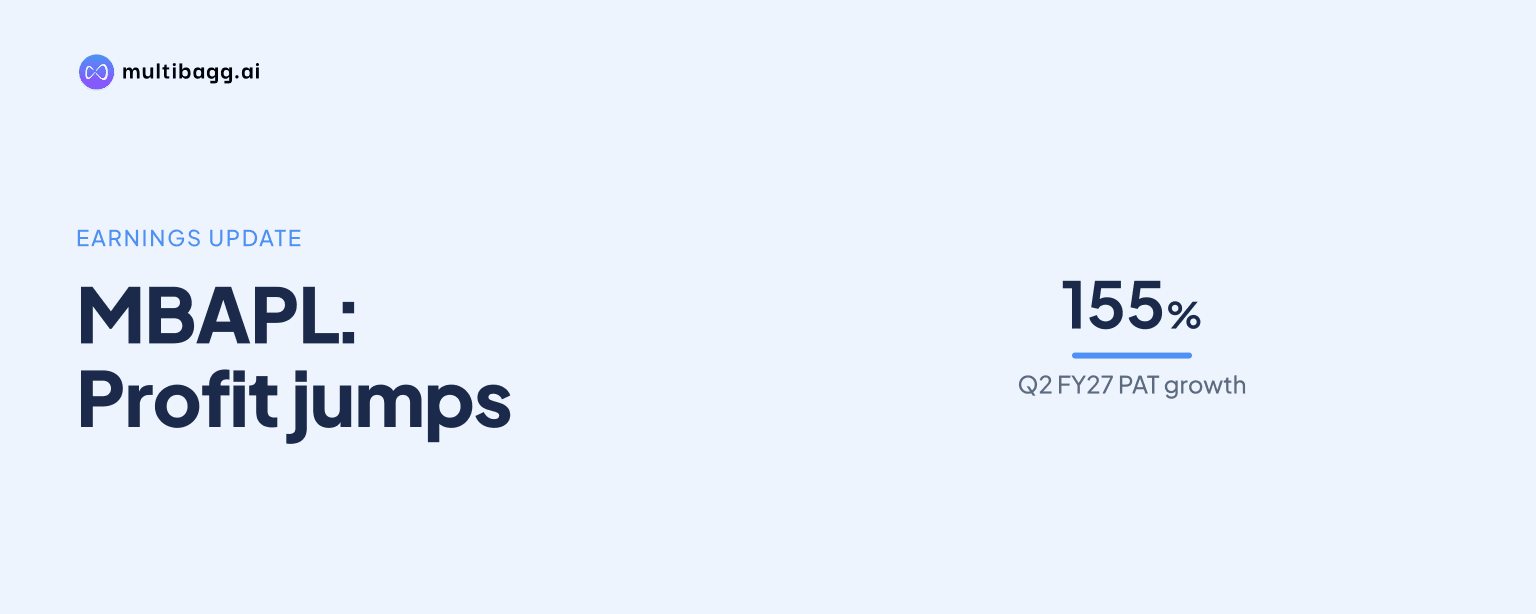
MBAPL reported Rs 78 crore of profit after tax in Q2 FY27, up 155% year on year, as revenue rose 59% to Rs 715 crore and earnings before interest, tax, depreciation and amortisation margin increased to 17.9% from 13.7%. The presentation describes revenue, EBITDA and profit as all-time-high quarterly results.
Know Madhya Bharat Agro Products inside out
Results, valuation, peers and who's buying, in one view.
How did MBAPL perform in Q2 FY27?
MBAPL delivered Rs 715 crore of revenue, Rs 128 crore of EBITDA and Rs 78 crore of profit after tax, or PAT, in Q2 FY27. The presentation identifies each of these as an all-time-high quarterly result. Revenue was Rs 450 crore in Q2 FY26 and Rs 420 crore in Q1 FY27, placing Q2 FY27 above both the year-earlier quarter and the preceding quarter.
EBITDA increased 107% from Rs 62 crore in Q2 FY26 to Rs 128 crore in Q2 FY27, while PAT rose 155% from Rs 31 crore to Rs 78 crore. Earnings per share, or EPS, increased to Rs 1.76 from Rs 0.70 a year earlier and Rs 0.75 in Q1 FY27. Profit growth therefore exceeded the reported 59% increase in revenue during the quarter.
What changed in MBAPL’s Q2 FY27 margins?
MBAPL’s EBITDA margin rose to 17.9% in Q2 FY27, from 13.7% in Q2 FY26 and 16.5% in Q1 FY27. This was a 4.2-percentage-point year-on-year rise and a 1.4-percentage-point increase from the preceding quarter. PAT margin also increased, reaching 10.9% from 6.8% a year earlier and 7.9% in Q1 FY27.
Chairman M.K. Ostwal said the Q2 FY27 performance reflected MBAPL’s business model and operational capabilities despite supply-chain disruptions, raw-material volatility and an uneven monsoon. He cited the commissioning of new nitrogen-phosphorus-potassium/diammonium phosphate, or NPK/DAP, and backward-integrated phosphoric-acid facilities at Dhule as an important milestone. Management said its focus is on production, capacity utilisation, operational efficiency and a more profitable NPK product mix.
How did MBAPL’s H1 FY27 results compare with last year?
MBAPL reported H1 FY27 revenue of Rs 1,135 crore, up 32% from Rs 860 crore in H1 FY26. EBITDA increased 66% to Rs 197 crore from Rs 119 crore, while PAT rose 89% to Rs 111 crore from Rs 59 crore. EPS also rose 89%, to Rs 2.52 from Rs 1.34 in the comparable half-year.
The first-half sales-volume trends differed by product. NPK/DAP sales declined 21% to 92,381 tonnes in H1 FY27 from 116,287 tonnes in H1 FY26, while single super phosphate, or SSP, sales increased 6% to 125,392 tonnes from 118,418 tonnes. MBAPL therefore recorded higher H1 revenue, EBITDA and PAT even though NPK/DAP sales volume was below the prior-year period.
Got a follow-up? Ask IRIS
What do MBAPL’s Q2 FY27 production and utilisation figures show?
MBAPL produced 53,088 tonnes of SSP in Q2 FY27, representing 37% utilisation of its 5.70 lakh metric-tonnes-per-annum, or MTPA, capacity. This was below 62,334 tonnes and 104% utilisation in Q2 FY26, but SSP capacity had increased from 2.40 lakh MTPA to 5.70 lakh MTPA from March 30, 2026. The reported production volume fell year on year while the installed-capacity base increased substantially.
NPK/DAP production was 47,807 tonnes in Q2 FY27, at 58% utilisation of 3.30 lakh MTPA, compared with 56,207 tonnes and 94% utilisation in Q2 FY26. Beneficated rock phosphate, or BRP, crushing was 43,367 tonnes at 92% utilisation, versus 45,263 tonnes and 96% a year earlier. Phosphoric-acid production was 7,227 tonnes at 42% utilisation, while sulphuric-acid production was 13,199 tonnes at 10% utilisation after sulphuric-acid capacity increased to 5.28 lakh MTPA from March 30, 2026.
How is MBAPL expanding its integrated fertilizer operations?
MBAPL’s 2026 capacity milestones include commissioning 3.30 lakh tonnes of SSP capacity in Maharashtra, 90,000 tonnes of NPK/DAP capacity in Madhya Pradesh, 1.65 lakh tonnes of sulphuric-acid capacity in Madhya Pradesh and 1.98 lakh tonnes in Maharashtra. The timeline states total capacities of 5.70 lakh tonnes for SSP, 3.30 lakh tonnes for NPK/DAP and 5.28 lakh tonnes for sulphuric acid after these additions.
MBAPL also disclosed a 10-year agreement with the Solar Energy Corporation of India for procurement of 1.30 lakh tonnes of green ammonia. Its presentation cites long-term agreements with suppliers in Egypt, Jordan and India for rock phosphate, as well as long-term arrangements for sulphur, sulphuric acid and ammonia. These sourcing arrangements and capacity additions provide the operating context for management’s stated plan to improve utilisation and expand its NPK presence.
What policy development did management identify for FY27?
Management identified the Government of India’s approval of a 64% increase in Nutrient-Based Subsidy rates for the Rabi 2026-27 season as a policy support factor. According to the chairman’s statement, the approval carries a total outlay of Rs 62,370 crore and includes enhanced per-kilogram support for nitrogen, phosphorus and sulphur, alongside a domestic sulphur package.
The chairman said these measures could shield farmers from global input-price volatility and support domestic phosphatic and complex-fertilizer production. That assessment was management’s view, rather than an earnings forecast. MBAPL’s presentation does not provide a quantified estimate of the effect of the Rabi 2026-27 subsidy rates on revenue, margins or profit.
Conclusion
MBAPL’s Q2 FY27 result showed earnings rising faster than sales: revenue increased 59% to Rs 715 crore, EBITDA rose 107% to Rs 128 crore and PAT increased 155% to Rs 78 crore. The corresponding EBITDA margin of 17.9% and PAT margin of 10.9% exceeded both Q2 FY26 and Q1 FY27 levels, while H1 FY27 EBITDA and PAT grew 66% and 89%, respectively.
The next operating measures to watch are utilisation of expanded capacity, particularly SSP at 37%, NPK/DAP at 58% and sulphuric acid at 10% in Q2 FY27. Management has stated that it will focus on production, utilisation, efficiency and a more profitable NPK mix, while the presentation also identifies the Rabi 2026-27 subsidy approval and the 10-year green-ammonia agreement as relevant developments.