










MBAPL sulphuric-acid capacity utilisation was 10% in Q2 FY27
Key highlights
- MBAPL reported 10% sulphuric-acid utilisation and 13,199 tonnes of output in Q2 FY27.
- Sulphuric-acid utilisation was 17% in Q1 FY27 and 90% in Q2 FY26.
- MBAPL's Q2 FY27 snapshot listed sulphuric-acid capacity at 528,000 MTPA, increased from 165,000 MTPA from 30 March 2026.
- MBAPL reported Q2 FY27 revenue of Rs 715 crore and EBITDA of Rs 128 crore, up 59% and 107% year on year.
powered by IRIS
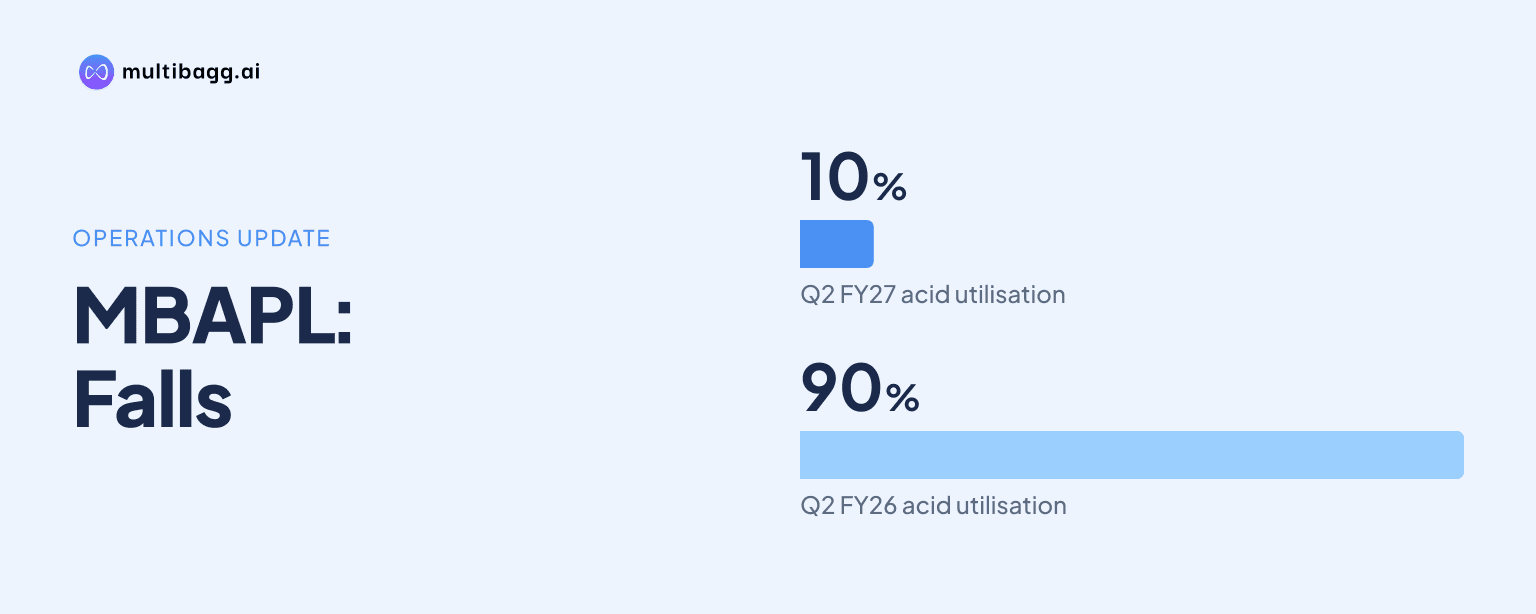
MBAPL reported 10% sulphuric-acid capacity utilisation in Q2 FY27, with output of 13,199 tonnes, while its operating snapshot listed 528,000 metric tonnes per annum of capacity. The rate was 17% in Q1 FY27 and 90% in Q2 FY26, even as the presentation described a capacity increase from 165,000 MTPA from 30 March 2026.
Know Madhya Bharat Agro Products inside out
Results, valuation, peers and who's buying, in one view.
What was MBAPL's sulphuric-acid utilisation in Q2 FY27?
MBAPL reported 10% utilisation at its sulphuric-acid unit in Q2 FY27, producing 13,199 tonnes against listed capacity of 528,000 metric tonnes per annum, or MTPA. The presentation places sulphuric acid within its integration operations, together with beneficiation of rock phosphate, or BRP, crushing and phosphoric acid.
The reported 10% rate was accompanied by lower output than in both comparison quarters supplied by MBAPL. Q2 FY26 output was 37,100 tonnes at 90% utilisation, while Q1 FY27 output was 22,963 tonnes at 17% utilisation. Q2 FY27 output was therefore 23,901 tonnes below Q2 FY26 and 9,764 tonnes below Q1 FY27.
How did MBAPL's acid unit compare with other operations?
MBAPL's sulphuric-acid utilisation declined by 7 percentage points sequentially, from 17% in Q1 FY27 to 10% in Q2 FY27, whereas BRP crushing rose to 92% from 66%. BRP output increased by 12,144 tonnes to 43,367 tonnes in Q2 FY27, compared with the acid unit's 9,764-tonne sequential production decline.
Phosphoric-acid utilisation increased to 42% in Q2 FY27 from 31% in Q1 FY27, and output rose to 7,227 tonnes from 5,332 tonnes. Nitrogen-phosphorus-potassium and diammonium phosphate, or NPK/DAP, utilisation also rose to 58% from 43%, with output increasing to 47,807 tonnes from 35,632 tonnes.
Sulphuric acid had the lowest reported utilisation among the five operating categories in Q2 FY27. Single super phosphate, or SSP, was the next-lowest at 37%, followed by phosphoric acid at 42%, NPK/DAP at 58% and BRP crushing at 92%; the acid-unit rate was 27 percentage points below SSP.
SSP was the other category with a sequential decline in Q2 FY27. Its utilisation fell from 45% in Q1 FY27 to 37%, and output declined from 63,592 tonnes to 53,088 tonnes, while NPK/DAP and both other integration operations reported sequential increases.
What does MBAPL's capacity information show?
MBAPL's Q2 FY27 operating snapshot lists sulphuric-acid capacity at 528,000 MTPA and states that capacity increased from 165,000 MTPA from 30 March 2026. On that snapshot's figures, the 10% utilisation reading follows a stated 363,000-MTPA increase in the installed base.
The presentation's historical operating table gives a different capacity series for the same unit: 165,000 tonnes in FY24, 165,000 tonnes in FY25 and 330,000 tonnes in FY26. That table reports annual sulphuric-acid utilisation of 62% in FY24, 103% in FY25 and 92% in FY26; the presentation does not reconcile its 330,000-tonne FY26 figure with the 528,000-MTPA Q2 FY27 snapshot.
The same Q2 FY27 snapshot states that SSP capacity rose from 240,000 MTPA to 570,000 MTPA from 30 March 2026, while NPK/DAP capacity rose from 240,000 MTPA to 330,000 MTPA from that date. Their Q2 FY27 utilisation rates were 37% and 58%, respectively, compared with 10% for sulphuric acid.
For phosphoric acid, MBAPL lists capacity of 69,000 MTPA, increased from 49,500 MTPA from 30 March 2025. The unit reported 42% utilisation and 7,227 tonnes of Q2 FY27 output, compared with 50% and 8,697 tonnes in Q2 FY26, showing that its utilisation was also below the prior-year quarter despite rising from Q1 FY27.
Got a follow-up? Ask IRIS
How did the utilisation gap sit alongside MBAPL's financial performance?
MBAPL reported Q2 FY27 revenue of Rs 715 crore, up 59% from Rs 450 crore in Q2 FY26, while earnings before interest, tax, depreciation and amortisation, or EBITDA, rose 107% to Rs 128 crore from Rs 62 crore. Profit after tax, or PAT, increased 155% to Rs 78 crore from Rs 31 crore, despite the 10% sulphuric-acid utilisation disclosed in the operating snapshot.
Margins were also higher in Q2 FY27 than in both supplied comparison quarters. EBITDA margin was 17.9%, versus 16.5% in Q1 FY27 and 13.7% in Q2 FY26, while PAT margin was 10.9%, versus 7.9% and 6.8%, respectively. These results establish higher reported profitability, but the presentation does not quantify the effect of the acid-unit utilisation rate on revenue, costs or margins.
For H1 FY27, revenue was Rs 1,135 crore, up 32% from Rs 860 crore in H1 FY26, while EBITDA increased 66% to Rs 197 crore and PAT rose 89% to Rs 111 crore. NPK/DAP sales declined 21% to 92,381 tonnes over the same six months, whereas SSP sales increased 6% to 125,392 tonnes.
The chairman described supply-chain disruptions, raw-material volatility and an uneven monsoon as Q2 FY27 challenges, while stating that MBAPL's focus was to strengthen production, improve capacity utilisation and operational efficiency. The presentation identifies captive sulphuric-acid production as part of its approach to sulphur-price volatility, alongside domestic and international sulphur sourcing relationships, but gives no unit-specific explanation for the 10% reading.
Conclusion
MBAPL's Q2 FY27 data show a contrast between higher financial results and low reported use of sulphuric-acid capacity. Revenue reached Rs 715 crore, EBITDA reached Rs 128 crore and PAT reached Rs 78 crore, while sulphuric-acid output fell to 13,199 tonnes and utilisation reached 10%. By comparison, BRP crushing, phosphoric acid and NPK/DAP all recorded higher utilisation than in Q1 FY27.
The next disclosures will show whether management's stated production, utilisation and efficiency focus lifts sulphuric-acid output from the Q2 FY27 level. Readers can also watch for clarification of the 528,000-MTPA Q2 capacity figure against the 330,000-tonne FY26 figure in the historical table, as MBAPL supplied no sulphuric-acid utilisation target or reconciliation in this presentation.