










MBAPL’s 130,000-tonne green-ammonia supplies due April 2029
Key highlights
- MBAPL expects green-ammonia supplies from April 2029 under a 130,000-metric-tonne arrangement over 10 years.
- The arrangement has an upper price limit and downward flexibility, subject to contractual terms.
- MBAPL increased SSP capacity to 570,000 metric tonnes per annum and NPK/DAP capacity to 330,000 metric tonnes per annum on 30 March 2026.
- India’s NPK/DAP sales were 42% import supplied and 58% domestically supplied, according to MBAPL’s presentation.
powered by IRIS
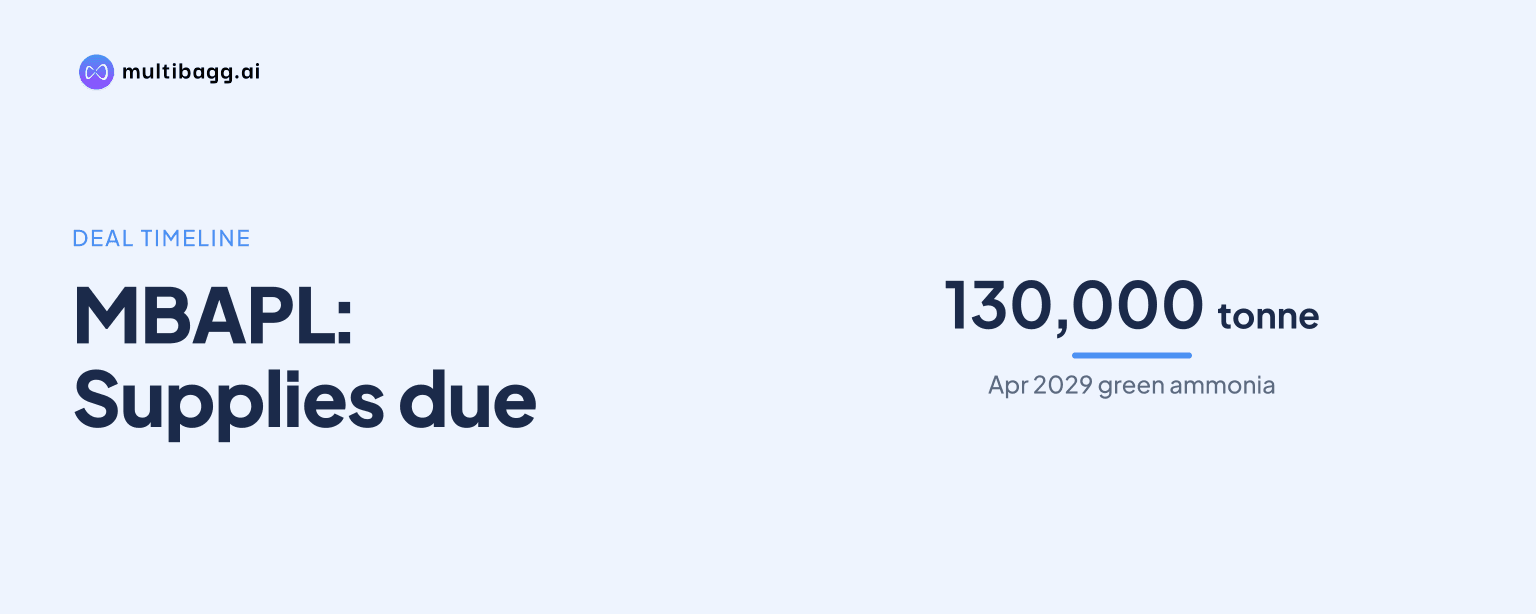
MBAPL expects green-ammonia supplies from April 2029 under an arrangement for 130,000 metric tonnes over 10 years, with an upper price limit and downward flexibility subject to contractual terms. The presentation positions the arrangement as a response to ammonia-price volatility, but does not disclose annual volumes, the price ceiling or expected savings.
Know Madhya Bharat Agro Products inside out
Results, valuation, peers and who's buying, in one view.
What does MBAPL’s green-ammonia arrangement cover?
MBAPL has disclosed a total green-ammonia arrangement for 130,000 metric tonnes over 10 years, rather than an annual commitment of 130,000 metric tonnes. Supplies are expected from April 2029, and the presentation identifies the arrangement as its mitigation measure for ammonia-price volatility. It does not identify the supplier, the annual delivery schedule, a contract value or the facilities that would receive the material.
The stated pricing structure consists of an upper price limit and downward flexibility, subject to contractual terms. This indicates that the arrangement is intended to cap the procurement price while retaining scope for a lower price under the contract’s terms. MBAPL does not disclose the ceiling level, the reference price used for any downward adjustment, or an estimate of the effect on ammonia procurement costs.
April 2029 places the expected supplies after MBAPL’s stated FY28 expansion objective of about 225% in fertiliser capacity and about 218% in integrated capacity. The source does not link the 130,000-metric-tonne quantity to a specific fertiliser grade, plant or output target. It also does not state how much of MBAPL’s future ammonia requirement the arrangement could cover.
Why is MBAPL seeking ammonia price protection?
MBAPL is seeking ammonia-price protection because it identifies continued raw-material volatility, shipping disruption and higher freight costs as risks arising from the West Asia crisis. Its raw-material chart marks 28 February 2026 as the start of the Middle East crisis and tracks rock phosphate, ammonia and sulphur through October 2026. The chart does not provide the individual quarterly price values in the presentation text.
For Q2 FY27, MBAPL said phosphoric-acid and sulphur prices were elevated, ammonia prices softened and rock-phosphate prices remained broadly stable. The green-ammonia arrangement therefore addresses one specified input, while separate measures address sulphur, rock phosphate and logistics. No ammonia-price forecast or comparison with the expected April 2029 supply date is provided.
MBAPL’s wider procurement response includes long-term sourcing arrangements across multiple geographies, domestic sourcing where available and inventory planning. The company says these measures are intended to manage supply disruptions and procurement lead times. Its stated strategic objective is to improve cost competitiveness, strengthen supply-chain resilience and manage exposure to global volatility.
Got a follow-up? Ask IRIS
How does green ammonia fit MBAPL’s manufacturing plan?
MBAPL places green-ammonia sourcing within a manufacturing strategy that also includes domestic scale-up and backward integration. Its stated growth plan calls for about 225% fertiliser-capacity expansion and about 218% integrated-capacity growth by FY28. The presentation describes green ammonia as an opportunity for cleaner and more predictable sourcing supported by price protection, without quantifying an environmental benefit or cost reduction.
MBAPL expanded single super phosphate, or SSP, capacity to 570,000 metric tonnes per annum from 240,000 metric tonnes per annum on 30 March 2026. Nitrogen, phosphorus and potassium fertiliser and diammonium phosphate, or NPK/DAP, capacity increased to 330,000 metric tonnes per annum from 240,000 metric tonnes per annum on the same date. These additions expand fertiliser output capacity, but the source does not specify ammonia consumption per tonne of SSP or NPK/DAP production.
The company has also increased integration capacity. Sulphuric-acid capacity rose to 528,000 metric tonnes per annum from 30 March 2026, while phosphoric-acid capacity was 69,000 metric tonnes per annum following an increase from 49,500 metric tonnes per annum on 30 March 2025. MBAPL says captive acid production supports backward integration, whereas the green-ammonia arrangement is disclosed as a sourcing measure.
What operating conditions matter before April 2029?
MBAPL’s Q2 FY27 production figures show that utilisation varied materially across the expanded manufacturing base. NPK/DAP production reached 47,807 tonnes at 58% utilisation, compared with 35,632 tonnes at 43% in Q1 FY27 and 56,207 tonnes at 94% in Q2 FY26. SSP production was 53,088 tonnes at 37% utilisation, below 63,592 tonnes at 45% in Q1 FY27 and 62,334 tonnes at 104% in Q2 FY26, when installed capacity was lower.
Integration assets also recorded different utilisation levels in Q2 FY27. BRP crushing produced 43,367 tonnes at 92% utilisation, up from 31,223 tonnes at 66% in Q1 FY27 and close to 45,263 tonnes at 96% in Q2 FY26. Sulphuric-acid output was 13,199 tonnes at 10% utilisation, compared with 22,963 tonnes at 17% in Q1 FY27 and 37,100 tonnes at 90% in Q2 FY26, following the stated capacity increase to 528,000 metric tonnes per annum.
The demand backdrop cited by MBAPL includes India’s 42% import share of NPK/DAP sales, versus 58% supplied domestically. NPK consumption was 23.46 million tonnes in FY26, marginally below 23.50 million tonnes in FY25 but above 21.89 million tonnes in FY24. SSP consumption increased to 5.53 million tonnes in FY26 from 4.93 million tonnes in FY25.
For Rabi 2026–27, MBAPL reported fertiliser inventory of 23.52 million tonnes in India as of 10 November 2026, up 35.6% year on year. NPK stock was about 6.09 million tonnes, up 43.4% year on year, while the nutrient-based subsidy allocation increased to Rs 62,370 crore from Rs 37,592 crore. These factors concern nearer-term availability and demand rather than the expected April 2029 commencement of green-ammonia supplies.
Conclusion
MBAPL’s 130,000-metric-tonne green-ammonia arrangement is a 10-year procurement measure aimed at managing ammonia-price volatility through an upper price limit and downward flexibility. It sits alongside rock-phosphate beneficiation, sulphuric-acid integration, diversified sourcing and inventory planning as the company expands fertiliser and integrated manufacturing capacity.
The next disclosed milestone is the expected commencement of supplies in April 2029. Before then, the stated FY28 capacity-expansion plan, ammonia and freight movements, and any management disclosure on annual volumes, supplier identity, pricing terms and expected cost effects will determine how clearly the arrangement can be assessed.