










Megatherm H1FY27 income rose 20% but EBITDA fell 11% year on year
Key highlights
- Megatherm’s H1FY27 total income rose 20.10% year on year to Rs 196.49 crore.
- Megatherm’s H1FY27 EBITDA fell 11.14% year on year to Rs 17.889 crore.
- Megatherm’s EBITDA margin declined to 9.10% in H1FY27 from 12.30% in H1FY26.
- Megatherm disclosed an expansion project costing Rs 70.05 crore, including working capital.
powered by IRIS
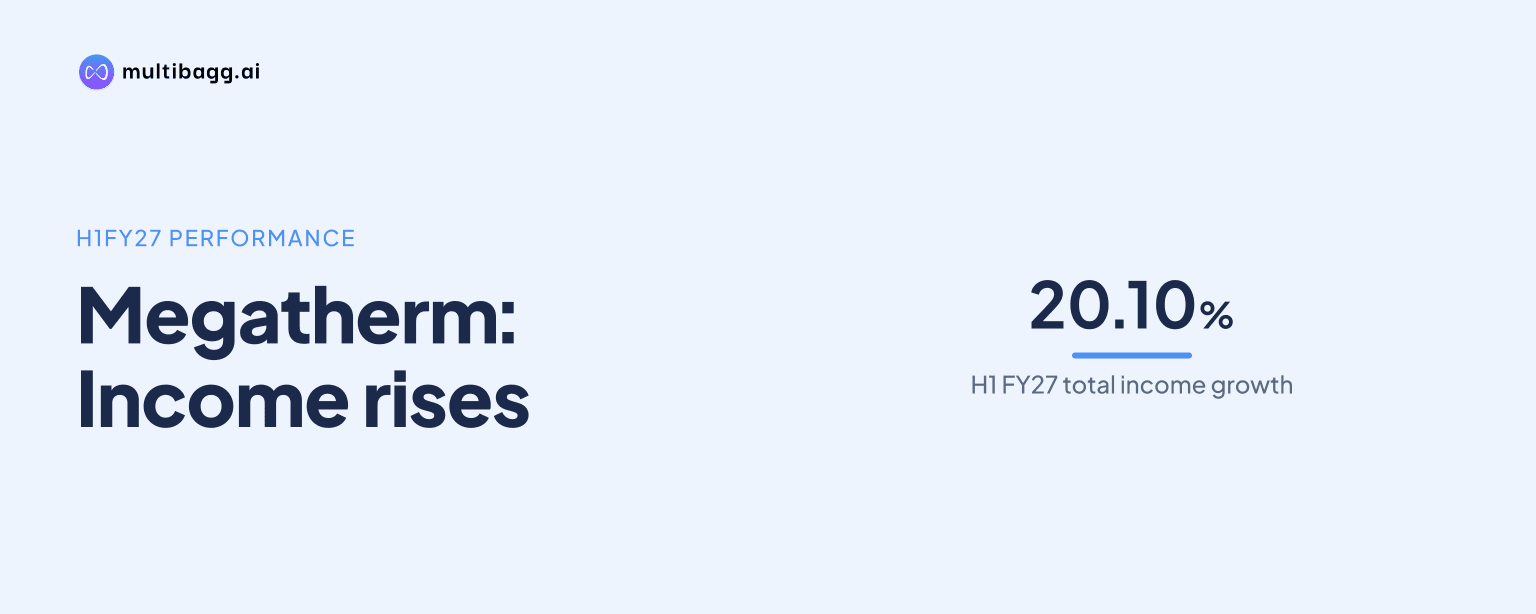
In H1FY27, Megatherm increased total income 20.10% year on year to Rs 196.49 crore, but EBITDA fell 11.14% to Rs 17.889 crore as total expenditure rose 24.48%, with the presentation citing investments in growth verticals and showing raw-material and other costs rose faster than income.
Know Megatherm Induction inside out
Results, valuation, peers and who's buying, in one view.
Why did Megatherm’s EBITDA fall despite higher H1FY27 income?
Megatherm’s EBITDA fell because total expenditure increased faster than total income in H1FY27. Income rose by Rs 32.881 crore from Rs 163.609 crore in H1FY26 to Rs 196.49 crore, while expenditure increased by Rs 35.124 crore from Rs 143.478 crore to Rs 178.602 crore. EBITDA consequently declined by Rs 2.242 crore from Rs 20.131 crore.
Raw-material costs were the largest disclosed cost movement, rising 39.71% year on year to Rs 167.416 crore, compared with 20.10% growth in total income. Other expense increased 32.12% to Rs 22.86 crore, while employee benefit expense rose 16.76% to Rs 13.101 crore. Changes in inventories were negative Rs 24.776 crore in H1FY27, compared with negative Rs 4.876 crore in H1FY26.
The same gap between income and expenditure appeared against H2FY26. H1FY27 income was 3.84% above Rs 189.225 crore in H2FY26, whereas expenditure rose 5.34% from Rs 169.544 crore. EBITDA therefore declined 9.10% half on half from Rs 19.68 crore, while the presentation described the period as one of operational efficiency amid growth investments.
How much did Megatherm’s margins and profit change in H1FY27?
Megatherm’s EBITDA margin declined to 9.10% in H1FY27 from 12.30% in H1FY26 and 10.40% in H2FY26. That was a 3.20-percentage-point decline year on year and a 1.30-percentage-point reduction from the preceding half year. The movement followed expenditure growth of 24.48%, exceeding the 20.10% increase in income.
Reported profit after tax declined 20.83% year on year to Rs 9.532 crore from Rs 12.041 crore in H1FY26. It was also 18.11% below Rs 11.64 crore reported in H2FY26. Reported profit-after-tax margin narrowed to 4.85%, from 7.36% a year earlier and 6.15% in the preceding half year.
The reduction below EBITDA included higher depreciation and interest. Depreciation rose 19.30% year on year to Rs 2.634 crore, taking profit before interest and tax to Rs 15.255 crore, down 14.89%. Interest expense increased 32.49% to Rs 2.413 crore, and profit before tax before exceptional items declined 20.25% to Rs 12.842 crore; reported earnings per share were Rs 5.07 against Rs 6.39 in H1FY26.
Got a follow-up? Ask IRIS
Which investments did Megatherm link to its H1FY27 cost base?
Megatherm linked part of its cost base to hiring, marketing and research and development in growth verticals, particularly transformers. Employee benefit expense reached Rs 13.101 crore in H1FY27, up 16.76% from H1FY26, and the presentation said the company was expanding its team in businesses including transformers.
In induction, Megatherm said it was continuing investment and marketing for export markets and making significant research-and-development investment to support differentiation in growth verticals. The company said its induction vertical grew by more than 20% despite Gulf-region headwinds and no Gulf orders during the period. It also cited multiple memorandums of understanding in foreign markets and new enquiries.
The divisional disclosure distinguishes core businesses from businesses in a growth and investment phase. Steel had an overhead percentage of 10% and spares and services 11%, compared with 23% for heating, hardening and foundry and 18% for transformers. Megatherm said core verticals remained profitable and contributed to the bottom line, while heating, hardening, foundry and transformers were receiving expansion investment.
What could change Megatherm’s H2FY27 results?
Megatherm said transformer dispatches that began in September are expected to reflect in H2 results. Dispatch has started for inverter-duty transformers used in solar and battery energy storage system applications. The presentation did not provide an H2FY27 revenue, profit or margin estimate for these shipments.
Megatherm has also launched projects for cast-resin transformers, heavy-duty transformers and backward integration of manufacturing capacity. Management said six months of successful operations with at least 40 megawatts of capacity would enable eligibility for National Thermal Power Corporation tenders. This is a stated eligibility plan rather than a disclosed contract award.
The expansion project has a disclosed total cost of Rs 70.05 crore, including working capital. Phase 1 accounts for Rs 39.75 crore for a new shed, core product lines and cast resin, while Phase 2 accounts for Rs 30.30 crore for cast-resin transformers up to 12 megavolt-amperes and power transformers of 220 kilovolts and above. The project includes a 6,300-square-metre integrated pre-engineered shed on company-owned land.
Conclusion
Megatherm’s H1FY27 result shows that 20.10% income growth did not translate into higher operating profit. Total expenditure rose 24.48%, led by a 39.71% increase in raw-material costs and a 32.12% increase in other expense, reducing EBITDA to Rs 17.889 crore and EBITDA margin to 9.10%. Higher depreciation and interest then contributed to a 20.83% decline in reported profit after tax.
The next items to watch are the H2FY27 effect of transformer dispatches that started in September, progress toward National Thermal Power Corporation tender eligibility after six months of qualifying operations, and execution of the Rs 70.05 crore expansion plan. Megatherm also said Gulf demand could reopen when the war ends, leaving the timing of that market recovery unresolved.