










Merritronix lifts EBITDA margin to 17.42% over two years
Key highlights
- Merritronix’s EBITDA margin increased from 7.82% in FY24 to 17.42% in FY26.
- Revenue from operations rose from Rs 85.6991 crore in FY24 to Rs 155.8956 crore in FY26.
- PAT increased from Rs 3.0503 crore in FY24 to Rs 16.103 crore in FY26.
- Merritronix reported negative operating cash flow of Rs 23.3821 crore in FY26.
powered by IRIS
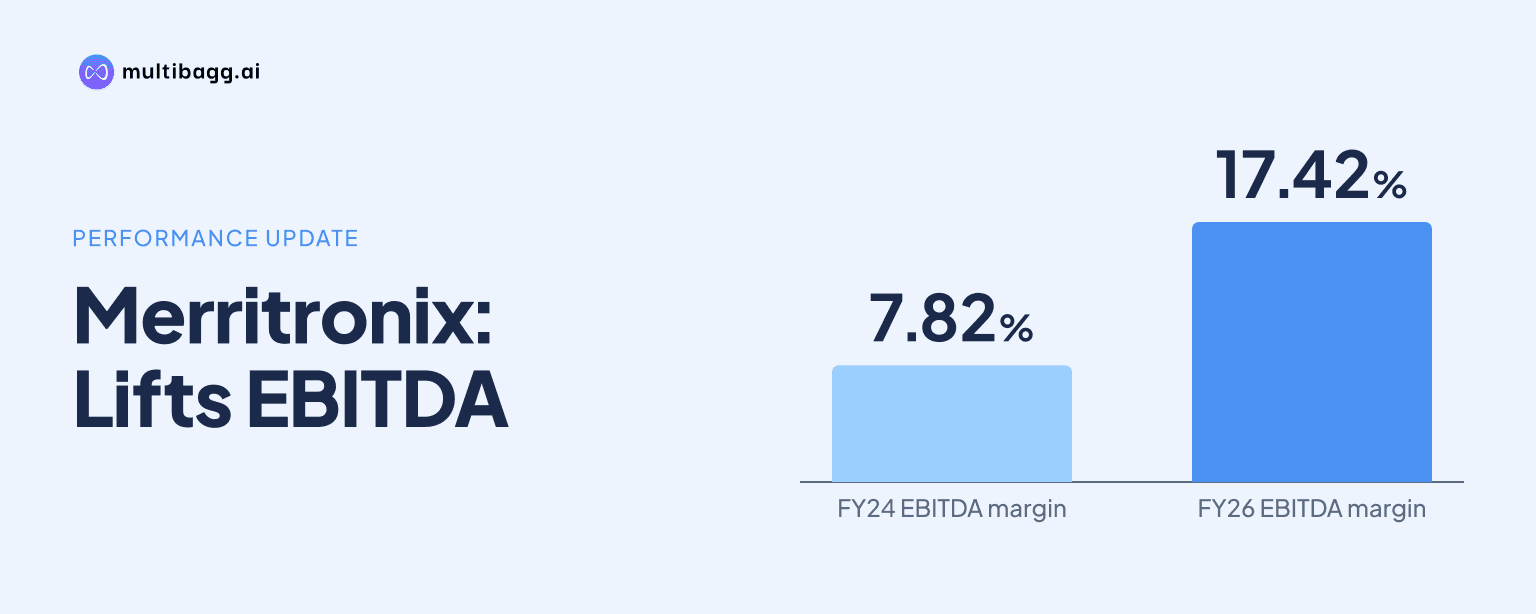
In FY26, Merritronix reported an EBITDA margin of 17.42%, up from 7.82% in FY24, while revenue from operations increased to Rs 155.8956 crore from Rs 85.6991 crore. Merritronix links its margin-expansion plan to direct defence public sector undertaking (PSU) engagement, turnkey delivery and higher-complexity programmes supported by surface-mount technology investments.
Know Merritronix inside out
Results, valuation, peers and who's buying, in one view.
How did Merritronix’s profitability change from FY24 to FY26?
Merritronix increased its EBITDA margin by 9.60 percentage points between FY24 and FY26 as revenue, earnings before interest, tax, depreciation and amortisation (EBITDA), and profit after tax (PAT) rose. The presentation states a revenue compound annual growth rate (CAGR) of about 34.80% for FY24 to FY26, alongside EBITDA CAGR of about 101.15% and PAT CAGR of about 129.74%.
Merritronix’s EBITDA margin moved from 7.82% in FY24 to 13.31% in FY25 and 17.42% in FY26, while PAT margin rose from 3.56% to 7.63% and then 10.33%. The FY26 profit-and-loss statement separately reports EBITDA of Rs 27.5732 crore on total income of Rs 156.2483 crore, compared with Rs 15.6165 crore in FY25 and Rs 6.8817 crore in FY24. The financial-highlights table supplies the Rs 27.2168 crore EBITDA figure associated with the reported 17.42% margin.
How does direct PSU engagement fit Merritronix’s margin plan?
Merritronix says direct engagement with defence PSUs can reduce dependence on intermediaries and support value capture from higher-complexity programmes. Its stated margin-expansion route combines direct customer engagement with indigenisation and turnkey delivery, but the presentation does not disclose a numerical target for direct-PSU revenue, future operating margin or the value of such work.
The strategy also includes a planned move from component-level work towards complete system design and manufacturing. Merritronix says it will invest in research and development, strengthen system-level design, prototyping and testing, and align with future customer platforms for integrated programme participation. These are capability plans, and the presentation does not quantify their revenue share or margin contribution.
Merritronix identifies obsolescence management as a defence and aerospace capability relevant to this approach. Its offerings include reverse engineering, form-fit-function replacements, alternate-component qualification and selective system redesign, which are intended to extend the life of legacy avionics, naval, surveillance and communication systems without complete platform replacement.
Got a follow-up? Ask IRIS
What operating capabilities support Merritronix’s growth plan?
Merritronix says its surface-mount technology (SMT) and through-hole technology assembly lines support high-density and high-complexity electronic assemblies. The infrastructure includes automated optical inspection, X-ray inspection and functional testing, while it can handle ball-grid-array and micro-ball-grid-array components through processes compliant with IPC-A-610 Class 3, a quality classification cited for aerospace and defence requirements.
During FY25-26, Merritronix invested in new-generation SMT equipment and commissioned a Panasonic NPM D3A pick-and-place line in January 2026. Management says targeted automation and process improvements are intended to raise execution speed and resource efficiency, supported by procurement, inventory and production-planning discipline. The presentation provides no throughput, utilisation or capital-expenditure figure for the line.
Merritronix also outlines selective expansion into unmanned aerial vehicles, electric-vehicle power electronics and advanced industrial applications, while retaining defence and aerospace as its core. Management says this uses existing high-density printed circuit board assembly, system-integration and quality-compliance capabilities, aiming to reduce customer and programme concentration with limited incremental investment.
What do Merritronix’s balance sheet and cash flows show?
Merritronix reported debt to equity of 0.81 times in FY26, down from 1.10 times in FY25 and 1.93 times in FY24, while its current ratio rose from 1.11 times in FY24 to 1.35 times in FY25 and 1.56 times in FY26. Return on equity was 46.03% in FY26, below 69.21% in FY25 but above 44.22% in FY24; return on capital employed followed a similar pattern at 45.26%, 66.21% and 43.13%, respectively.
The FY26 balance sheet shows a larger working-capital base than in FY25. Inventory increased to Rs 71.3076 crore from Rs 39.6862 crore, while trade receivables rose to Rs 36.5465 crore from Rs 20.3591 crore. Short-term borrowings increased to Rs 37.9018 crore from Rs 13.7551 crore, and cash and bank balances rose to Rs 25.6962 crore from Rs 2.4206 crore.
Merritronix recorded negative cash flow from operating activities of Rs 23.3821 crore in FY26, following negative Rs 6.6433 crore in FY25 and positive Rs 4.5324 crore in FY24. Cash flow from financing activities was Rs 41.1473 crore in FY26, producing a net increase in cash and cash equivalents of Rs 15.1798 crore. The reported margin and earnings progression therefore coincided with higher inventory, receivables and financing inflows.
Conclusion
Merritronix’s reported EBITDA margin rose from 7.82% in FY24 to 17.42% in FY26 as revenue from operations increased from Rs 85.6991 crore to Rs 155.8956 crore and PAT rose from Rs 3.0503 crore to Rs 16.103 crore. Management attributes its strategy to direct defence-PSU engagement, higher-complexity work, indigenisation and turnkey delivery, supported by a planned expansion in system-design and manufacturing capability.
The next disclosed execution points are the January 2026 commissioning of the Panasonic NPM D3A SMT line and progress from component-level activity to integrated programmes. The presentation does not give direct-PSU revenue, order-value or margin targets, while FY26 negative operating cash flow of Rs 23.3821 crore and higher inventory and receivables leave cash conversion as an unresolved matter to monitor.