










Merritronix H1 FY27 profit more than triples, income up 91%
Key highlights
- Merritronix reported H1 FY27 total income of Rs 107.21 crore, up 91.36% from Rs 56.03 crore.
- Merritronix’s H1 FY27 profit after tax was Rs 12.09 crore, up 223.72% year on year.
- Merritronix reported H1 FY27 EBITDA of Rs 15.99 crore, a 94.76% increase.
- Merritronix reported an order book of Rs 101.64 crore as of September 30, 2026.
powered by IRIS
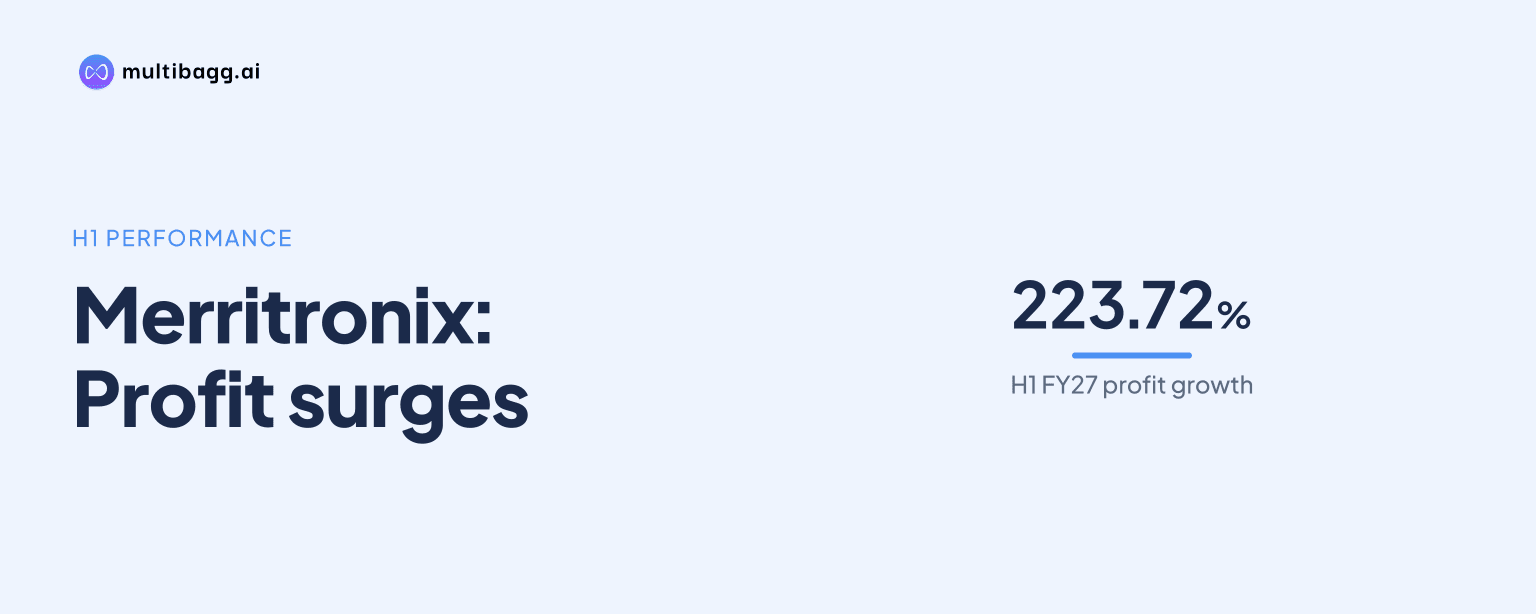
Merritronix Limited reported H1 FY27 profit after tax of Rs 12.09 crore, up 223.72% from H1 FY26, while total income rose 91.36% to Rs 107.21 crore. Earnings before interest, tax, depreciation and amortisation rose 94.76% to Rs 15.99 crore, and lower depreciation and amortisation accompanied faster growth in profit before tax.
Know Merritronix inside out
Results, valuation, peers and who's buying, in one view.
How did Merritronix perform in H1 FY27?
Merritronix generated total income of Rs 107.21 crore in H1 FY27, compared with Rs 56.03 crore in H1 FY26, producing the reported 91.36% increase. Revenue from operations rose to Rs 106.37 crore from Rs 55.95 crore, while other income increased to Rs 84.20 lakh from Rs 7.88 lakh.
The H1 FY27 statement shows that revenue from operations remained the principal source of income in both half-years. Other income rose by Rs 76.32 lakh, but represented less than the Rs 50.42 crore increase in revenue from operations between H1 FY26 and H1 FY27.
Why did Merritronix profit increase faster than income in H1 FY27?
Merritronix’s profit after tax increased faster than income because profit before tax rose 196.89% to Rs 14.14 crore, compared with a 91.36% increase in total income to Rs 107.21 crore. EBITDA, meaning earnings before interest, tax, depreciation and amortisation, increased 94.76% to Rs 15.99 crore from Rs 8.21 crore.
Depreciation and amortisation declined to Rs 1.53 crore in H1 FY27 from Rs 2.48 crore in H1 FY26, a reduction of Rs 95.74 lakh. Finance expenses moved in the other direction, rising to Rs 32.36 lakh from Rs 27.31 lakh, while tax expense increased to Rs 2.05 crore from Rs 1.03 crore.
The movement in depreciation and amortisation is a disclosed difference between the EBITDA and profit-before-tax comparisons. Merritronix did not provide a separate explanation for the lower depreciation and amortisation charge or for the individual factors behind the 223.72% increase in profit after tax.
What changed in Merritronix’s cost base?
Merritronix’s total expenses increased to Rs 91.22 crore in H1 FY27 from Rs 47.82 crore in H1 FY26, while total income grew slightly faster to Rs 107.21 crore from Rs 56.03 crore. The difference between income and expenses, represented by EBITDA, therefore rose to Rs 15.99 crore from Rs 8.21 crore.
Cost of materials consumed, the largest disclosed expense line, rose to Rs 87.82 crore from Rs 45.97 crore, broadly following the increase in revenue from operations. Employee benefits expense rose to Rs 1.30 crore from Rs 1.01 crore, whereas operating and selling expenses increased to Rs 2.10 crore from Rs 83.64 lakh.
The cost mix changed across the disclosed lines in H1 FY27. Materials rose by Rs 41.85 crore, operating and selling expenses rose by Rs 1.27 crore, and employee benefits expense rose by Rs 29.04 lakh, while depreciation and amortisation fell by Rs 95.74 lakh.
Got a follow-up? Ask IRIS
What is Merritronix doing beyond electronics manufacturing?
Merritronix is seeking to build a vertically integrated offering through alliances with design and hardware-engineering partners, covering radio frequency and analog design through precision manufacturing. Managing Director Dovari Amarnath said the company aims to offer complete, compliant solutions for defence, aerospace and telecommunications customers.
In June 2026, Merritronix signed a memorandum of understanding with Analinear Design Technologies Pvt. Ltd. to become its preferred manufacturing partner. The company said the arrangement strengthens analog and mixed-signal electronics manufacturing and expands its addressable market across industrial, automotive, communications and defence electronics.
Also in June 2026, Merritronix entered an exclusive manufacturing partnership memorandum of understanding with Stuam Technologies Limited. Merritronix was named preferred contract manufacturer for Stuam’s current and future product portfolio, with defence communications, radar systems and mission-critical electronics identified as relevant areas.
What pipeline and operating platform does Merritronix report?
Merritronix reported an order book of Rs 101.64 crore as of September 30, 2026. The presentation does not disclose the programme mix, execution timetable, cancellation terms, expected margins or the amount of that order book that may be recognised after H1 FY27.
Merritronix describes its business as business-to-business electronics systems design and manufacturing for high-reliability assemblies and systems. Its listed capabilities include component sourcing, printed circuit board assembly using surface-mount and through-hole technologies, system integration, testing and box-build solutions for defence, aerospace, telecommunications and specialised industrial applications.
The company also reported annual installed capacity of about 2.095 million units in FY2026 and a repeat-customer rate of 86.08% as of March 31, 2026. Management said its alliances and contract manufacturing arrangements are intended to position Merritronix for larger, higher-value and multi-year programmes, without providing programme values or financial targets.
Conclusion
Merritronix’s H1 FY27 result combined a 91.36% rise in total income with a 223.72% increase in profit after tax. Materials remained the dominant cost line at Rs 87.82 crore, while the reduction in depreciation and amortisation to Rs 1.53 crore from Rs 2.48 crore was a notable movement in the path from EBITDA to profit before tax.
The next disclosed items to watch are conversion of the Rs 101.64 crore order book reported on September 30, 2026 and the development of the June 2026 arrangements with Analinear and Stuam. Management has framed those partnerships as a route to larger, higher-value, multi-year programmes, but the presentation leaves their values, timing and financial contribution unresolved.