








Mishra Dhatu Nigam Files Q2 FY27 Call Transcript as PAT Rises 116.84%

Find your next multibaggerBe a Pro Investor
Research stocks and track your picks on the go. Download the app.
Key highlights
- Mishra Dhatu Nigam Limited filed the transcript of its November 19, 2026 Q2 and H1 FY27 conference call.
- MIDHANI reported Q2 FY27 turnover of ₹295.91 crore, up 41.09% year-on-year.
- MIDHANI's Q2 FY27 profit after tax was ₹27.69 crore, up 116.84% year-on-year.
- MIDHANI disclosed an open order book of ₹2,164 crore as of October 1, 2026.
powered by IRIS
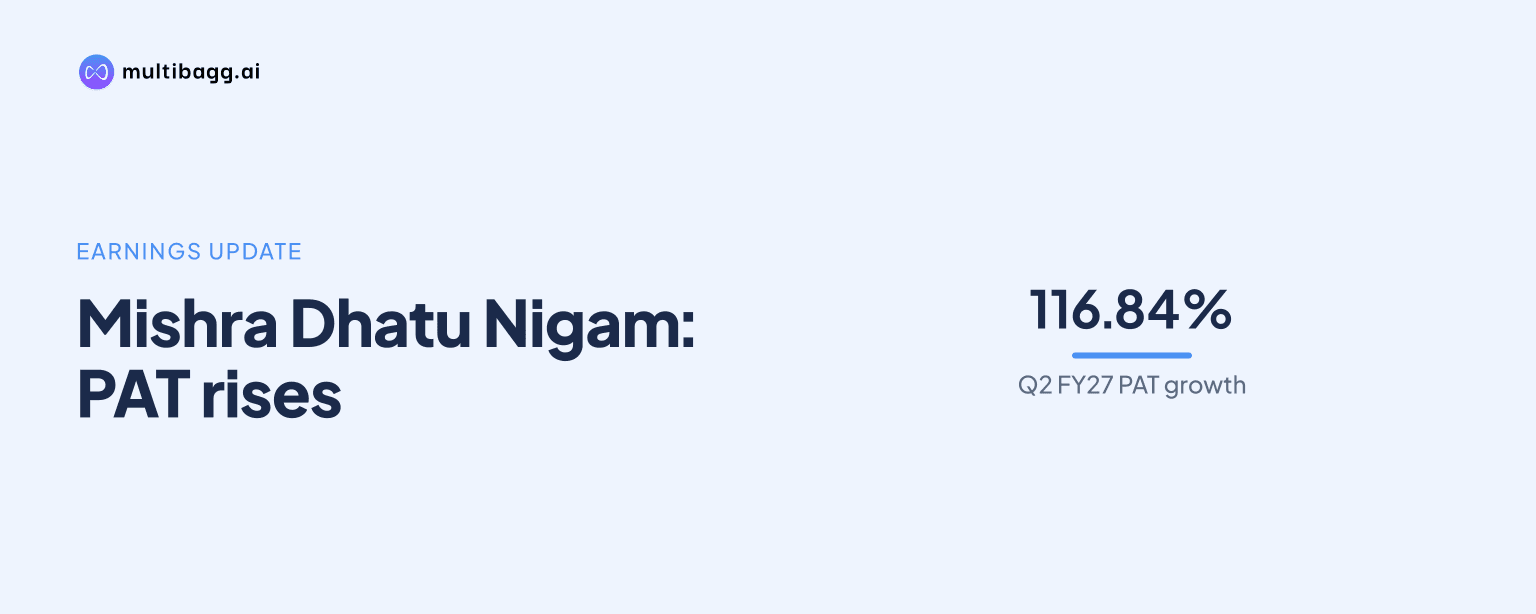
Mishra Dhatu Nigam Limited filed the transcript of its Q2 and H1 FY27 investor conference call, held on November 19, 2026, after reporting Q2 FY27 profit after tax of ₹27.69 crore, up 116.84% year-on-year. The filing gives investors access to management’s discussion of quarterly performance, margins, orders and operating conditions.
Know Mishra Dhatu Nigam inside out
Results, valuation, peers and who's buying, in one view.
What did Mishra Dhatu Nigam Limited file?
Mishra Dhatu Nigam Limited filed the transcript of its Q2 and H1 FY27 results conference call as an earnings-call transcript disclosure. The call was held on November 19, 2026, and was hosted by ICICI Securities. The filing dated November 25 places the record of management’s remarks and investor questions in the public domain.
The disclosure is relevant because it adds detail to the company’s reported quarterly financial performance. MIDHANI discussed its turnover, profitability, order book, manufacturing operations and demand across its specialised materials businesses during the call. A transcript allows investors to review the discussion without relying only on summaries or recordings.
What were MIDHANI’s key Q2 FY27 financial figures?
MIDHANI reported Q2 FY27 turnover of ₹295.91 crore, a 41.09% increase from ₹209.73 crore in the corresponding quarter of the previous year. Profit after tax rose 116.84% year-on-year to ₹27.69 crore, according to figures discussed in the call transcript.
Management also stated that EBITDA margin was 20% in the first half of FY27. It said higher costs for LPG, freight and raw materials had been absorbed in certain fixed-price contracts. These comments provide context for profitability during a period in which the company recorded higher turnover and net profit.
What did management say about orders and operations?
MIDHANI said its open order book stood at ₹2,164 crore as of October 1, 2026. Management identified aerospace, defence, space and energy-related applications as important areas for its specialised alloy and materials business. The transcript also referred to demand visibility from organisations including ISRO and DRDO, along with private aerospace activity.
The company discussed the nature of its manufacturing cycle, noting that a typical superalloy order can take two to three months from raw material to finished product because of batch processing and vacuum melting requirements. This operating characteristic is important when assessing the timing of revenue recognition and execution across its specialised product portfolio.
Management also referred to its plate mill as a strategic asset capable of rolling high-strength steels and aluminium products up to 3.2 metres in width. The stated applications include ISRO-related requirements, missile casings and other flat products. The company linked this capability to reducing dependence on imported materials for such applications.
Got a follow-up? Ask IRIS
Why does the transcript matter to MIDHANI investors?
The transcript matters because it sets out the management commentary behind MIDHANI’s Q2 FY27 numbers, including the 41.09% turnover growth and 116.84% growth in profit after tax. Investors can use the disclosure to assess whether the improvement was accompanied by comments on margins, order execution and customer demand.
The disclosed ₹2,164 crore order book provides a reference point for the scale of work available for execution, although the transcript does not establish the timing or value of future revenue recognition from each order. Management’s comments on fixed-price contracts and input costs also show that profitability can be influenced by cost movements even when revenue increases.
Aerospace was stated to account for 35% of the order book. Management said global original equipment manufacturers were looking to increase sourcing from India and that MIDHANI expected its aerospace contribution to rise. This was management’s stated outlook during the call, rather than a reported financial result.
How does the filing add context to FY27 performance?
The filing adds context by combining financial results with management’s explanation of the business environment. MIDHANI operates in specialised materials where product mix, qualification requirements, manufacturing processes and customer schedules can affect quarterly performance. The call discussion indicated that the company’s products include superalloys, titanium alloys and special steels for strategic and industrial applications.
Management stated an expectation of 20% revenue growth for FY27 and indicated a target to match or exceed a 23% EBITDA margin for the full year. These are management targets discussed during the conference call, not achieved FY27 results. The transcript therefore provides investors with a documented basis to track future disclosures against the company’s stated expectations.
Conclusion
Mishra Dhatu Nigam Limited’s filing makes the November 19 Q2 and H1 FY27 conference-call discussion publicly available. The transcript records a quarter in which turnover reached ₹295.91 crore and profit after tax rose 116.84% year-on-year to ₹27.69 crore, while management also addressed margin pressures, execution cycles and its order book.
The next points to watch are MIDHANI’s progress toward its stated 20% FY27 revenue-growth expectation and its full-year EBITDA margin target of at least 23%. Investors may also monitor subsequent disclosures for order inflows, execution of the ₹2,164 crore open order book and updates on specialised aerospace and strategic-material demand.

