








MIDHANI plans Rs 40 crore titanium powder plant within year

Find your next multibaggerBe a Pro Investor
Research stocks and track your picks on the go. Download the app.
Key highlights
- MIDHANI plans a titanium-powder facility with investment of about Rs 40 crore.
- MIDHANI said 100% of titanium powders are imported into India.
- MIDHANI expects to establish the facility within one year, subject to licensing and equipment supply.
- MIDHANI cited 40 years of titanium-alloy manufacturing experience for the project.
powered by IRIS
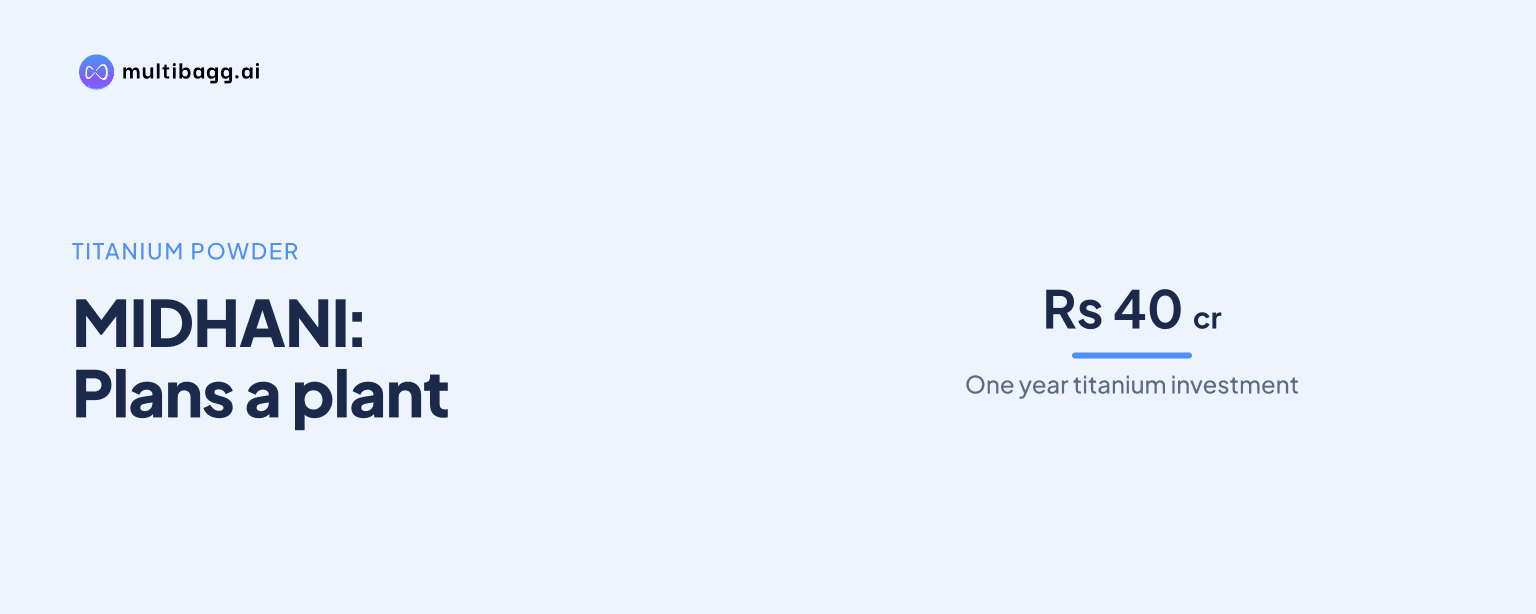
In the call, MIDHANI said it expects to establish a Rs 40 crore titanium-powder facility within one year, aiming to replace powders that management said are 100% imported into India. The project has a purchase order and a preliminary BAFA licence, but final progress depends on the dual-use technology process and equipment supply.
Know Mishra Dhatu Nigam inside out
Results, valuation, peers and who's buying, in one view.
What is MIDHANI building for additive manufacturing?
MIDHANI is planning a titanium-powder manufacturing unit for additive manufacturing, or 3D printing, with an investment of about Rs 40 crore. Management said the project is intended to make powder feedstock rather than printers, addressing an input used in additive-manufacturing equipment already available in India.
The company said it has placed a purchase order for the facility and that the supplier is working on providing the equipment. MIDHANI also cited its 40 years of experience in manufacturing titanium alloys as the basis for its move into titanium powders. The proposed facility would therefore extend its titanium-alloy capability into a more specialised form of material used for printed components.
Management linked the project to a shift among strategic customers, including launch-vehicle and missile customers, from conventional manufacturing to additive manufacturing for certain parts. According to management, additive manufacturing can reduce component-realisation time, lower the number of weld joints and allow greater integration of components. These are the stated application drivers for the Rs 40 crore powder project, rather than a disclosed revenue or output forecast.
MIDHANI did not disclose the plant’s annual production capacity, the titanium powder grades to be made, or a customer order for its output. It also did not give a commissioning month or a commercial-sales target. The one-year indication is an expectation to establish the facility, not a confirmed date for production or revenue generation.
Why is MIDHANI targeting imported titanium powders?
MIDHANI said India has no domestic manufacturer of quality additive-manufacturing printing powders and that 100% of titanium powders are imported. That import dependence is the principal market gap identified by management for the proposed Rs 40 crore facility.
Management said printer original equipment manufacturers, or OEMs, often require users to procure powders supplied by the printer maker, comparing the arrangement with printer cartridges. As a result, powders are imported from OEMs even where printing machines are available domestically. MIDHANI did not quantify the value of titanium-powder imports, the number of domestic users or the potential share it could supply.
Titanium powder requires handling controls that differ from bulk alloy production, management said. The powder can oxidise easily because of its surface area and must meet strict standards for chemical composition and gas content. These requirements explain why the company described powder-making technology as niche, despite MIDHANI’s stated 40-year record in titanium-alloy manufacturing.
The comparison shows that MIDHANI’s intended change is from imported powder dependence to a domestic manufacturing capability. It does not establish that imported purchases will cease immediately or that MIDHANI will supply every printer user. Management did not disclose qualification requirements from OEMs, end users or strategic customers after the equipment is installed.
Got a follow-up? Ask IRIS
What must happen before MIDHANI can establish the plant?
MIDHANI said the plant’s technology is dual-use and that this caused a delay, although it has received a preliminary BAFA licence. Management said it is working with the relevant party on the remaining process and did not state that final licensing, installation or commercial production had been completed.
The company said the supplier party is currently working toward equipment supply. This makes the expected one-year establishment period conditional on two specific mechanisms disclosed on the call: progress in the dual-use technology licensing process and delivery of the powder-making equipment. MIDHANI did not name the supplier or specify the equipment’s delivery date.
The project has advanced beyond an initial proposal because MIDHANI said it has issued a purchase order and obtained preliminary licensing. However, the disclosed milestones are not equivalent to a commissioned plant. The company did not say whether the preliminary BAFA licence needs to be followed by a final licence, nor did it provide the remaining approval sequence.
MIDHANI separately discussed a wider capital-expenditure plan of Rs 1,000 crore, for which it said specifications were under finalisation and completion could take at least three years. The company did not state whether the Rs 40 crore titanium-powder unit is included in that Rs 1,000 crore programme. The one-year timeline should therefore be treated as specific to the powder facility rather than as a timetable for the larger capital plan.
Management also described additive manufacturing as relevant to launch-vehicle and missile customers, but it gave no order book or sales guidance for titanium powder. The company’s existing open order book was Rs 2,164 crore, with 35% from aerospace and 22% from space, but it did not attribute any part of that order book to the proposed powder facility. This means the project’s strategic rationale is clearer than its near-term financial contribution.
Conclusion
MIDHANI’s Rs 40 crore titanium-powder project is a proposed domestic capability in a category management says is entirely import-dependent in India. The company’s case rests on additive manufacturing’s use in strategic components, its 40 years of titanium-alloy experience, and the strict oxidation, chemical-composition and gas-content controls required for powder production. The purchase order and preliminary BAFA licence indicate progress, but no capacity, customer commitment or revenue estimate was disclosed.
The next development to watch is the remaining dual-use technology process and the supplier’s equipment delivery, because MIDHANI said both underpin its expectation to establish the facility within one year. Investors can also watch for disclosure of powder grades, plant capacity, customer qualification and commercial-production timing. Those milestones would clarify whether the Rs 40 crore project progresses from planned infrastructure to domestic supply.

