








MIDHANI starts nickel and cobalt recovery trial for supply security

Find your next multibaggerBe a Pro Investor
Research stocks and track your picks on the go. Download the app.
Key highlights
- MIDHANI said India imports 100% of the nickel and cobalt used as critical inputs.
- MIDHANI’s Heavy Water Board MoU will assess nickel and cobalt recovery over about one year.
- MIDHANI’s scrap inventory fell from Rs 392 crore to about Rs 353 crore in the first six months.
- Aerospace represented 35% of MIDHANI’s Rs 2,164 crore open order book.
powered by IRIS
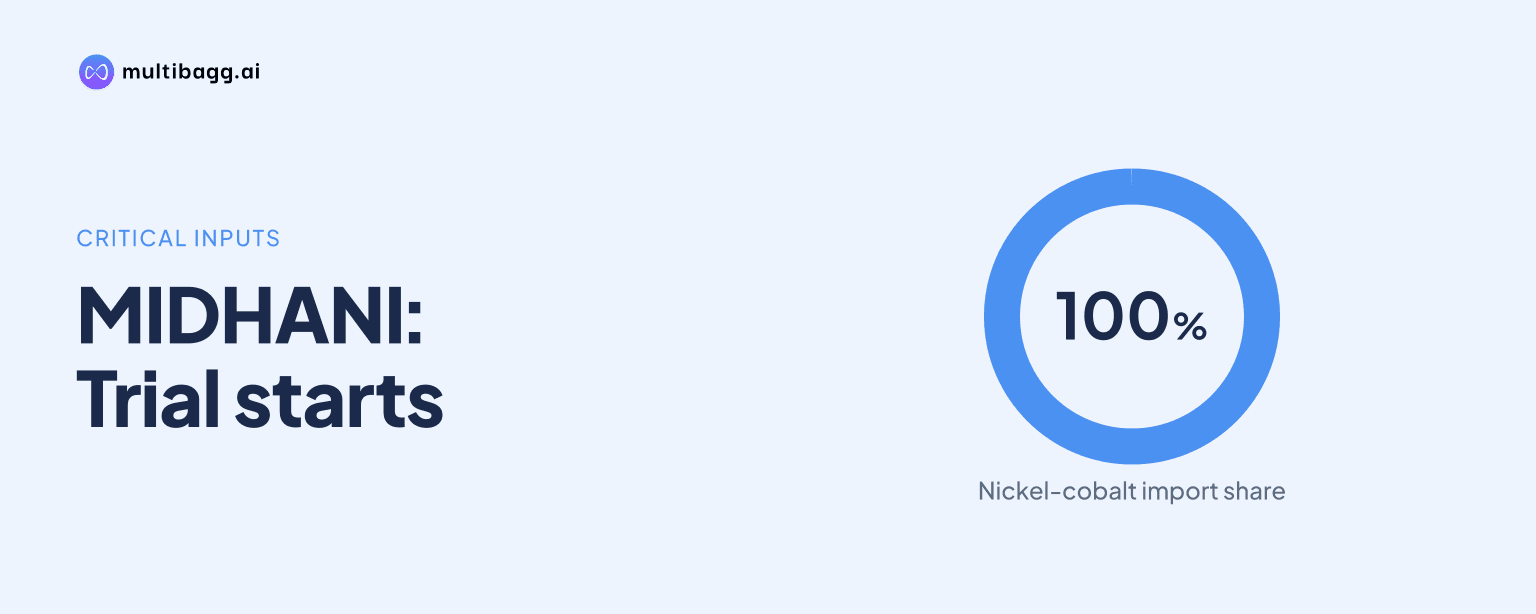
Mishra Dhatu Nigam Limited (MIDHANI) has begun a roughly one-year trial with the Heavy Water Board to recover nickel and cobalt to its required specifications for aerospace and defence melting, addressing India’s 100% import dependence on both metals rather than pursuing an immediate profit opportunity. Management said recovered metals must match MIDHANI’s purchased raw-material specifications.
Know Mishra Dhatu Nigam inside out
Results, valuation, peers and who's buying, in one view.
Why is MIDHANI starting nickel and cobalt recovery?
MIDHANI is starting the recovery trial because management said India has no domestic mineral resources from which it can naturally extract nickel and cobalt and imports 100% of both metals. The company identified the elements as inputs for alloys used across defence, space and energy, in addition to their role in lithium-ion batteries.
Management described the initiative as a supply-security measure, not a business case based on near-term savings. It said a disruption in supply chains could affect all participants in these sectors, while scrap recovery could become one source of supply if prices rise in future. The effort follows discussions with the Heavy Water Board over about three to four years.
MIDHANI’s existing business mix shows why the supply issue matters to its operations. Its open order book was Rs 2,164 crore, with aerospace accounting for 35%, space 22%, naval 14%, missile 10% and energy 8%; these segments collectively require specialised alloys and materials. Management also said the aerospace share of the open order book has been increasing.
How will MIDHANI test recovered nickel and cobalt?
MIDHANI will use the memorandum of understanding, or MoU, with the Heavy Water Board to assess over about one year whether recovered nickel and cobalt can be used again in its melting process to make aerospace and defence components. The Heavy Water Board had already conducted bench-level and pilot-plant trials before saying that recovery was feasible, according to management.
The critical test is material quality rather than a separate customer qualification programme. Management said the final electrowinning stage, an electrochemical process used to deposit metal, is intended to yield pure nickel and pure cobalt. MIDHANI’s MoU requires the metals to meet the same raw-material specifications as its imported inputs before they can be used as-is in melting.
Management said customer permission should not be necessary if the recovered material meets MIDHANI’s existing specifications, because it would be equivalent to the pure material the company imports. That is conditional on the trial establishing the required purity and suitability, rather than an assurance that recovered feedstock has already entered production.
What does MIDHANI’s scrap position show about available material?
MIDHANI reduced its scrap inventory by about Rs 39 crore in the first six months, with the inventory value declining from Rs 392 crore at the start of the year to about Rs 353 crore. Management characterised roughly Rs 350 crore of this amount as usable scrap, indicating that the recovery initiative begins alongside an established practice of reusing material in manufacturing.
The company said an average melt can use about 70% virgin material and 30% scrap, although certain orders require 100% virgin material. That distinction limits how much scrap can directly replace fresh inputs: material selection depends on order specifications, including the grade and purity required for particular defence, aerospace or energy products.
Management also drew a distinction between remelting scrap and recovering individual metals from it. It said remelting is generally preferable because recovery adds cost, while plant reverts are retained because they are useful for future melts. Scrap from less-frequently ordered grades can remain in inventory until a matching order returns, sometimes after two or three years.
Got a follow-up? Ask IRIS
Will the recovery project reduce MIDHANI’s costs soon?
MIDHANI has not disclosed a cost-saving estimate, capital commitment or commercial revenue target for the nickel and cobalt recovery work. Management explicitly said it was not approaching the project in profit mode, making supply continuity for critical materials the stated rationale for the approximately one-year assessment.
This contrasts with a separate facility discussed on the call, where management referred to a roughly Rs 40 crore facility delayed by dual-use technology licensing and said it could be established within one year after preliminary licensing. No comparable facility cost, commissioning timetable or equipment plan was provided for the Heavy Water Board recovery MoU.
Raw-material price movements remain relevant to the economics but were not quantified for nickel or cobalt. Management said prices depend on geopolitical conditions and that some cooling had recently been observed when supply chains were uninterrupted. It also noted that fixed-price contracts had absorbed increased raw-material costs while MIDHANI reported a 20% earnings before interest, tax, depreciation and amortisation, or EBITDA, margin in the first six months.
How does the project fit MIDHANI’s aerospace and defence plans?
The recovery trial fits MIDHANI’s focus on strategic alloy supply, particularly for the 35% aerospace component of its Rs 2,164 crore open order book. Management said MIDHANI supplies superalloys, titanium alloys and special steels to aerospace customers, while nickel and cobalt are important alloying elements for aerospace, defence, space and energy applications.
Management is pursuing higher aerospace output alongside the recovery work. It said titanium-alloy production reached a record in the prior year and is expected to exceed that level this year, while superalloy activity is more than five to six times its level of over five years ago. It added that discussions with global aerospace and aero-engine companies could lead to long-term contracts with price-variation clauses after audits that have run for about one to one-and-a-half years.
The company’s wide plate mill is another example of the strategic applications it cited, with capacity to roll plates up to 3.2 metres wide for uses including rocket-motor and missile casings. Management said the mill has also completed an aluminium order for an Ordnance Factory, while India currently imports 100% of wide aluminium plates. These initiatives share an indigenisation rationale, but MIDHANI has not linked the plate mill’s economics to nickel and cobalt recovery.
Conclusion
MIDHANI’s recovery trial is a measured attempt to establish a domestic secondary source of nickel and cobalt for critical alloys in a country that management says imports 100% of both metals. The main evidence of strategic relevance is the company’s Rs 2,164 crore open order book, led by aerospace at 35%, and its reliance on specialised alloy production for defence, space and energy markets.
The next milestone is the roughly one-year MoU assessment with the Heavy Water Board, particularly whether electrowinning can deliver pure metals that meet MIDHANI’s existing raw-material specifications. Management did not quantify recovery volumes, project cost, production use or supply impact on this call, leaving those matters unresolved until a later update.

