








MIDHANI’s Rs 1,000 crore expansion needs at least three years

Find your next multibaggerBe a Pro Investor
Research stocks and track your picks on the go. Download the app.
Key highlights
- MIDHANI said the proposed expansion investment would take 3 to 4 years, with a minimum period of 3 years.
- MIDHANI has in-principle Board approval, while technical specifications remain under finalisation.
- MIDHANI reported an Rs 2,164 crore open order book, with aerospace accounting for 35%.
- MIDHANI reduced scrap inventory from Rs 392 crore to about Rs 353 crore in the first 6 months.
powered by IRIS
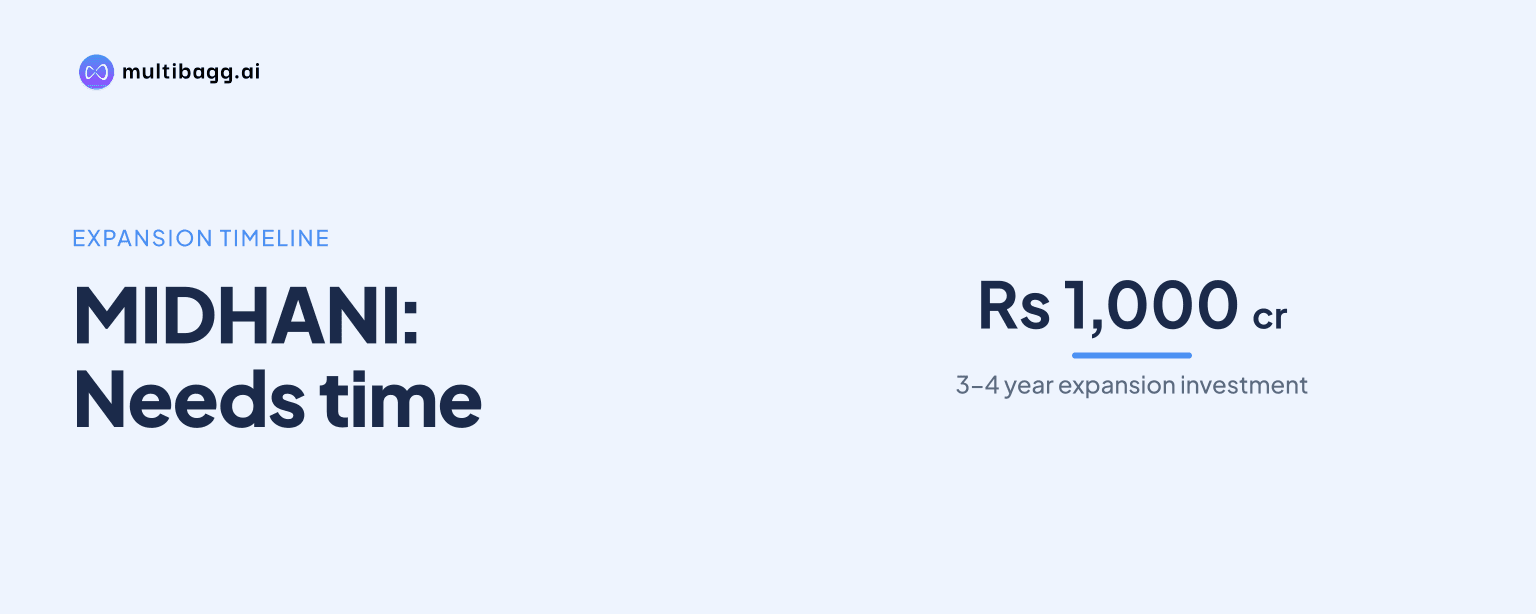
MIDHANI said its Rs 1,000 crore expansion would require at least three years of investment and could take three to four years, while technical specifications remain under finalisation. The company has received in-principle Board approval, but management said it was still working on other modalities and expected more clarity by the next quarter.
Know Mishra Dhatu Nigam inside out
Results, valuation, peers and who's buying, in one view.
What is the approval status of MIDHANI’s Rs 1,000 crore expansion?
MIDHANI has in-principle approval from its Board, not a fully detailed project approval ready for execution. Madhubala Kalluri said the company was working on other modalities, while Paul Antony said approvals from appropriate authorities were at the final stage and technical specifications were being finalised.
Management said the envisaged project cost was within the Board’s approval powers. This indicated that the company did not identify a pending Government of India funding approval during the call. However, MIDHANI did not disclose a final capital allocation, financing mix, capacity addition or commissioning schedule for the Rs 1,000 crore programme.
The distinction between in-principle approval and completed project preparation is material because the programme’s underlying specifications are not yet final. Management did not say when construction would begin, whether the spending would be phased, or whether individual facilities could start operating before the full three-to-four-year investment period ends.
When could MIDHANI’s expansion capacity become operational?
MIDHANI said the investment would take a minimum of three years and was likely to take three to four years. The company did not provide a commissioning date, so the call does not establish when the proposed capacity could begin contributing to production or revenue.
That timeline contrasts with MIDHANI’s separate additive-manufacturing powder facility, which management expects to establish in about one year. The powder project has a purchase order in place, preliminary BAFA licence approval and an indicated cost of about Rs 40 crore, while the larger Rs 1,000 crore expansion remains in the specification and approval process.
Management said the powder facility addresses India’s dependence on imported additive-manufacturing powders, including titanium powder. MIDHANI said it has 40 years of experience in titanium-alloy production, but described powder-making as a niche technology requiring strict control of chemical composition and gas content.
The two projects therefore have different levels of readiness. The Rs 40 crore powder facility has equipment procurement and preliminary licensing progress, whereas the Rs 1,000 crore programme has no disclosed final scope, project start date or output target.
What facilities and markets could MIDHANI’s capex support?
MIDHANI described the Wide Plate Mill as a strategic facility that can roll materials up to 3.2 metres wide. Management said the mill produces plates for Indian Space Research Organisation rocket motor casings, missile casings and other strategic applications, and that all of MIDHANI’s flat products come from this facility.
An analyst referred to an investment of about Rs 400 crore in the Wide Plate Mill as part of the Rs 1,000 crore plan, but MIDHANI did not confirm that allocation or provide asset-turn expectations. Management said the mill was originally intended for steel, but it has also executed an aluminium order for an Ordnance Factory.
MIDHANI did not disclose a numerical utilisation rate for the Wide Plate Mill. Management said the facility is order-driven rather than a continuous-production asset that can be measured through a steady 90% or 95% utilisation level. It also said certain long hot-rolling products are diverted to the mill for supply to the energy sector.
The potential end-markets are reflected in MIDHANI’s Rs 2,164 crore open order book. Aerospace was the largest disclosed segment at 35%, followed by space at 22%, while naval, missile and energy sectors together represented 32%.
Management said aerospace sourcing from Indian suppliers could increase, but it did not quantify orders or revenue that might arise from the expansion. It also said that production orders for the Advanced Medium Combat Aircraft programme had not yet been received, although MIDHANI is executing trial titanium-alloy orders for new grades.
Got a follow-up? Ask IRIS
How does the capex timetable compare with MIDHANI’s operating targets?
MIDHANI’s capex timetable is longer than management’s near-term operating target of 20% revenue growth. Management said it aims to achieve 20% growth, but did not state that completing the Rs 1,000 crore expansion is required to meet that objective.
The company also said it expects financial year 2027 earnings before interest, tax, depreciation and amortisation, or EBITDA, margin to exceed the prior year’s 22.8%. MIDHANI reported a 20% EBITDA margin in the first six months despite higher liquefied petroleum gas costs and raw-material prices under fixed-price contracts.
Management linked potential margin improvement to rising sales volumes because fixed costs remain almost unchanged. It said some cooling in raw-material prices was visible as supply-chain conditions improved, but added that prices remain dependent on geopolitical conditions.
MIDHANI also reported progress in reducing scrap inventories during the first six months. It said about Rs 39 crore of opening scrap quantities had been reduced, taking scrap inventory from Rs 392 crore at the start of the year to about Rs 353 crore, of which roughly Rs 350 crore was usable material.
Management said an average production mix can use 70% virgin material and 30% scrap. Some orders, however, require 100% virgin material, making the benefit of scrap use dependent on the product and customer specification.
What are the remaining execution risks for MIDHANI’s expansion?
MIDHANI’s central disclosed execution issue is that technical specifications remain unfinished. Management said it expects to provide more information in the next call, but it has not disclosed the final facilities covered, expenditure split, phases of execution or capacity expected from the Rs 1,000 crore programme.
Order availability is another variable because management said Wide Plate Mill use depends on received orders. In naval opportunities, MIDHANI said it had participated in a tender but could not estimate potential order value before bids were opened, adding that better information might be available by the third-quarter conference call.
Raw-material security remains relevant to the company’s production plans. MIDHANI said India imports 100% of nickel and cobalt, and it is assessing recovery of those metals under a memorandum of understanding with the Heavy Water Board over about one year.
Management said recovered nickel and cobalt would need to meet MIDHANI’s raw-material specifications before being used in melting for aerospace or defence components. The initiative is intended to support supply assurance, rather than providing a disclosed near-term cost-saving target.
Conclusion
MIDHANI’s Rs 1,000 crore expansion remains a medium-term project rather than an immediate capacity addition. The company has in-principle Board approval and says approvals and technical specifications are progressing, but the disclosed minimum three-year investment period means the programme has no stated near-term commissioning outcome.
The next item to watch is the next conference call, when management said it expects to provide more clarity on approvals and specifications. Investors can also monitor whether MIDHANI discloses the final project scope, spending allocation, phase-wise commissioning plan and any connection between the expansion and its Rs 2,164 crore open order book.

