








MIDHANI Expects FY27 EBITDA Margin Above 22.8% on H2 Sales

Find your next multibaggerBe a Pro Investor
Research stocks and track your picks on the go. Download the app.
Key highlights
- MIDHANI expects FY27 EBITDA margin to exceed FY26’s 22.8%, after reporting 20% in H1 FY27.
- MIDHANI’s H1 FY27 turnover rose 40.81% year on year to Rs 535.40 crore.
- MIDHANI reported an open order book of Rs 2,164 crore as of October 1, 2026.
- MIDHANI is working toward a Ministry sales target of Rs 1,600 crore for FY27.
powered by IRIS
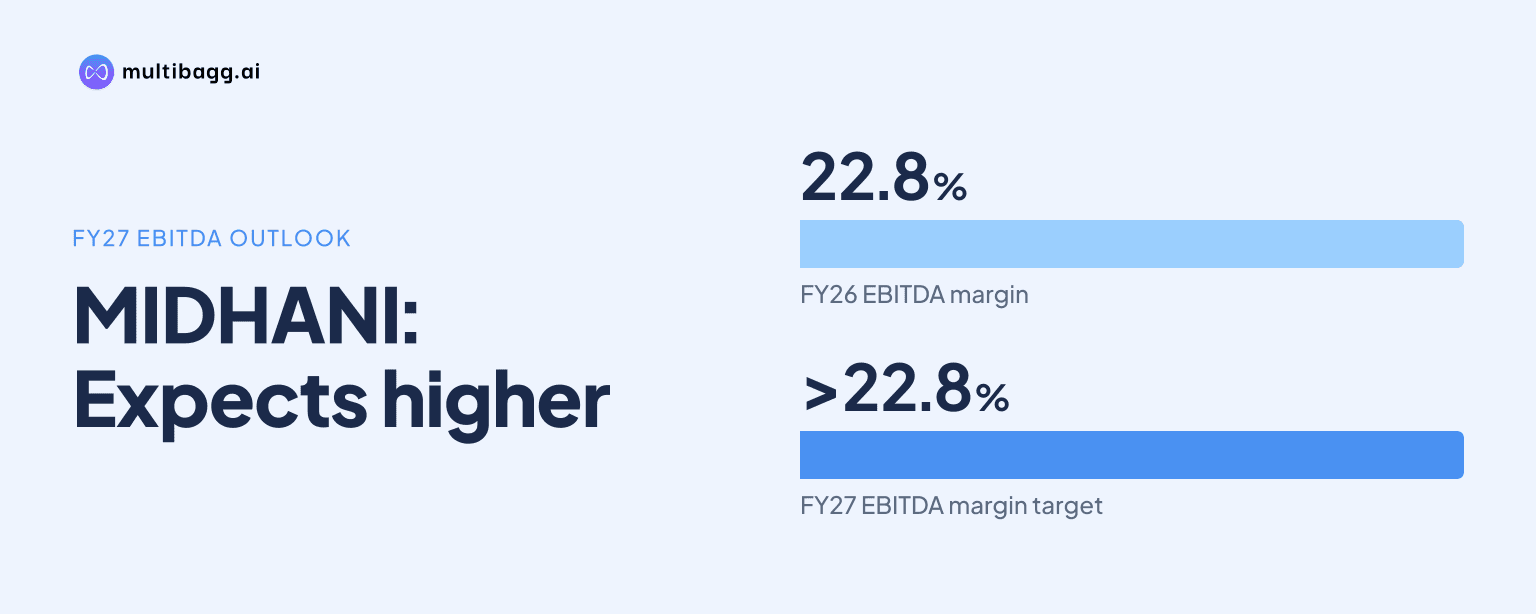
Mishra Dhatu Nigam Limited expects its FY27 earnings before interest, tax, depreciation and amortisation (EBITDA) margin to exceed FY26’s 22.8% as higher sales in the second half absorb largely fixed costs, after reporting a 20% EBITDA margin in H1 FY27. Management said this expectation already accounts for higher raw-material costs and fixed-price contracts.
Know Mishra Dhatu Nigam inside out
Results, valuation, peers and who's buying, in one view.
What EBITDA margin does MIDHANI expect in FY27?
MIDHANI expects FY27 EBITDA margin to cross 22.8%, the level it reported for FY26. Director of Finance Madhubala Kalluri said the company was confident because sales are expected to be higher in the third and fourth quarters than in H1 FY27, when EBITDA margin stood at 20%.
Management did not give a specific full-year EBITDA-margin number above 22.8% or a quarterly margin forecast. It linked the improvement to a Ministry sales target of Rs 1,600 crore for FY27, saying that higher sales volumes should improve cost absorption even after accounting for the input-cost increases discussed during Q1.
The stated FY27 target would represent an improvement from the 20% H1 FY27 margin. Management also said it aims for 20% revenue growth, but described the margin outcome as an expectation dependent on delivering the planned sales increase rather than as a firm financial guarantee.
How did MIDHANI perform in H1 FY27?
MIDHANI reported H1 FY27 turnover of Rs 535.40 crore, up 40.81% from Rs 380.22 crore in the corresponding period a year earlier. Profit after tax rose 72.05% to Rs 44.01 crore, while value of production increased 14.76% to Rs 571.15 crore.
MIDHANI’s H1 turnover growth exceeded its increase in value of production, with sales rising 40.81% and production value rising 14.76%. Management did not quantify the effect of product mix, inventory movement or pricing on this difference, but it identified sales growth as the mechanism expected to lift EBITDA margin in H2.
In Q2 FY27, turnover rose 41.09% to Rs 295.91 crore from Rs 209.73 crore a year earlier, while profit before tax increased 102.6% to Rs 38.75 crore. Q2 profit after tax rose 116.84% to Rs 27.69 crore and value of production grew 21.2% to Rs 310.80 crore.
Why should higher H2 sales increase MIDHANI’s margin?
MIDHANI says higher sales volumes should raise EBITDA margin because its fixed costs remain almost unchanged as revenue rises. Management said a larger sales base in FY27 and subsequent years would therefore have a positive effect on margins, provided the expected volume growth is achieved.
The company’s specialist manufacturing model makes sales conversion and capacity use relevant to this calculation. MIDHANI said a typical super-alloy batch takes two to three months from raw material to finished product, using vacuum-melting furnaces ranging from 600 kilograms to 8 tonnes rather than continuous steelmaking equipment.
Management said tonnage does not fully explain its sales growth because the value of individual alloy categories differs. Super alloys account for about 20% of revenue, titanium alloys 22%, maraging steels 13%, special steels 36%, and other grades the balance; some titanium products have lower tonnage but higher value.
MIDHANI also described its revenue mix by customer category as about 48% from public-sector undertakings, around 26% from defence and about 10% from exports. The call did not disclose EBITDA margins by alloy, customer segment or order, so it did not establish which product category will be the main contributor to H2 margin expansion.
Got a follow-up? Ask IRIS
How do fixed-price contracts and costs affect MIDHANI’s outlook?
MIDHANI said most of its contracts are fixed price, and contracts with delivery periods below 18 months generally do not allow a price-variation formula. Management said it factors likely inflation into initial contract pricing based on past experience, but this does not eliminate exposure to cost changes during execution.
Management said higher liquefied petroleum gas (LPG) and freight costs affected margins in an earlier quarter. Ms Kalluri said MIDHANI still delivered a 20% EBITDA margin in H1 FY27 despite higher raw-material prices and fixed-price contracts, and expects H2 sales growth to absorb those costs.
MIDHANI normally uses about 30% to 50% graded scrap or plant reverts, depending on product specifications and end-user approval. Some programmes, including Gaganyaan-related requirements for the Department of Space, require 100% virgin material and therefore cannot use recycled input in the same proportion.
The company has signed a memorandum of understanding with the Heavy Water Board to recover nickel and cobalt from machining scrap. Management described the arrangement as a long-term effort to return recovered metals to internal consumption, but gave no savings estimate, commissioning date or FY27 EBITDA contribution.
What sales visibility supports MIDHANI’s H2 plan?
MIDHANI had an open order book of Rs 2,164 crore as of October 1, 2026, which management said can support execution over about 1.5 to two years. It also expected Rs 450 crore to Rs 500 crore of orders during Q3 FY27, although the timing and value of individual awards remain subject to customer decisions.
The order book comprised aerospace at 35%, space at 22%, naval at 14%, missile at 10% and energy at 8%, with other sectors accounting for the balance. This order-book split is distinct from the revenue mix disclosed on the call, and management did not provide a sector-wise H2 revenue schedule.
MIDHANI said it had participated in new naval tenders but could not estimate the likely order value before the bids were opened. It also expects to establish a Rs 40 crore additive-manufacturing powder facility within about one year, following a preliminary BAFA licence, but did not attach revenue or margin guidance to that project.
Conclusion
MIDHANI’s FY27 margin case rests on converting higher H2 sales into better absorption of a largely fixed cost base. The company reported 20% EBITDA margin in H1 FY27 alongside turnover growth of 40.81% to Rs 535.40 crore, and management expects the full-year margin to exceed FY26’s 22.8% despite fixed-price contracts and higher input costs.
The next measures to watch are progress toward the Rs 1,600 crore FY27 sales target, execution from the Rs 2,164 crore order book and the receipt of the Rs 450 crore to Rs 500 crore of orders management expects in Q3 FY27. Management also said it expects to provide better figures in the next half on enquiries following S-400 certification.

